AAV Capsid Development
Custom AAV Capsid Development
Engineered by us. Tailored for you.
Delivering the therapeutic payload to the right target tissue, organ or cell is crucial for the success of your gene therapy. Yet adeno-associated virus (AAV) engineering and development can be challenging, requiring significant investment, expertise and innovation. Collaborate with Revvity's gene delivery team, formerly SIRION Biotech, to benefit from many years of experience and innovation in AAV capsid engineering and development to help accelerate your gene therapy's journey to the clinic.
Your innovation partner for AAV development
We have a track record of innovation in AAV development and approaches. Partner with us to stay at the forefront of AAV engineering, and to work with the experts who are shaping its future.
And with no competing therapeutic pipeline, you can be confident that we are fully dedicated to developing the novel adeno-associated virus vectors you need.
You can benefit from:
- Reduced timelines: Pre-enriched materials, established processes and partnership networks all contribute to a shortened development path.
- Novel variants: Our broad library of optimized inputs increases the potential of identifying variants with improved performance.
- Financial flexibility: Outsource your AAV development project to our dedicated team for greater flexibility of your resources.
- Our expertise: Partner with our expert team to benefit from over a decade of experience, innovation, and a strong partnership network.
1000+ de novo batches of AAV manufactured
500+ novel AAVs created and evaluated
10+ years of experience in AAV vector projects with professional alliance management
Enhanced AAV capsid directed evolution
Our tailored and unbiased de novo approach to capsid randomization is based on proven peptide display and DNA shuffling, and iterative screening in NHP.
- Pre-enriched libraries for major target organs to help optimize costs and shorten your development timelines
- Reducing off-targeting effects with pre-selecting variants with reduced liver targeting
- RNA- and DNA-driven evolution to help improve the efficiency of identifying functional capsids
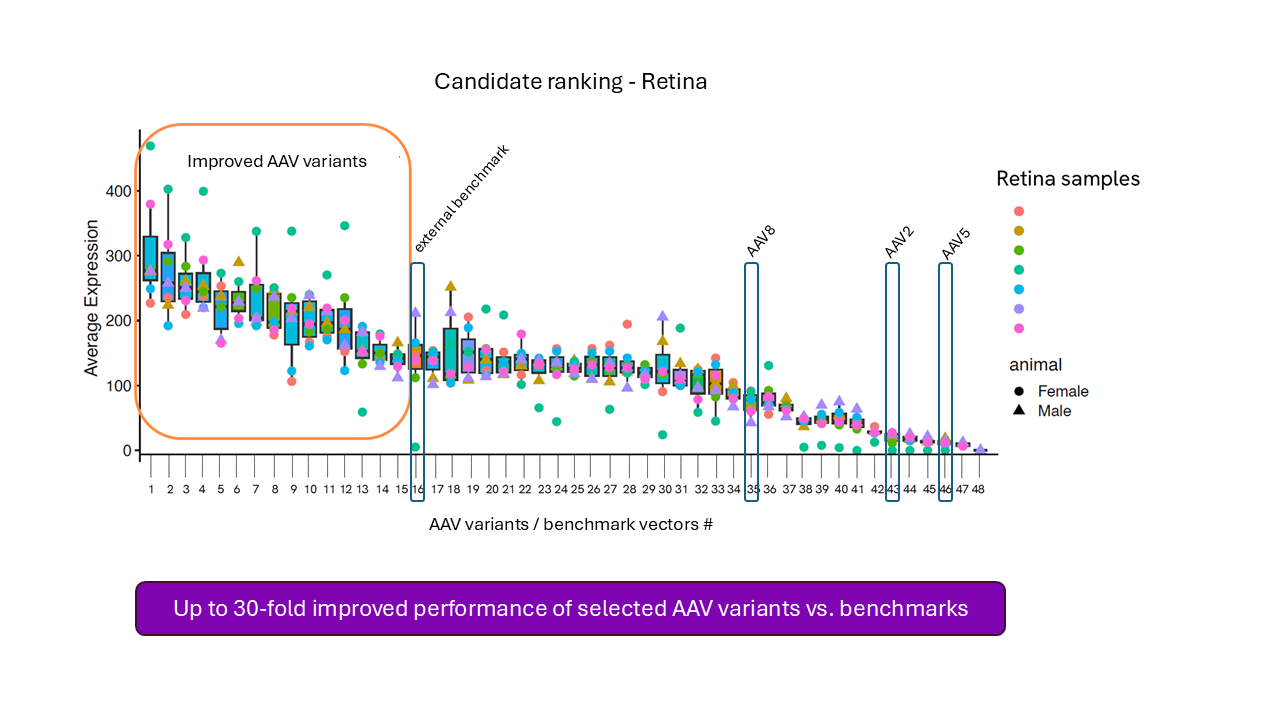
In this ophthalmology case study, our gene delivery team demonstrated a 30-fold improvement in AAV transduction compared to the benchmarks.
What our partners value from us
- Close collaboration with exchange of know-how from both parties resulting in joint decision making to deliver customized programs focused on the client's end goal.
- Our established partnership network with commercial and academic leaders in the field of AAVs, including with Prof. Dr. Dirk Grimm, a pioneer in AAV capsid evolution from Heidelberg University in Germany.
- Our capabilities in gene editing and delivery, including over 20 years of innovation and experience in viral vector manufacturing.
Please contact us to learn more about our adeno-associated virus capsid development capabilities and to speak to our licensing team.
A commercial license is required for any clinical or commercial application involving AAVs developed using Revvity technologies.

Featured resources
Explore our gene delivery technologies and services

You may also be interested in