



Small RNA library prep and accessory products
Your small RNA-seq hub
Everything you need for small RNA seq, all in one place. Revvity offers a comprehensive solution for small RNA seq including library prep kits, targeted blockers designed to remove highly abundant species, and spike-in controls designed to support reproducible library construction across a wide dynamic range, and tools that support ribosome profiling workflows through enrichment of ribosome-protected fragments. Explore the products below to match workflow needs, sample type, throughput, and sequencing compatibility.
Small RNA sequencing library prep
Unlike long RNA workflows, small RNA-seq library prep requires specialized chemistry to efficiently capture very short RNA molecules and to minimize the formation of adapter dimers, which can otherwise dominate libraries.
In most workflows the process begins with the ligation of a 3′ adapter to the small RNAs. This adapter is adenylated, which reduces the risk of unwanted ligation events such as dimers or concatemers and improves the specificity of ligation to the RNA target. Once the 3′ adapter is in place, a 5′ adapter is ligated to RNAs that carry a 5′ phosphate group, creating the priming sites needed for downstream cDNA synthesis. After adapter ligation, the RNA molecules are converted into cDNA by reverse transcription, followed by PCR amplification with indexed primers.
This step not only increases the quantity of material available for sequencing but also introduces the barcodes required to multiplex multiple samples in a single sequencing run. A critical part of small RNA library preparation is the subsequent size selection step. Because the inserts are extremely short, size selection ensures that only molecules containing a genuine small RNA insert are retained. For example, libraries prepared for microRNA analysis typically yield a final product of around 160 bp. This enrichment is essential to reduce background noise from adapter dimers and to achieve accurate representation of small RNA species in the sequencing data.
Depletion of dominant species
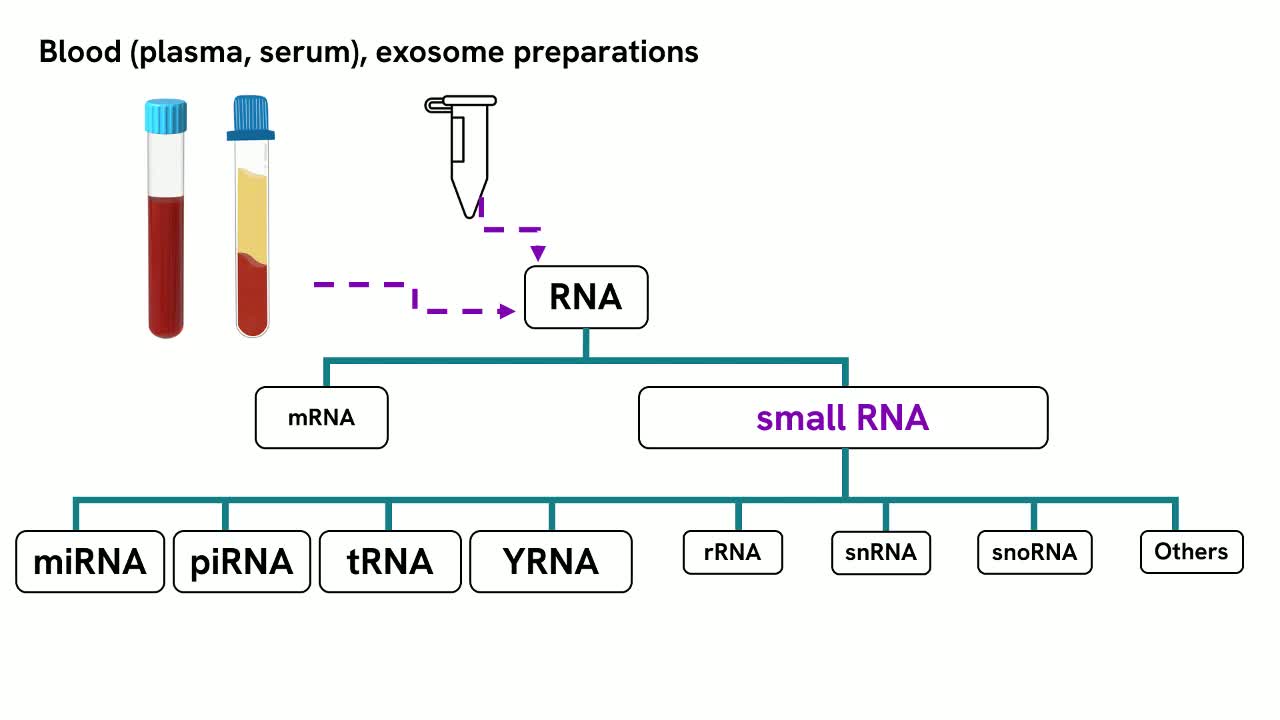
Small RNA libraries are frequently dominated by a few species (tRNA, tRNA-derived fragments, Y-RNA fragments, and a handful of highly expressed miRNAs), consuming most sequencing reads and masking low-abundance signals. To increase library diversity, we offer a depletion strategy based on targeted blockers. These blockers are short, sequence-specific oligos that hybridize to abundant small RNAs during the 3' adapter-ligation step of the NEXTFLEX Small RNA-Seq Kit v4 workflow, preventing adapter addition to the targeted species and reducing their carryover.
For RNA isolated from human whole blood or plasma, NEXTFLEX™ blood miRNA blockers reduce the abundance of common high-abundance miRNAs, including hsa-miR-451a, hsa-miR-486-5p, and hsa-miR-92a-3p, freeing read depth for study-relevant targets. For other sample types or organisms, NEXTFLEX™ Custom Small RNA Blockers can be designed to deplete user-specified high-abundance small RNAs, including tRNA or Y-RNA fragments and overexpressed miRNAs, with up to 10 targets per project.
Spike-in controls
Small RNA spike-in controls are a mix of synthetic small RNAs not present in natural samples. Added to total RNA before library preparation, they function as internal standards to quality-check assay performance and normalize results across samples and batches. miND® Spike-In Controls enable absolute normalization by converting sequencing read counts into molecules per microliter (copies/µL), improving comparability across experiments, cohorts, and laboratories, especially for low-input matrices such as biofluids.
Ribosome profiling (Ribo-seq) enrichment
Ribosome profiling workflows rely on the isolation of ribosome-protected fragments (RPFs) from actively translating ribosomes to measure translation across the transcriptome. Enrichment of translation-engaged ribosomal complexes can improve focus on actively translated regions and provide an alternative to gradient-based upstream separation methods. RiboLace® Pro uses an affinity-based capture workflow to enrich actively translating ribosomes and generate RPFs compatible with standard Ribo-seq library preparation approaches, including the NEXTFLEX™ Small RNA-Seq Kit.
Explore our solutions


Featured resources
FAQs
-
How can I request Automation Support for small RNA-seq library prep?
Please fill out the application support form and one of our automation experts will reach out to you.


