


Cellular Internalization Kits and Reagents
Antibody and ADC internalization assays: Tools for analyzing cellular uptake
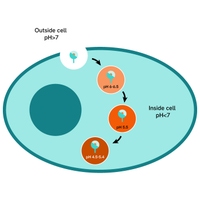
Internalization and trafficking to lysosomes are critical processes for antibody-drug conjugates (ADCs) and G protein-coupled receptor (GPCR) therapeutics. For ADCs, internalization enables payload release in acidic endo-lysosomal compartments following target binding, while GPCR internalization regulates receptor availability at the cell surface, controlling desensitization and the duration of receptor-mediated signaling.
Revvity offers two complementary tools for measuring antibody and ADC internalization and analyzing cellular uptake: pHSense™ provides quantitative, plate-based measurement using time-resolved fluorescence (TRF) for scalable screening and dose-response analysis, while PhenoVue™ enables high-content imaging of internalization kinetics, intracellular trafficking, and lysosomal localization. Together, these tools support ADC research from candidate screening through mechanistic characterization.
For research use only. Not for use in diagnostic procedures.


Choosing an ADC internalization assay or cellular uptake analysis tool
Both pHSense and PhenoVue measure antibody and ADC internalization, but they provide different types of information. Use this table to determine which tool best fits your research needs:
| Research Need | Recommended Tool | Why |
|---|---|---|
| High-throughput screening of ADC candidates | pHSense | High-throughput plate-based format enables rapid evaluation across multiple candidates |
| Quantify ADC cellular uptake at scale | pHSense | Quantitative TRF signal provides quantitative measurement across doses and timepoints |
| Generate dose-response or kinetic data | pHSense or PhenoVue | pHSense for quantitative curves; PhenoVue for temporal visualization |
| Measure EC50 for internalization | pHSense | Quantitative plate-based readout enables precise EC50 determination |
| Visualize ADC uptake in live cells | PhenoVue | High-content imaging reveals where uptake occurs within individual cells |
| Analyze intracellular trafficking | PhenoVue | Real-time imaging tracks ADC movement from cell surface to lysosomes |
| Study lysosomal localization | PhenoVue | Spatial resolution shows whether ADC reaches acidic compartments |
| Analyze single-cell uptake heterogeneity | PhenoVue | High-content imaging reveals cell-to-cell differences in uptake |
| Combine quantitative + mechanistic analysis | pHSense + PhenoVue | Two-stage workflow: screen with pHSense, characterize with PhenoVue |


Hear from our customers
"We use pHSense and PhenoVue as complementary tools at different stages of our ADC development workflow, and the combination is powerful. We start with pHSense screening to quickly identify promising antibody candidates from our panel. It's fast, easy, and perfect for high-throughput evaluation. Then we follow up with PhenoVue imaging experiments on our top candidates to gain deeper mechanistic insight into trafficking pathways and intracellular localization. This two-stage approach gives us both the speed we need for screening and the detailed understanding required for confident candidate selection. It's a workflow that actually makes sense."
Frédéric Delobel
Ridgeline
"With pHSense, my experience was very positive. The assay itself was straightforward to set up and run, and I was able to detect a clear, specific signal within just 20 minutes, compared to the 3 hours needed with other probes. The signal-to-noise ratio was greatly improved in my tests, allowing for further flexibility and optimization options. The support provided by the Revvity team was very helpful. Overall, I would recommend pHSense for groups investigating antibody internalisation in adherent cell systems."
Dimitri Sideris
The Discovery Centre (DISC) - AstraZeneca, UK
FAQs: ADC internalization assays and cellular uptake analysis
-
What is an ADC internalization assay?
An ADC internalization assay measures how efficiently antibody-drug conjugates are taken up by cells and trafficked to intracellular compartments. This is critical because ADC efficacy depends on internalization — the payload must reach acidic lysosomes to be released and kill the target cell.
-
Why is internalization important for ADC development?
Internalization is a prerequisite for ADC efficacy. Without efficient cellular uptake and trafficking to lysosomes, the cytotoxic payload cannot be released, and the ADC cannot kill target cells. Measuring internalization early in development helps identify promising ADC candidates before investing in efficacy studies.
-
What tools are available for analyzing ADC cellular uptake?
Revvity offers two complementary tools: pHSense for quantitative, plate-based measurement of ADC uptake across multiple candidates, and PhenoVue for high-content imaging of uptake and intracellular trafficking. See the comparison table above to determine which tool fits your research needs.
-
What is the difference between pHSense and PhenoVue?
pHSense is a plate-reader-based assay that provides quantitative measurement of ADC internalization using time-resolved fluorescence (TRF). It's ideal for high-throughput screening and generating dose-response curves. PhenoVue is a high-content imaging tool that visualizes where ADC uptake occurs within cells and how internalized ADC traffics to lysosomes. It's ideal for mechanistic characterization after initial screening.
-
Which assay is best for high-throughput ADC screening?
pHSense is best for high-throughput screening. The plate-based format enables rapid evaluation of many ADC candidates in parallel, with quantitative readout and minimal hands-on time.
-
Which tool is best for visualizing ADC trafficking?
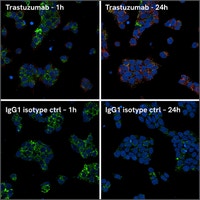
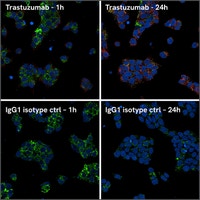
PhenoVue is best for visualizing trafficking. High-content imaging reveals real-time movement of internalized ADC from the cell surface through endosomes to lysosomes, providing mechanistic insight into internalization pathways.
-
Can ADC internalization be measured in live cells?
Yes. Both pHSense and PhenoVue measure internalization in live cells without requiring cell lysis or fixation. This enables kinetic measurements and real-time visualization of internalization dynamics.
Featured products
Featured resources

