


Microplates for Cell Imaging
Out of focus images and inaccurate data collection are common issues caused by microplates that have not been specifically designed for the unique challenges of cell imaging and high-content screening. This can result in missed data points, sample re-screening, missed project timelines, and ultimately higher costs.
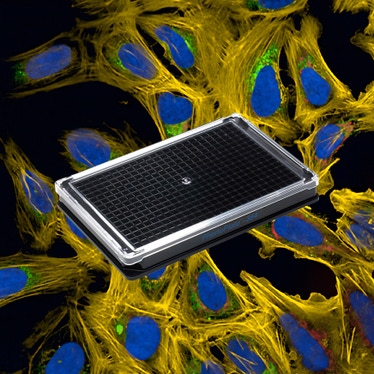
Drawing on many years of experience, Revvity's expert team has developed PhenoPlate™ microplates (formerly known as CellCarrier™ Ultra microplates) as a key part of our complete solution for high-content applications. These microplates have been engineered to deliver superior images and the highest quality data for high-content applications.
- Optimal clarity and fast autofocusing from excellent flatness of the plate bottom
- Superior image quality from high optical quality of cyclic olefin imaging surface
- Better well access when using water immersion and high NA objectives with ultra-low plate bottom
- Reduced evaporation from new design, low-profile polystyrene lid
- Less risk of damaging the imaging surface when stacking with unique corner spacers
- Available with different coatings to suit your application
We also offer ViewPlate™ microplates engineered for bottom reading systems and high content imaging, which can be used for a range of cell-based assay applications including imaging, fluorescence, luminescence and absorbance as well as cell culture if tissue-culture treated.

For research use only. Not for use in diagnostic procedures.

How can we help you?
Need help at 1am? We've got it covered. The Application Support Knowledgebase (ASK) contains detailed information on assay development, protocols, tips, FAQs, citations, troubleshooting and more. Accessible 24 hours a day, 7 days a week on our website.
Need help at 1am? We've got it covered. The Application Support Knowledgebase (ASK) contains detailed information on assay development, protocols, tips, FAQs, citations, troubleshooting and more. Accessible 24 hours a day, 7 days a week on our website.


FAQs
-
What are the main advantages of PhenoPlate microplates?
PhenoPlate microplates are intended for high-content imaging, with controlled bottom flatness and thickness (200 µm for the relevant formats), optical performance suitable for confocal acquisition and Z-stacks, reduced focus drift and reproducible imaging. They integrate into Revvity high-content imaging workflows. Confirm specifications against the technical data sheet (TDS) for the exact plate format.
-
What is the difference between PhenoPlate and ViewPlate microplates?
PhenoPlate microplates use an optically optimized polymer bottom (COP in the specified standard formats) and are intended for demanding high-content imaging workflows, including high-resolution confocal imaging.
ViewPlate microplates are polystyrene-based plates suited to more conventional cell-based assays and imaging.
Choose based on optical requirements, objective compatibility, coating and format.
-
Are PhenoPlate microplates compatible with non-Revvity imaging systems?
Yes. PhenoPlate microplates can be used on non-Revvity microscopy and high-content imaging platforms, including systems from Molecular Devices, Yokogawa, Thermo Fisher, Leica, Olympus and Nikon. Compatibility with a particular objective, plate holder, autofocus method and acquisition setup should be checked, and imaging parameters may need optimization.
-
Which plate should I use for 3D spheroid high content analysis?
For 384-well spheroid formation, staining and high-content imaging in a single plate, select PhenoPlate 3D 384-well microplate, ULA-coated. For a simpler 96-well spheroid culture workflow, a suitable CellCarrier Spheroid ULA plate may be considered, subject to imaging requirements. For enhanced spheroid positioning during seeding in the 3D 384-well plate, consider the optional PhenoPlate 3D Dual-Angle Fixed Stand (6005155).
-
What coatings are available for PhenoPlate microplates, and which should I choose?
Available options depend on format and include poly-D-lysine (PDL), collagen, fibronectin and tissue-culture-treated/uncoated variants. PDL is commonly selected for neuronal or weakly adherent cells, collagen for some hepatocyte models and fibronectin for certain epithelial models. Select the coating based on cell type and assay requirements; verify the specific catalog offering and validated coating conditions.
-
Can DMSO be used with PhenoPlate microplates, and at what concentrations?
Yes, at typical cell-based assay levels such as ≤0.1% final DMSO. For 0.5–1%, validate compatibility for the plate, coating, assay duration and cell model. Neat (100%) DMSO is not recommended: internal observations reported well-to-well leakage. Do not use PhenoPlate microplates as DMSO compound-storage or source plates.
-
Are PhenoPlate microplates compatible with automated high-throughput screening workflows?
Yes. PhenoPlate microplates are used in automated high content analysis workflows and have been evaluated with liquid-handling or dispensing systems including Multidrop, Janus Mini MDT and AssayMate™. Validate robotic gripping, plate positioning, dispensing settings, sealing, and reader compatibility for the specific format and equipment configuration.
-
What is the PhenoPlate 3D 384-well microplate, ULA-coated, and what are its advantages?
PhenoPlate 3D 384-well microplate combines spheroid formation, staining and imaging in one 384-well plate. It uses ULA-coated funnel-shaped wells with a flat 200 µm optical imaging region and is intended for high-resolution confocal acquisition, including water-immersion objectives up to 63×. Internal evaluation reported 93.5% spheroid retention and no focus errors under the specified tested conditions (5% field-of-view overlap).
-
How should PhenoPlate microplates be stored and handled?
Keep plates in their original sealed packaging, protected from moisture and contamination; follow the product-specific TDS for storage temperature, shelf life and handling instructions. Avoid unnecessary temperature cycling and prolonged exposure to conditions that may affect coating or optical performance. Shipping and storage requirements can differ by coating and plate type; do not assume a universal freezing requirement.
-
Are common fixation solvents (methanol, ethanol, isopropanol) compatible with PhenoPlate microplates?
Short exposures during standard fixation or staining may be compatible, but bulk-polymer resistance does not establish compatibility with the finished coated plate. Check the effect of solvent concentration, contact time and temperature on optical properties, surface coatings and assay performance. Validate prolonged or high-concentration exposure before routine use.
-
Can PhenoPlate microplates be centrifuged?
Brief, low-speed centrifugation in a suitable microplate rotor may be feasible, but no official maximum centrifugation specification was provided in the source information. A short exposure at approximately 300–500 × g is a conservative practical guideline, not a validated product limit. High-speed or extended centrifugation requires application-specific verification. Inspect plates for deformation, leakage and imaging defects; solvent exposure may increase risk.
-
What is the PhenoPlate 1536-well low rim microplate?
The PhenoPlate 1536 low rim microplate is a 1536-well COP microplate intended for ultra-high-throughput imaging. The low-rim geometry is designed to reduce edge interference during acquisition, particularly at higher magnification. Consult TDS for dimensions, supported objectives and the complete product specifications.
-
Can I order custom microplates?
Yes. Custom options may include coatings, barcoding and selected special configurations. Contact cc.eu.customs@revvity.com and provide the custom request form and required specifications. Custom orders are assigned a CUSM part number; manufacturing and fulfillment arrangements should be confirmed at order.
