
US

Revvity Sites Globally
Select your location.
*e-commerce not available for this region.

AlphaLISA Mouse TNF-α Biotin Free Detection Kit, 100 Assay Points

AlphaLISA Mouse TNF-α Biotin Free Detection Kit, 100 Assay Points

AlphaLISA Biotin Free

| Feature | Specification |
|---|---|
| Application | Protein Quantification |
| Dynamic Range | 7 - 100,000 pg/mL |
| Limit of Detection | 7 pg/mL |
| Limit of Quantification | 24 pg/mL |
| Sample Volume | 10 µL |
Product variants
Unit Size: 100 assay points
Part #:
AL541HV
List price
USD 1,045.45
Your online price:
Unit Size: 500 assay points
Part #:
AL541C
List price
USD 2,463.76
Your online price:
Unit Size: 5,000 assay points
Part #:
AL541F
List price
USD 16,428.50
Your online price:
For research use only. Not for use in diagnostic procedures. All products to be used in accordance with applicable laws and regulations including without limitation, consumption, and disposal requirements under European REACH regulations (EC 1907/2006).
AlphaLISA Mouse TNF-α Biotin Free Detection Kit, 100 Assay Points
AlphaLISA Biotin Free
AlphaLISA Mouse TNF-α Biotin Free Detection Kit, 100 Assay Points
Product information
Overview
Formats:
- Our HV (100 assay point) kits allow you to run 100 wells in 96-well format, using a 100 µL reaction volume (10 µL of sample).
- Our 500 assay point kit allows you to run 500 wells in 96-well or 384-well format, using a 50 µL reaction volume (5 µL of sample).
- Our 5,000 assay point kit allows you to run 5,000 wells in 96-well or 384-well format, using a 50 µL reaction volume (5 µL of sample).
Features and Benefits:
- No-wash steps, no separation steps
- Compatible with high biotin samples, including RPMI and high-biotin tissue extracts
- ELISA alternative technology
- Sensitive detection
- Broad sample compatibility
- Results in less than 3 hours
Tumor Necrosis Factor Alpha is a multifunctional proinflammatory cytokine synthesized mainly by nucleated blood cells as a 233 aa type II transmembrane protein which is cleaved by ADAM17 between aa76-77 to form a soluble homotrimeric complex. TNFα plays a role in lipid metabolism, coagulation and endothelial function and has been associated with cancer, infection and inflammation (including inflammatory bowel disease), ischemia/reperfusion injury and heart failure, and insulin resistance. This kit is used when the analyte is in a matrix containing high levels of biotin, such as can be found in cell culture media such as RPMI, or milk.
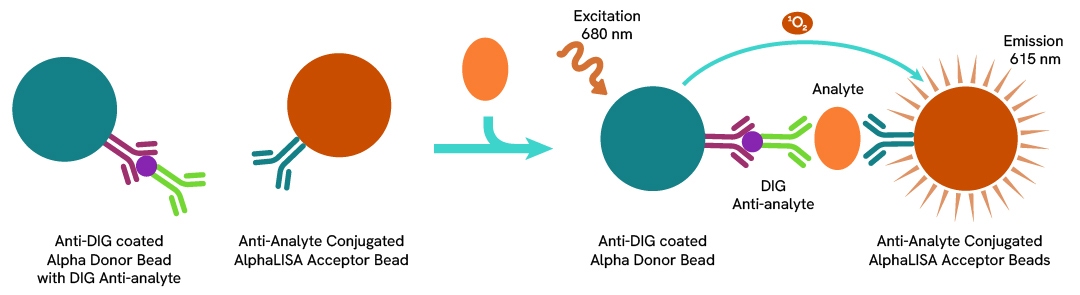
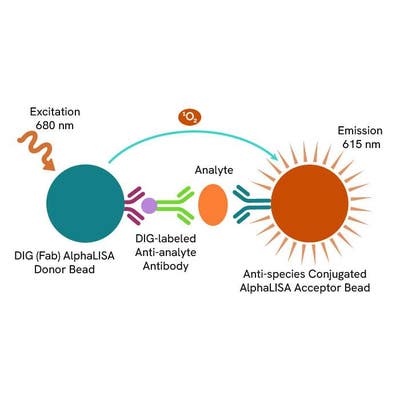
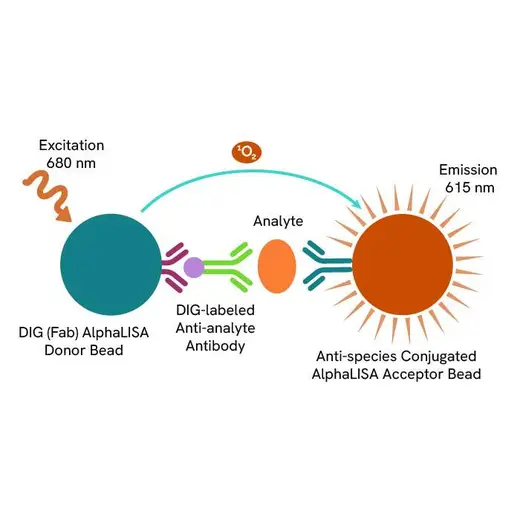
AlphaLISA technology allows the detection of molecules of interest in a no-wash, highly sensitive, quantitative assay. In an AlphaLISA biotin-free assay, a DIG-labeled anti-analyte antibody binds to the anti-DIG-coated Donor beads while another anti-analyte antibody is conjugated to AlphaLISA Acceptor beads. In the presence of the analyte, the beads come into close proximity. The excitation of the Donor beads causes the release of singlet oxygen molecules that triggers a cascade of energy transfer in the Acceptor beads, resulting in a sharp peak of light emission at 615 nm.
How it works
Principle of the AlphaLISA biotin-free assay
The AlphaLISA Biotin-Free assay is based on an AlphaLISA sandwich immunoassay involving a digoxigenin anti-analyte antibody bound to anti-DIG AlphaLISA Donor beads and an anti-analyte antibody conjugated to AlphaLISA Acceptor beads. Both antibodies are directed against the analyte of interest. In the presence of the target, both antibodies bind to analyte and the beads come into proximity. The excitation of the Donor beads provokes the release of singlet oxygen molecules that triggers a cascade of energy transfer within the Acceptor beads, resulting in emission with λmax at 615 nm. The intensity of the signal is directly proportional to the concentration of analyte present in the sample.
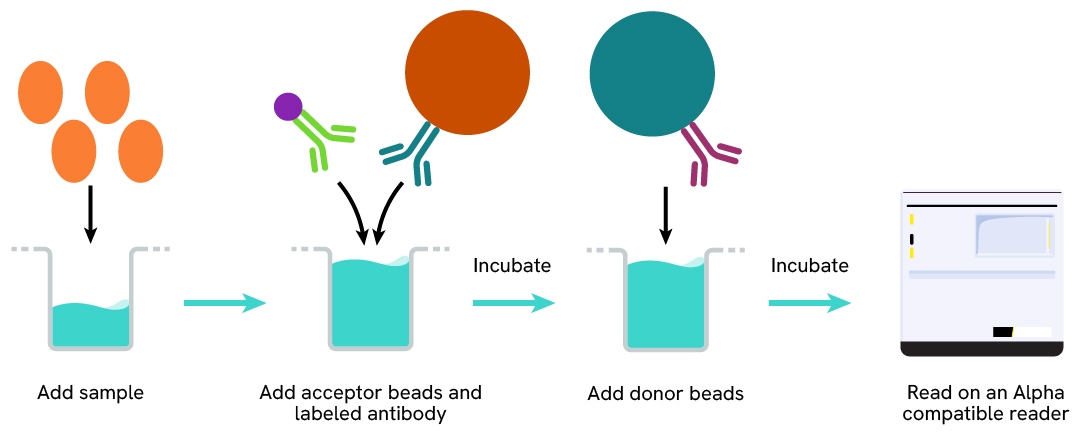
Protocol of the AlphaLISA biotin-free assay
The AlphaLISA Biotin-Free assay can be run in a 96- or 384-well detection plate (50 µL final). As described here, samples or standards are dispensed directly into the assay plate for the detection of the analyte of interest by AlphaLISA reagents. No washing steps are needed. The protocol can be further miniaturized or upscaled by simply resizing each addition volume proportionally.
Specifications
| Application |
Protein Quantification
|
|---|---|
| Automation Compatible |
Yes
|
| Brand |
AlphaLISA
|
| Detection Modality |
Alpha
|
| Dynamic Range |
7 - 100,000 pg/mL
|
| Limit of Detection |
7 pg/mL
|
| Limit of Quantification |
24 pg/mL
|
| Product Group |
Kit
|
| Sample Volume |
10 µL
|
| Shipping Conditions |
Shipped in Blue Ice
|
| Target |
TNFα
|
| Target Class |
Cytokines
|
| Target Species |
Mouse
|
| Technology |
Alpha
|
| Therapeutic Area |
Inflammation
|
| Unit Size |
100 assay points
|
Video gallery
AlphaLISA Mouse TNF-α Biotin Free Detection Kit, 100 Assay Points
AlphaLISA Mouse TNF-α Biotin Free Detection Kit, 100 Assay Points
Resources
Are you looking for resources, click on the resource type to explore further.

Application Note
Avoiding biotin interference in AlphaLISA assays
AlphaLISA™ technology is a highly sensitive, easy-to-use, and reproducible method for detecting and quantifying molecules in...


Loading...
How can we help you?
We are here to answer your questions.