
US

Revvity Sites Globally
Select your location.
*e-commerce not available for this region.

HTRF Human Phospho-AKT (Ser473) Detection Kit, 500 Assay Points

HTRF Human Phospho-AKT (Ser473) Detection Kit, 500 Assay Points

generic HTRF phospho primary image
The HTRF Human Phospho-AKT (Ser473) Detection Kit is an immunoassay designed for the detection and quantitation of Human AKT when phosphorylated at Ser473 in cellular lysates, in a homogeneous (no-wash steps, no separation steps) format.
| Feature | Specification |
|---|---|
| Application | Cell Signaling |
| Sample Volume | 16 µL |
The HTRF Human Phospho-AKT (Ser473) Detection Kit is an immunoassay designed for the detection and quantitation of Human AKT when phosphorylated at Ser473 in cellular lysates, in a homogeneous (no-wash steps, no separation steps) format.
Product variants
Unit Size: 96 assay points
Part #:
64AKSPET
List price
USD 739.00
Your price:
Unit Size: 500 assay points
Part #:
64AKSPEG
List price
USD 2,387.00
Your price:
Unit Size: 10,000 assay points
Part #:
64AKSPEH
List price
USD 13,884.00
Your price:
For research use only. Not for use in diagnostic procedures. All products to be used in accordance with applicable laws and regulations including without limitation, consumption, and disposal requirements under European REACH regulations (EC 1907/2006).
HTRF Human Phospho-AKT (Ser473) Detection Kit, 500 Assay Points
generic HTRF phospho primary image
Loading...
Product information
Overview
The Phospho-AKT (Ser473) kit is designed to robustly and efficiently monitor AKT phosphorylation on Ser473 across all isoforms, as a readout of Pi3K pathway activation. Also known as Protein Kinase B (PKB), AKT is an oncogene that controls apoptosis, cell proliferation, transcription, cell migration, and glucose metabolism.
HTRF assays offer many advantages over other technologies:
- Homogeneous add-and-read format
- No wash steps
- Low background
- Straightforward miniaturization from 96- or 384-well microplates to high density assay formats such as 384-well low volume and 1536-well plates
- Stable signal, providing flexibility in time of readout or size of assays
How it works
Phospho-AKT (Ser473) assay principle
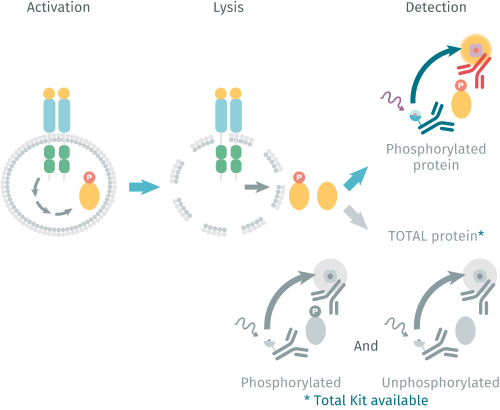
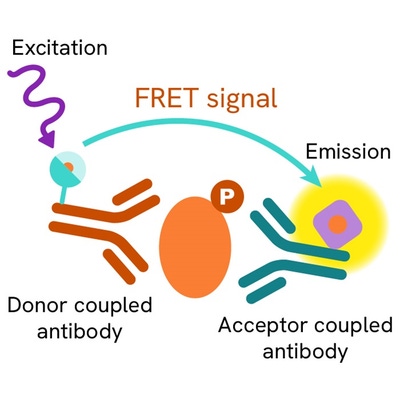
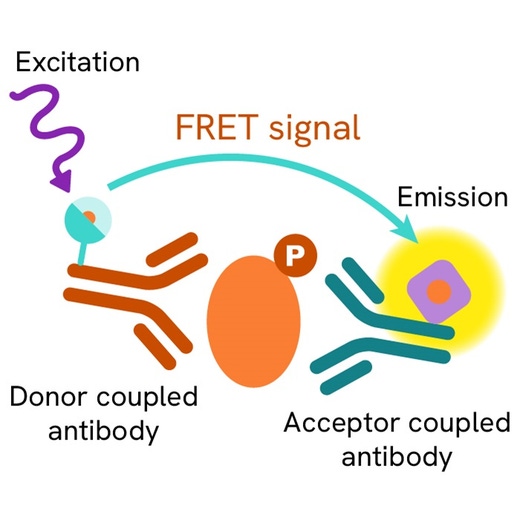
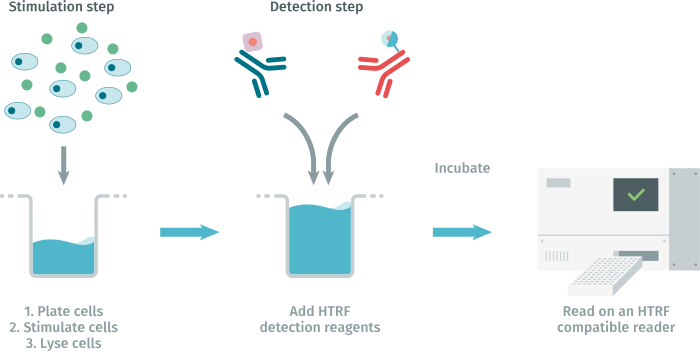
The Phospho-AKT (Ser473) assay measures AKT when phosphorylated at Ser473. Contrary to Western Blot, the assay is entirely plate-based and does not require gels, electrophoresis or transfer. The Phospho-AKT (Ser473) assay uses 2 labeled antibodies: one with a donor fluorophore, the other one with an acceptor. The first antibody is selected for its specific binding to the phosphorylated motif on the protein, the second for its ability to recognize the protein independent of its phosphorylation state. Protein phosphorylation enables an immune-complex formation involving both labeled antibodies and which brings the donor fluorophore into close proximity to the acceptor, thereby generating a FRET signal. Its intensity is directly proportional to the concentration of phosphorylated protein present in the sample, and provides a means of assessing the proteins phosphorylation state under a no-wash assay format.
Phospho-AKT (Ser473) 2-plate assay protocol
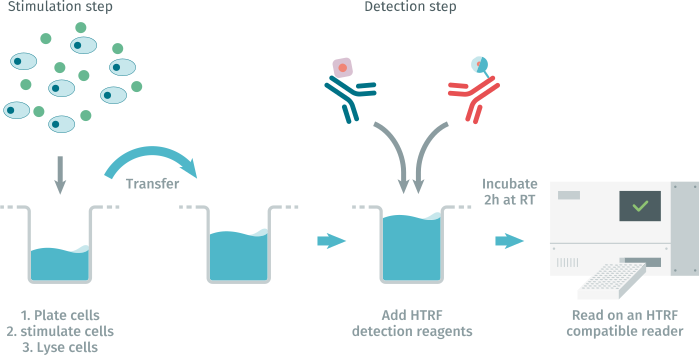
The 2 plate protocol involves culturing cells in a 96-well plate before lysis then transferring lysates to a 384-well low volume detection plate before adding Phospho-AKT (Ser473) assay HTRF detection reagents. This protocol enables the cells' viability and confluence to be monitored.
Phospho-AKT (Ser473) assay 1-plate assay protocol
Detection of Phosphorylated AKT (Ser473)with HTRF reagents can be performed in a single plate used for culturing, stimulation and lysis. No washing steps are required. This HTS designed protocol enables miniaturization while maintaining robust HTRF quality.
Assay validation
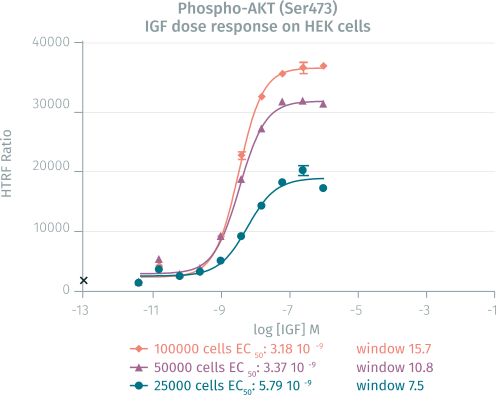
Phospho-AKT (Ser473) Assay IGF Dose-Response on HEK 293 cells
Results obtained on HEK cells plated using 3 cell densities (12,500 - 25,000 - 50,000 cells per well). After being starved for 24 hours, cells were stimulated for 10 minutes with various concentrations of IGF. Phosphorylated AKT was measured after 3.5 hours using the two-plate assay protocol.
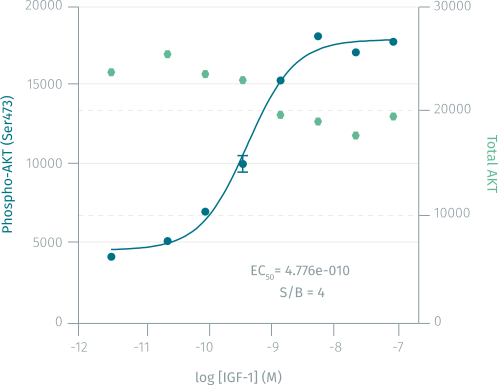
Total AKT used to control the phosphorylation status of AKT (Ser473).
HEK293 cells (100,000 cells/well) were activated with IGF-1 for 10 min, using the two-plate assay protocol of the Phospho-AKT (Ser473) and Total-AKT assays. As expected, results obtained show a dose-response increase of AKT phosphorylation upon IGF-1 stimulation, while the AKT expression level remains constant.
Simplified pathway
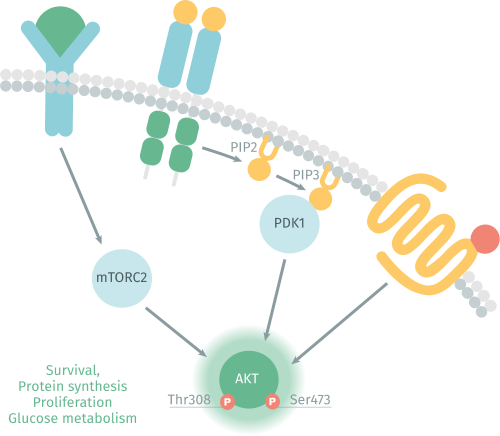
AKT Simplified Pathway
AKT (or protein kinase B) plays a key role in controlling survival and apoptosis. This serine/threonine protein kinase is regulated by insulin and various growth and survival factors, to work in a wortmannin-sensitive pathway involving PI 3 kinase. When the Pleckstrin Homology (PH) domain of AKT binds to phosphoinositides, AKT can be phosphorylated by two different kinases, PDK1 at threonine 308 and mTORC2 (mammalian target of rapamycin) at serine 473, which switch on AKT activation.
Specifications
| Application |
Cell Signaling
|
|---|---|
| Automation Compatible |
Yes
|
| Brand |
HTRF
|
| Detection Modality |
HTRF
|
| Molecular Modification |
Phosphorylation
|
| Product Group |
Kit
|
| Sample Volume |
16 µL
|
| Shipping Conditions |
Shipped in Dry Ice
|
| Target |
AKT
|
| Target Class |
Phosphoproteins
|
| Target Species |
Human
|
| Technology |
TR-FRET
|
| Unit Size |
500 assay points
|
Video gallery
HTRF Human Phospho-AKT (Ser473) Detection Kit, 500 Assay Points
Citations
Resources
Are you looking for resources, click on the resource type to explore further.

Application Note
A guideline for HTRF cell-based phospho-protein data normalization
Get the best out of your phosphorylation assays
Combining phospho and total protein assays enables better analysis. This...

Whitepaper
An overview of atherosclerosis
Atherosclerosis pathogenesis, cellular actors, and pathways
Atherosclerosis is a common condition in which arteries harden and...

Brochure
HTRF assays and reagents product list
Discover the versatility and precision of Homogeneous Time-Resolved Fluorescence (HTRF) technology. Our HTRF portfolio offers a...
Application Note
HTRF platform for anticancer drug discovery: from 2D and 3D cell cultures to xenograft models
One technology across all samples
Simplify pathway analysis. Learn how HTRF can do it all, from classic 2D cell models to 3D cell...
Application Note
HTRF reveal subtle effects in tumor xenografts: a method of choice beyond Western blot
Tumor xenograft analysis: HTRF versus Western blot
Don’t miss out on important data
Tumor xenografts are a known staple when...

Guide
HTRF solutions, guide to major applications
This guide provides you an overview of HTRF applications in several therapeutic areas.
Loading...


How can we help you?
We are here to answer your questions.