US

Revvity Sites Globally
Select your location.
*e-commerce not available for this region.



PhenoVue Fluor 647 pH-sensitive Fab Anti-human IgG - 2 x 96 wells
PhenoVue Fluor 647 pH-sensitive Fab Anti-human IgG - 2 x 96 wells
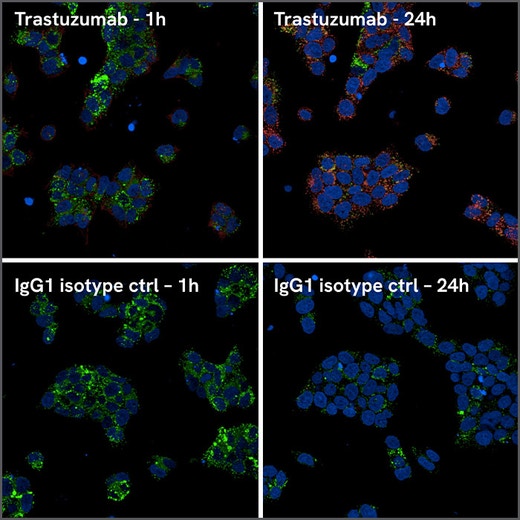
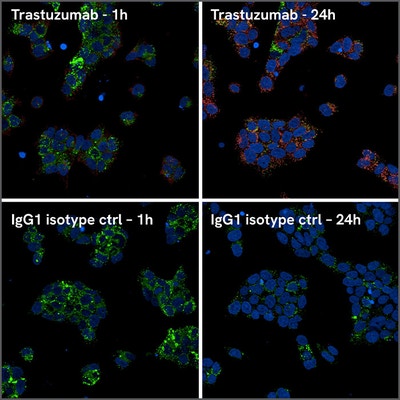
Representative images of BT-474 cells showing Trastuzumab uptake detected with the PhenoVue Fluor 647 pH-sensitive Fab anti-human IgG.
The PhenoVue™ Fluor 647 pH-sensitive Fab anti-human IgG is a ready-to-use fluorescent probe that monitors antibody internalization. This Fab fragment binds with high affinity to the Fc region of human IgG antibodies, whether unconjugated or conjugated (including ADCs). Its fluorescence remains low at neutral extracellular pH (≥7) but increases as the Fab-antibody complex traffics into acidic intracellular compartments such as early and late endosomes and lysosomes. This pH-responsive behavior provides a high signal-to-background ratio, facilitating clear, specific, and reliable visualization of antibody internalization events in live cells.
| Feature | Specification |
|---|---|
| Quantity | 1 |
The PhenoVue™ Fluor 647 pH-sensitive Fab anti-human IgG is a ready-to-use fluorescent probe that monitors antibody internalization. This Fab fragment binds with high affinity to the Fc region of human IgG antibodies, whether unconjugated or conjugated (including ADCs). Its fluorescence remains low at neutral extracellular pH (≥7) but increases as the Fab-antibody complex traffics into acidic intracellular compartments such as early and late endosomes and lysosomes. This pH-responsive behavior provides a high signal-to-background ratio, facilitating clear, specific, and reliable visualization of antibody internalization events in live cells.
Product variant
Unit Size: 100 µL
Part #:
2HFAB647PH1
List price
USD 848.00
Your price:
For research use only. Not for use in diagnostic procedures.
PhenoVue Fluor 647 pH-sensitive Fab Anti-human IgG - 2 x 96 wells
Representative images of BT-474 cells showing Trastuzumab uptake detected with the PhenoVue Fluor 647 pH-sensitive Fab anti-human IgG.
Loading...
Product information
Overview
The study of antibody internalization is important in the research and development of antibody-drug conjugates (ADCs), a rapidly expanding class of biopharmaceuticals that link a monoclonal antibody to a cytotoxic payload via a cleavable linker. Upon internalization and lysosomal processing, the payload is released, triggering cell death through mechanisms such as DNA damage or microtubule disruption. Assessment of antibody internalization is therefore critical for the design, optimization, and evaluation of ADCs and related biologics.
The PhenoVue Fluor 647 pH-sensitive Fab anti-human IgG is available as an individual reagent and is also a key component of the PhenoVue human IgG antibody internalization kit (Fluor 647, pH-sensitive). In both formats, the probe is compatible with standard cell culture conditions and exerts minimal impact on cell viability and proliferation, providing reproducible results even during extended time-lapse imaging.
Specifications
| Color |
Deep Red
|
|---|---|
| Form |
Liquid
|
| Maximum Emission Wavelength (Emmax) |
670 nm
|
| Maximum Excitation Wavelength (Exmax) |
650 nm
|
| Application |
High Content Imaging
Microscopy
|
|---|---|
| Assay Points |
2 x 96-well or 1 x 384-well microplates
|
| Brand |
PhenoVue™
|
| Detection Modality |
Fluorescence
|
| Filter |
Cy5
|
| Host Species |
Goat
|
| Product Group |
Antibody
|
| Quantity |
1
|
| Sample Type |
Live cells only
|
| Shipping Conditions |
Shipped in Dry Ice
|
| Storage Conditions |
-16° C or below, protected from light
|
| Target Species |
Human
|
| Type |
Individual reagent
|
| Unit Size |
100 µL
|
Spectra viewer
Resources
Are you looking for resources, click on the resource type to explore further.

Product Info
PhenoVue Fluor 647 pH-sensitive Fab anti-human IgG product information sheet
Loading...


How can we help you?
We are here to answer your questions.