


Overview
Cell proliferation studies based on the thymidine incorporation assay are employed frequently in immunological, cancer, stem cells, and pharmaceutical research to assess the ability both of natural and synthetic compounds to stimulate or inhibit the proliferation of lymphocytes and other cells.
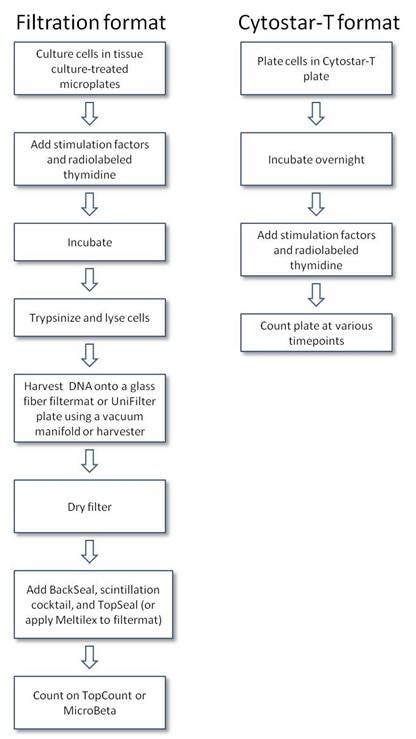
Cell proliferation assays measure the incorporation of a radiolabeled DNA precursor, 3H- or 14C- thymidine, into the replication strands of DNA produced during cell division. Cultures are typically set up in microplates. The labeled DNA is usually captured with a cell harvester on glass fiber filters discs, which are then placed in liquid scintillation counting vials or directly harvested into a filter plate for counting on a scintillation beta-counter. The assay can also be performed using a scintillating Cytostar-T® plate, which requires no filtration step or scintillation cocktail.
What do I need to run this assay
Filtration format
Reagents available from Revvity:
- Radiolabeled thymidine (see next section)
- TC-treated microplates for cell culturing
- Glass fiber filters (UniFilter plates or Filtermat)
- Scintillation cocktail and Sample Bag for MicroBeta Counters (Cat. No. 1450-432) if using Filtermat
- Scintillation vials (if using filter discs)
- Cell harvester
- TopSeal™-A (Cat. No. 6050185) and BackSeal (Cat. No. 6005199) (if using UniFilter plates)
- Radiometric detector (such as a Tri-Carb™ liquid scintillation counter, or a high-throughput detector such as the MicroBeta2™)
Reagents available from other suppliers:
- Stimulation factors
- Trypsin
- Wash buffer (e.g., PBS)
CytoStar-T format
- CytoStar-T plates, 96-well (Cat. No. RPNQ0162, RPNQ0163)
- TopSeal-A adhesive plate seal (Cat. No. 6050185)
- White BackSeal, if counting from the top (Cat. No. 6005199)
- Radiolabeled thymidine (see next section)
- High-throughput radiometric detector
- Cell culture medium, buffer for labeling
- Stimulation factors
Products and catalog numbers
Thymidine radiochemicals
(Sample list of thymidine products. Visit our website for our complete listing)
| Radiochemical | Concentration | Specific Activity | Packaging buffer | Storage temp. | Cat. number |
|---|---|---|---|---|---|
| Thymidine, [Methyl-3H]- | 1 mCi/mL | 2 Ci/mmol | Steri-packaged, aqueous solution | 5°C | NET027A |
| 1 mCi/mL | 20 Ci/mmol | Steri-packaged, aqueous solution | 5°C | NET027X | |
| 1 mCi/mL | 20 Ci/mmol | Ethanol:Water (7:3) | 5°C | NET027E | |
| 1 mCi/mL | 40-60 Ci/mmol | Steri-packaged, 2% Ethanol solution | 5°C | NET027W | |
| 1 mCi/mL | 70-90 Ci/mmol | Steri-packaged, aqueous solution | 5°C | NET027Z | |
| Thymidine, [2-14C] | 0.1 mCi/mL | >50 mCi/mmol | Steri-packaged, aqueous solution | 5°C | NEC156 |
| Thymidine, [6-3H] | 1 mCi/mL | >10 Ci/mmol | Steri-packaged, aqueous solution | 5°C | NET355 |
Choose the right thymidine
Notes
- Total vs. DNA only proliferation: Thymidine will label both DNA and RNA. Thymidine labeled on the methyl group will only label DNA.
- Stability vs. toxicity: Formulations containing ethanol will last longer in storage, however, may kill cells. Formulations without ethanol are less toxic to cells but have a shorter shelf life.
- Ease vs. flexibility: fixed specific activity means that the same volume can be used every time. Products with variable specific activities tend to have higher specific activities (and therefore more signal); however, the volume needs to be calculated each time.
- Level of proliferation: high specific activity will give more signal, but will be less stable in storage
Protocol-in-brief
Protocol
Suggested CytoStar-T [3H]-Thymidine Uptake Assay Outline, optimization required
- Seed cells in CytoStar-T 96-well plate:
- Adherent (5×10³–3×10⁴ cells/well)
- Suspension (5×10⁴–2×10⁵ cells/well), 100 µL medium
- Incubate as needed.
- Optimization needed: Cell density affects signal and linearity.
-
Add treatments (optional) in 100 µL medium and incubate.
Optimization needed: Pre-incubation time influences proliferation response.
-
Add [3H]-thymidine directly to wells: 0.5 µCi/well; incubate 4–6 h (pulse) or longer as the experiment dictates.
Optimization needed: Isotope concentration and labeling time drive sensitivity and background.
-
Ensure cells are close to plate bottom: Let settle or centrifuge (~200 × g, 3–5 min).
Optimization needed: Critical for signal intensity.
-
Optional wash with PBS (1–2×).
Optimization needed: Reduces background but may disturb cells.
-
Equilibrate plate 30–60 min at room temperature.
Optimization needed: Improves signal stability.
- Read directly in scintillation plate reader such as MicroBeta2TM (CPM output).
-
Include controls (background, negative, positive).
Optimization needed: Required to interpret assay background and performance.
Suggested CytoStar-T [2-14C]-Thymidine Uptake Assay Outline, optimization required
- Seed cells in CytoStar-T 96-well plate:
- Adherent (5×10³–3×10⁴ cells/well)
- Suspension (5×10⁴–2×10⁵ cells/well), 100 µL medium
- Incubate as needed.
- Optimization needed: Cell density affects signal and linearity.
- Add treatments (optional) in 100 µL medium and incubate.
- Optimization needed: Pre-incubation time influences proliferation response.
- Add [2-14C]-thymidine directly to wells: 0.1–0.5 µCi/well; incubate 4–6 h (pulse) or longer as the experiment dictates.
- Optimization needed: Isotope concentration and labeling time drive sensitivity and background.
- Ensure cells are close to plate bottom: Let settle or centrifuge (~200 × g, 3–5 min).
- Optimization needed: Critical for signal intensity.
- Optional wash with PBS (1–2×).
- Optimization needed: Reduces background but may disturb cells.
- Equilibrate plate 30–60 min at room temperature.
- Optimization needed: Improves signal stability.
- Read directly in scintillation plate reader such as MicroBeta2TM (CPM output).
- Include controls (background, negative, positive).
- Optimization needed: Required to interpret assay background and performance.
Citations
- Inglis, J.J., Simelyte, E., McCann, F.E., Criado, G. & Williams, R.O. Protocol for the induction of arthritis in C57BL/6 mice. Nat Protoc 3, 612-618 (2008). Link
- Liu, S. & Yamauchi, H. p27-Associated G1 arrest induced by hinokitiol in human malignant melanoma cells is mediated via down-regulation of pRb, Skp2 ubiquitin ligase, and impairment of Cdk2 function. Cancer Lett 286, 240-249 (2009). Link
- Munier, C.M.L., Zaunders, J.J., Ip, S., Cooper, D.A. & Kelleher, A.D. A culture amplified multi-parametric intracellular cytokine assay (CAMP-ICC) for enhanced detection of antigen specific T-cell responses. J. Immunol. Methods 345, 1-16 (2009). Link
- Lee-Hoeflich, S.T. et al. A central role for HER3 in HER2-amplified breast cancer: implications for targeted therapy. Cancer Res 68, 5878-5887 (2008). Link
- Sommerfeld, M.R. et al. In vitro metabolic and mitogenic signaling of insulin glargine and its metabolites. PLoS ONE 5, e9540 (2010). Link
- Trojel-Hansen, C., Erichsen, K.D., Christensen, M.K. et al. Novel small molecule drugs inhibit tumor cell metabolism and show potent anti-tumorigenic potential. Cancer Chemother Pharmacol 68, 127–138 (2011). https://doi.org/10.1007/s00280-010-1453-3
- Mirza, A., et al., RNA interference targeting of A1 receptor-overexpressing breast carcinoma cells leads to diminished rates of cell proliferation and induction of apoptosis. Cancer Biology & Therapy 4:12, 1355-1360 (2005). https://www.tandfonline.com/doi/epdf/10.4161/cbt.4.12.2196?needAccess=true
- Mitsutake N., et al., Conditional BRAFV600E expression induces DNA synthesis, apoptosis, dedifferentiation, and chromosomal instability in thyroid PCCL3 cells. Cancer Res. 65:6, 2465-2473 (2005) https://doi.org/10.1158/0008-5472.CAN-04-3314
- Grempler, R., et al., Inhibition of SH2-domain containing inositol phosphatase 2 (SHIP2) in insulin producing INS1E cells improves insulin signal transduction and induces proliferation. FEBS Letters 581:20, 5885-5890, (2007) https://doi.org/10.1016/j.febslet.2007.11.066
Other Revvity cell proliferation technologies
- DELFIA fluorescent cell proliferation assay
- ATPLite™ 1-step luminescent assay
- ATPLite luminescent assay
- For research use only. Not for use in diagnostic procedures
