
US

Revvity Sites Globally
Select your location.
*e-commerce not available for this region.

Tag-lite SNAP-Lumi4-Tb Labeling Reagent, 2 nmoles
Tag-lite SNAP-Lumi4-Tb Labeling Reagent, 2 nmoles

Tube Labeling Reagent Clear cap
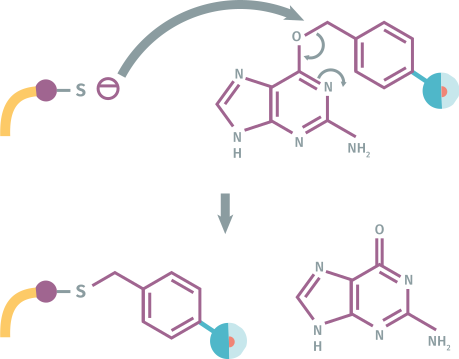
SNAP-Tag, Clip-Tag, and HALO-Tag are protein labeling systems enabling the covalent attachement of fluorophores onto proteins of interest. SNAP-Lumi4-Tb enables SNAP-tagged proteins to become labeled with a Terbium fluorophore.
| Feature | Specification |
|---|---|
| Application | Receptor-Ligand Binding |
SNAP-Tag, Clip-Tag, and HALO-Tag are protein labeling systems enabling the covalent attachement of fluorophores onto proteins of interest. SNAP-Lumi4-Tb enables SNAP-tagged proteins to become labeled with a Terbium fluorophore.
Product variants
Unit Size: 2 nmoles
Part #:
SSNPTBC
List price
USD 2,056.00
Your price:
Unit Size: 5 nmoles
Part #:
SSNPTBD
List price
USD 4,335.00
Your price:
Unit Size: 25 nmoles
Part #:
SSNPTBG
List price
USD 17,801.00
Your price:
Unit Size: 100 nmoles
Part #:
SSNPTBX
List price
USD 53,751.00
Your price:
For research use only. Not for use in diagnostic procedures. All products to be used in accordance with applicable laws and regulations including without limitation, consumption, and disposal requirements under European REACH regulations (EC 1907/2006).
Tag-lite SNAP-Lumi4-Tb Labeling Reagent, 2 nmoles
Tube Labeling Reagent Clear cap
Loading...
Product information
Overview
Over the past few years, SNAP-Tag, CLIP-Tag, and Halo-Tag technologies combined with TR-FRET have paved the road to the development of many non-radioactive, no-wash binding assays. The method is based on transfecting cells using plasmids encoding a SNAP-Tag (or CLIP-Tag, or Halot-Tag) and subsequently labeling them with acceptors or donors. SNAP-Lumi4-Tb allows the labeling of SNAP-Tagged proteins with a terbium fluorophore.
Tag-lite assays offer many features and applications over traditional receptor/ligand binding assays:
- Non-radioactive
- Homogeneous and filtration-free
- Ready-to-use kits and reagents for binding assays
- Does not alter the receptor pharmacology
- Peer-reviewed, validated technology
- Thorough kinetic studies with true Kd and Ki values, association (Kon) and dissociation (Koff) rate constants
- Screening and profiling of biologics and large molecules
How it works
Receptor labeling
SNAP-tag® is a small fusion tag that covalently interacts with specific substrates. SNAP-tag enables the specific and covalent labeling of any protein of interest. Cells are provided unlabeled and need to be labeled with Lumi4-Terbium prior to running a binding assay. Labeling reagents are available from the Revvity catalog in 4 different sizes. For more details refer to labeling procedure.
Specifications
| Application |
Receptor-Ligand Binding
|
|---|---|
| Automation Compatible |
Yes
|
| Brand |
Tag-lite
|
| Detection Modality |
HTRF
|
| Product Group |
Fluorescent Reagent
|
| Shipping Conditions |
Shipped in Dry Ice
|
| Target Class |
GPCR
|
| Technology |
TR-FRET
|
| Therapeutic Area |
Cardiovascular
Infectious Diseases
Metabolism/Diabetes
NASH/Fibrosis
Neuroscience
Oncology & Inflammation
Rare Diseases
|
| Unit Size |
2 nmoles
|
Video gallery
Tag-lite SNAP-Lumi4-Tb Labeling Reagent, 2 nmoles
Citations
Resources
Are you looking for resources, click on the resource type to explore further.

Literature - Publication Review
Advanced immunoassay technologies for streamlined CMC development of biologics
Discover how Revvity's no-wash immunoassay technologies - including HTRF and AlphaLISA - streamline CMC processes for biologic...
Literature - Publication Review
Homogenous fluorescent assay applications for the characterization of anti-obesity molecules.

Guide
HTRF solutions, guide to major applications
This guide provides you an overview of HTRF applications in several therapeutic areas.
Loading...


How can we help you?
We are here to answer your questions.