
US

Revvity Sites Globally
Select your location.
*e-commerce not available for this region.

HTRF Human APP (BACE1 Substrate) Biotin Eu-Conjugate, 5,000 Assay Points
HTRF Human APP (BACE1 Substrate) Biotin Eu-Conjugate, 5,000 Assay Points
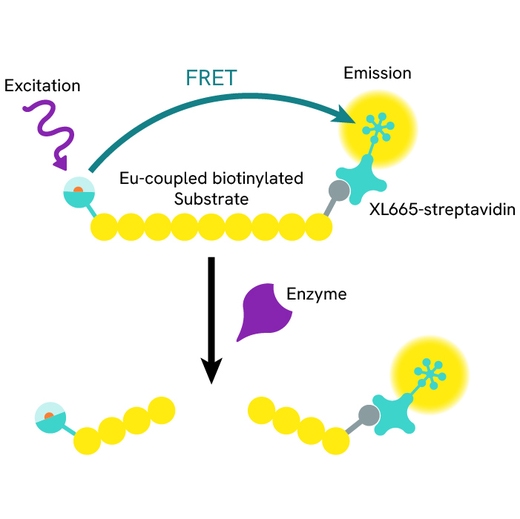

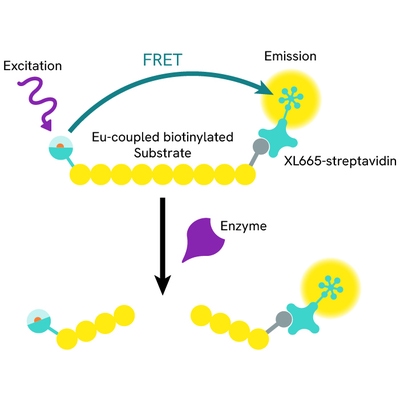
Generic HTRF biotinylated coupled substrate XL665 streptavidin image
APP substrate is labeled with both biotin and Eu3+ Cryptate and used to monitor human beta-secretase (BACE1) activity.
| Feature | Specification |
|---|---|
| Application | Protein Quantification |
APP substrate is labeled with both biotin and Eu3+ Cryptate and used to monitor human beta-secretase (BACE1) activity.
Product variants
Unit Size: 5,000 assay points
Part #:
64APBKAA
List price
USD 1,958.00
Your price:
Unit Size: 20,000 assay points
Part #:
64APBKAB
List price
USD 6,662.00
Your price:
For research use only. Not for use in diagnostic procedures. All products to be used in accordance with applicable laws and regulations including without limitation, consumption, and disposal requirements under European REACH regulations (EC 1907/2006).
HTRF Human APP (BACE1 Substrate) Biotin Eu-Conjugate, 5,000 Assay Points
Generic HTRF biotinylated coupled substrate XL665 streptavidin image
Loading...
Product information
Overview
Beta-secretase (BACE1) is an enzyme which cleaves amyloid precursor protein (APP) to produce the amyloid ß42 peptide, responsible for insoluble amyloid plaques in Alzheimer's disease (AD).
HTRF APP substrate labeled with both biotin and Eu3+ Cryptate, used with HTRF SA-XL665 or Sa-d2, provides a sensitive and efficient method for screening BACE1 inhibitors with the robustness of HTRF technology.
HTRF assays offer many advantages over other technologies:
- Homogeneous add-and-read format
- No wash steps
- Low background
- Straightforward miniaturization from 96- or 384-well microplates to high density assay formats such as 384-well low volume and 1536-well plates
- Stable signal, providing flexibility in time of readout or size of assays
How it works
Assay principle
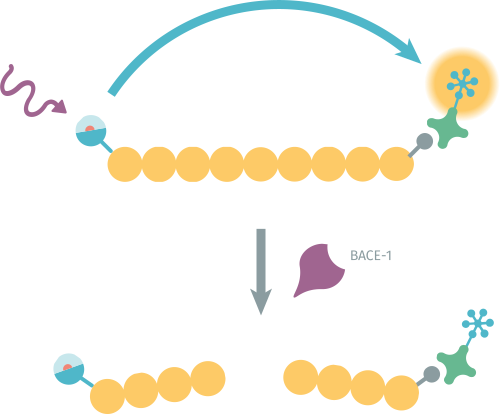
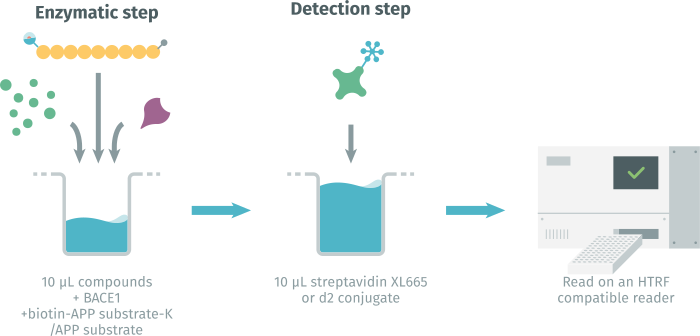
The HTRF BACE1 assay is based on our amyloid precursor protein (APP) substrate, labeled with both biotin and Eu3+ Cryptate. Active BACE1 enzyme cleaves the substrate, causing the loss of energy transfer, and thus a reduction in SA-XL665 or Sa-d2 emissions.
Assay protocol
The assay is run in a two-step process: 1.BACE1 enzymatic reaction: Mix together the APP substrate, BACE1 and/or compounds, then incubate (we recommend a time course study to determine the optimal stimulation time). 2.BACE1 activity detection: Add Streptavidin-XL665 or Streptavidin-d2.
Assay validation
Evaluation of BACE1 peptidic inhibitors
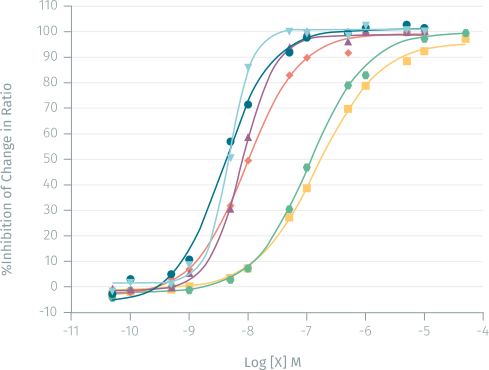
The HTRF BACE1 assay was used to compare the activity of soluble proBACE1 (sproBACE1) and a soluble BACE1 that was autoprocessed to remove the prodomain sequence (sautoBACe1), in the presence of selected inhibitors. 25 nM Biotin-APP substrate-Eu cryptate, 5 µM unlabeled APP peptide substrates and 6 nM enzyme were incubated for 3 h at 30 °C, pH 5.0, in the presence and absence of increasing concentrations of peptidic inhibitors.
IC50s included in Table below and are in good agreement with those reported in the literature using kinetic assays (Kennedy ME et al, Anal Biochem, 2003 Aug 1;319(1):49-55.). sproBACE1 (¦) and sautoBACE1 (°) KTEEISEVNL-(statine)-VAEF (- - - - -) EVNL(GHET)AAEF (—) ELDL(GHET)AVEF
| Peptide inhibitor | IC50 for sproBACE1 (nM) | IC50 for sautoBACE1 (nM) |
|---|---|---|
| KTEEISEVN-(statine)-VAEF | 92 ± 9 | 82 ± 18 |
| EVNL(?HET)AAEF | 8 ± 3 | 6 ± 2 |
| ELDL(?HET)AVEF | 4 ± 1 | 4 ± 1 |
| IsoValeryl-VV-statine-A-statine | n.d | n.d |
Specifications
| Application |
Protein Quantification
|
|---|---|
| Automation Compatible |
Yes
|
| Brand |
HTRF
|
| Detection Modality |
HTRF
|
| Product Group |
Fluorescent Reagent
|
| Shipping Conditions |
Shipped in Dry Ice
|
| Target |
BACE-1
|
| Target Class |
Biomarkers
|
| Target Species |
Human
|
| Technology |
TR-FRET
|
| Unit Size |
5,000 assay points
|
Video gallery
HTRF Human APP (BACE1 Substrate) Biotin Eu-Conjugate, 5,000 Assay Points
Resources
Are you looking for resources, click on the resource type to explore further.

Brochure
HTRF assays and reagents product list
Discover the versatility and precision of Homogeneous Time-Resolved Fluorescence (HTRF) technology. Our HTRF portfolio offers a...

Guide
HTRF solutions, guide to major applications
This guide provides you an overview of HTRF applications in several therapeutic areas.
Loading...


How can we help you?
We are here to answer your questions.