US

Revvity Sites Globally
Select your location.
*e-commerce not available for this region.



Centrifuge Bucket Insert I200 1/50 for B200 (4/pk)
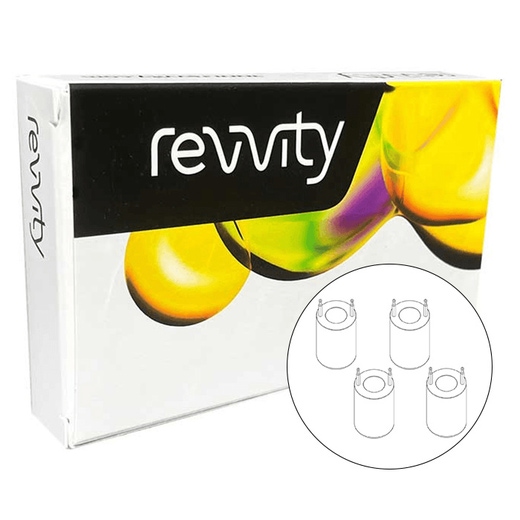
Centrifuge Bucket Insert I200 1/50 for B200 (4/pk)
Centrifuge Bucket Insert I200 1/50 for B200 buckets on swing-out rotor RS 4/200 (4/pk)
Centrifuge Bucket Insert I200 1/50 for B200 (4/pk)
Swing-out buckets inserts used with swing-out rotors in CF-350 centrifuges.
Note: Sample tubes, collection vessels, centrifuge rotors are sold separately. Make sure to purchase buckets and lids intended to fit the corresponding insert, as needed.
Product variants
For research use only. Not for use in diagnostic procedures.
| Feature | Specification |
|---|---|
| Instrument Compatibility | CF-350 centrifuge |
| Quantity | 4 |
| Sample Volume | 50 mL |
| Angle | 90° |
| Maximum G Force | 3,402 rcf |
| Feature | Specification |
|---|---|
| Instrument Compatibility | CF-350 centrifuge |
| Quantity | 4 |
| Sample Volume | 50 mL |
| Angle | 90° |
| Maximum G Force | 3,402 rcf |
Product information
Overview
Bucket Insert used to centrifuge 50 mL conical tubes on centrifuge rotor RS 4/200 (4-placement, swing-out rotor supporting maximum 200 mL per placement) when used with B200 buckets and lids. 1 tubes per insert, for a maximum total of 4 tubes per rotor.
Note: Unit purchase of 1 includes 4 inserts. To support, for example, a full 4-placement run, you need to order 1 unit only.
Swing-out buckets inserts used with swing-out rotors in centrifuges are important to support diverse tube types properly and safely. They help researchers utilize different size tubes and/or vessels into the same centrifuge bucket or swing-out rotor with ease to properly support safe sample centrifugation.
As a standard nomenclature for our buckets and inserts: Inserts are associated with maximum volume capacity of a rotor 'placement', number of vessels (tubes) per insert, and nominal volume for each vessel (or tube). I200 1/30, for example, is an Insert for a swing-out, 4-place rotor supporting a max of 200 mL per 'placement' (so total 4 buckets (with corresponding inserts) x 200 mL per 1 rotor), and 1/30 indicates 1 vessel (or tube) of up to 30 mL per insert.
Specifications
| Angle |
90°
|
|---|
| Instrument Compatibility |
CF-350 centrifuge
|
|---|---|
| Maximum G Force |
3,402 rcf
|
| Product Compatibility |
50 mL conical tubes (30 x 115 mm [D x L]) for B200 buckets
|
| Quantity |
4
|
| Sample Volume |
50 mL
|
| Type |
RS 4/200
|
Resources
Are you looking for resources, click on the resource type to explore further.


Loading...
How can we help you?
We are here to answer your questions.