
US

Revvity Sites Globally
Select your location.
*e-commerce not available for this region.

AlphaLISA Human Myoglobin Detection Kit, 500 Assay Points
 View All
AlphaLISA Human Myoglobin Detection Kit, 500 Assay Points

AlphaLISA Sandwich Anti-analyte Conjugated Acceptor Bead

| Feature | Specification |
|---|---|
| Application | Protein Quantification |
| Dynamic Range | 1.0 - 100,000 pg/mL |
| Limit of Detection | 1.0 pg/mL |
| Sample Volume | 5 µL |
Product variants
Unit Size: 500 assay points
Part #:
AL285C
List price
USD 4,722.55
Your online price:
Unit Size: 5,000 assay points
Part #:
AL285F
List price
USD 36,853.40
Your online price:
For research use only. Not for use in diagnostic procedures. All products to be used in accordance with applicable laws and regulations including without limitation, consumption, and disposal requirements under European REACH regulations (EC 1907/2006).
AlphaLISA Human Myoglobin Detection Kit, 500 Assay Points
AlphaLISA Sandwich Anti-analyte Conjugated Acceptor Bead
AlphaLISA Human Myoglobin Detection Kit, 500 Assay Points
Product information
Overview
Formats:
- Our 500 assay point kit allows you to run 500 wells in 96-well or 384-well format, using a 50 µL reaction volume (5 µL of sample).
- Our 5,000 assay point kit allows you to run 5,000 wells in 96-well or 384-well format, using a 50 µL reaction volume (5 µL of sample).
Features:
- No-wash steps, no separation steps
- ELISA alternative technology
- Sensitive detection
- Broad sample compatibility
- Small sample volume
- Results in less than 3 hours
- Half the time of an ELISA assay
Myoglobin is a heme protein with a molecular weight of approximately 17.5 kDa. Myoglobin is expressed in cardiac myocytes and oxidative skeletal muscle fibres. The principal function of myoglobin is to transport oxygen from the sarcolemma to the mitochondria in heart and muscle cells. Functionally, myoglobin is well accepted as an oxygen-storage protein in muscle, capable of releasing oxygen during periods of hypoxia or anoxia. After muscle tissue damage such as crush injuries, burns, myocardial infarction and muscle diseases, increased levels of myoglobin are found in the blood and urine. Myoglobin is an early marker for myocardial infarct, because it is one of the first biomarkers to rise above normal levels.
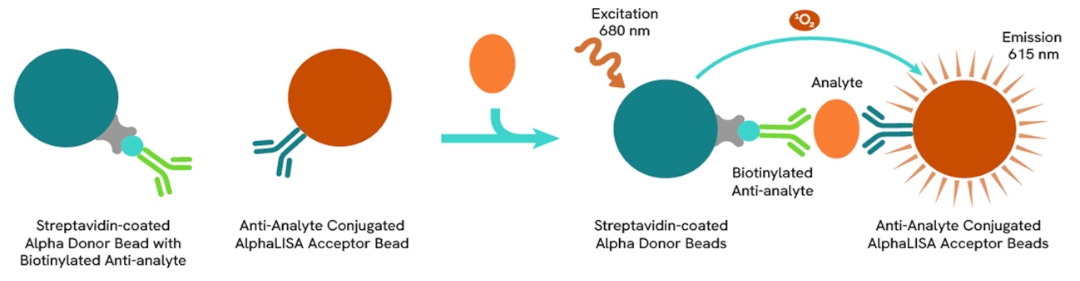
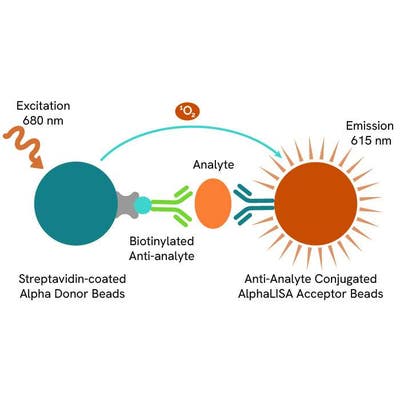
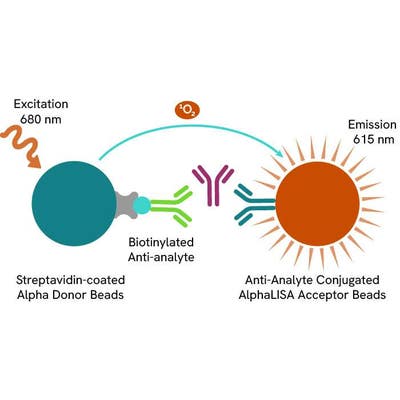
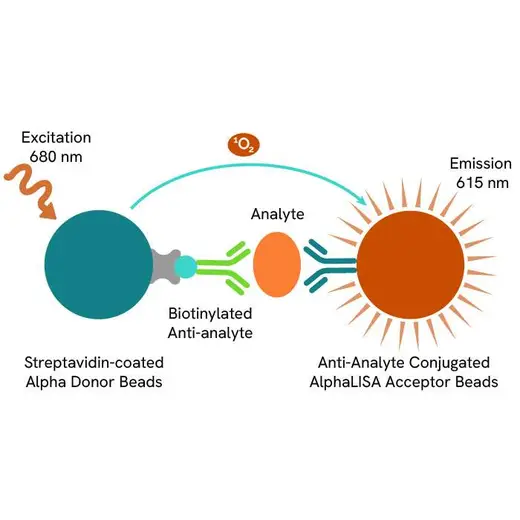
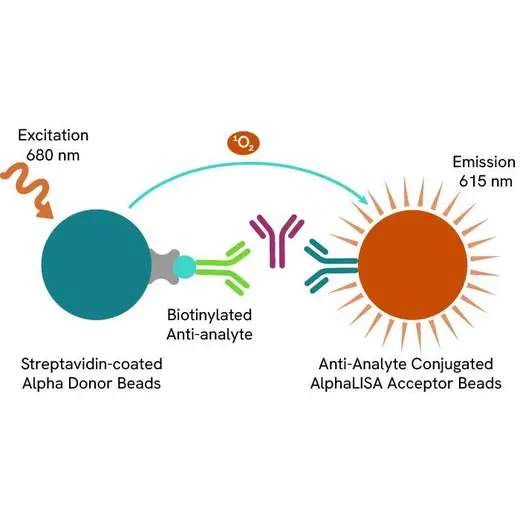
AlphaLISA technology allows the detection of molecules of interest in a no-wash, highly sensitive, quantitative assay. In an AlphaLISA assay, a biotinylated anti-analyte antibody binds to the Streptavidin-coated Donor beads while another anti-analyte antibody is conjugated to AlphaLISA Acceptor beads. In the presence of the analyte, the beads come into close proximity. The excitation of the Donor beads causes the release of singlet oxygen molecules that triggers a cascade of energy transfer in the Acceptor beads, resulting in a sharp peak of light emission at 615 nm.
How it works
Principle of the AlphaLISA assay
The AlphaLISA assay is based on an AlphaLISA sandwich immunoassay involving a biotinylated anti-analyte antibody bound to Streptavidin-coated AlphaLISA Donor beads and an anti-analyte antibody conjugated to AlphaLISA Acceptor beads. Both antibodies are directed against the analyte of interest. In the presence of the target, both antibodies bind to analyte and the beads come into proximity. The excitation of the Donor beads provokes the release of singlet oxygen molecules that triggers a cascade of energy transfer within the Acceptor beads, resulting in emission with λmax at 615 nm. The intensity of the signal is directly proportional to the concentration of analyte present in the sample.
Protocol of the AlphaLISA assay
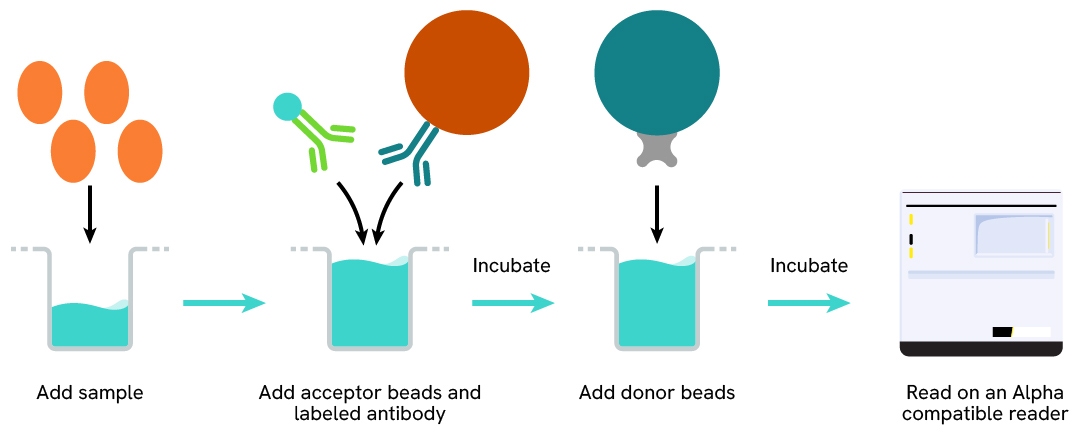
The AlphaLISA assay can be run in a 96- or 384-well detection plate (50 µL final). As described here, samples or standards are dispensed directly into the assay plate for the detection of the analyte of interest by AlphaLISA reagents. No washing steps are needed. The protocol can be further miniaturized or upscaled by simply resizing each addition volume proportionally.
Specifications
| Application |
Protein Quantification
|
|---|---|
| Automation Compatible |
Yes
|
| Brand |
AlphaLISA
|
| Detection Modality |
Alpha
|
| Dynamic Range |
1.0 - 100,000 pg/mL
|
| Limit of Detection |
1.0 pg/mL
|
| Product Group |
Kit
|
| Sample Volume |
5 µL
|
| Shipping Conditions |
Shipped in Blue Ice
|
| Target |
Myoglobin
|
| Target Class |
Biomarkers
|
| Target Species |
Human
|
| Technology |
Alpha
|
| Therapeutic Area |
Cardiovascular
|
| Unit Size |
500 assay points
|
Video gallery
AlphaLISA Human Myoglobin Detection Kit, 500 Assay Points
AlphaLISA Human Myoglobin Detection Kit, 500 Assay Points
Resources
Are you looking for resources, click on the resource type to explore further.


Loading...
How can we help you?
We are here to answer your questions.