US

Revvity Sites Globally
Select your location.
*e-commerce not available for this region.


LANCE Ultra Mouse IgG Detection Kit, 500 Assay Points
LANCE Ultra Mouse IgG Detection Kit, 500 Assay Points
Lance Ultra Detection Kit
The LANCE® Ultra Mouse IgG Detection Kit is designed for detection and quantitation of Mouse IgG in cell culture media using a homogeneous TR-FRET (no-wash steps, no separation steps) assay.
| Feature | Specification |
|---|---|
| Application | Protein Quantification |
| Dynamic Range | 33.4 - 300,000 pg/mL |
| Limit of Detection | 33.4 pg/mL |
| Limit of Quantification | 166.9 pg/mL |
| Sample Volume | 15 µL |
The LANCE® Ultra Mouse IgG Detection Kit is designed for detection and quantitation of Mouse IgG in cell culture media using a homogeneous TR-FRET (no-wash steps, no separation steps) assay.
Product variants
Unit Size: 500 Assay Points
Part #:
TRF1529C
List price
USD 1,279.00
Your online price:
Unit Size: 10,000 Assay Points
Part #:
TRF1529M
List price
USD 17,049.00
Your online price:
For research use only. Not for use in diagnostic procedures. All products to be used in accordance with applicable laws and regulations including without limitation, consumption, and disposal requirements under European REACH regulations (EC 1907/2006).
LANCE Ultra Mouse IgG Detection Kit, 500 Assay Points
Lance Ultra Detection Kit
LANCE Ultra Mouse IgG Detection Kit, 500 Assay Points
Loading...
Product information
Overview
The LANCE® Ultra Mouse IgG Detection Kit is designed for detection and quantitation of Mouse IgG in cell culture media using a homogeneous TR-FRET (no-wash steps, no separation steps) assay.
- No-wash steps, no separation steps
- TR-FRET technology
- Sensitive detection
- High reproducibility
- Faster time-to-results
- Easy automation
- 96-well, 384-well, and 1536-well formats
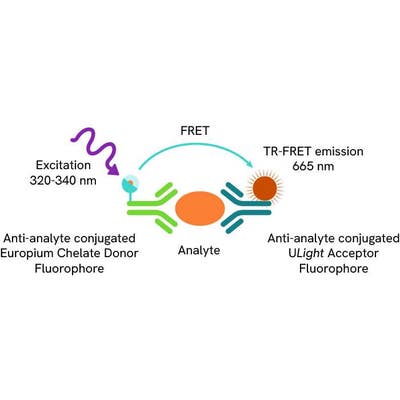
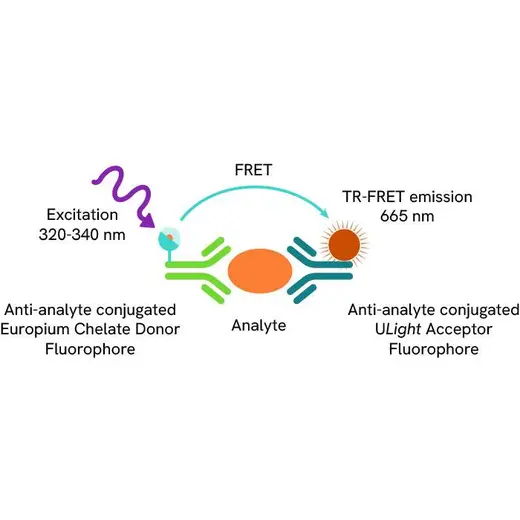
LANCE® and LANCE® (Lanthanide chelate excite) Ultra are our TR-FRET (time-resolved fluorescence resonance energy transfer), homogeneous (no wash) technologies. One antibody of interest is labeled with a donor fluorophore (a LANCE Europium chelate) and the second molecule is labeled with an acceptor fluorophore (ULight™ dye). Upon excitation at 320 or 340 nm, energy can be transferred from the donor Europium chelate to the acceptor fluorophore if sufficiently close for FRET (~10 nm). This results in the emission of light at 665 nm.
There are five classes of mammalian immunoglobulins: IgA, IgD, IgE, IgM, and IgG. IgG is the most abundant immunoglobulin and is equally distributed in blood and tissue. In mice, the IgG class is further divided into four subclasses: IgG, IgG2a/ IgG2c (strain specific), IgG2b, and IgG3. The general immunoglobulin structure is composed of four polypeptide chains, two heavy and two light chains linked together and to each other by disulfide bonds, creating a tetrameric quaternary structure. IgG is involved in response to a foreign antigen. The presence of IgG usually signifies a mature antibody response. IgG has a molecular weight of about 150 kDa, it can bind to many pathogens and also plays an important role in antibody-dependent cell-mediated cytotoxicity. Typically mouse serum and plasma samples contain about 7 to 10 mg/ml of IgG. The present kit permits detection of mouse IgG (i.e. analyte) in different sample matrices, including different cell culture media.
Specifications
| Application |
Protein Quantification
|
|---|---|
| Automation Compatible |
Yes
|
| Brand |
LANCE Ultra
|
| Detection Modality |
LANCE
|
| Dynamic Range |
33.4 - 300,000 pg/mL
|
| Limit of Detection |
33.4 pg/mL
|
| Limit of Quantification |
166.9 pg/mL
|
| Product Group |
Kit
|
| Sample Volume |
15 µL
|
| Shipping Conditions |
Shipped in Blue Ice
|
| Target |
IgG
|
| Target Class |
Biologics
|
| Target Species |
Mouse
|
| Technology |
TR-FRET
|
| Unit Size |
500 Assay Points
|
Resources
Are you looking for resources, click on the resource type to explore further.

Product Info
LANCE and LANCE Ultra TR-FRET technology product list
LANCE™ Ultra TR-FRET is a no-wash proximity assay technology that combines the benefits of time resolution (TR) with fluorescence...


How can we help you?
We are here to answer your questions.