
US

Revvity Sites Globally
Select your location.
*e-commerce not available for this region.

AlphaLISA SureFire Ultra Human and Mouse IRF6 Dimer Detection Kit, 500 Assay Points
AlphaLISA SureFire Ultra Human and Mouse IRF6 Dimer Detection Kit, 500 Assay Points
Principle of the protein complex detection AlphaLISA SureFire Ultra assay
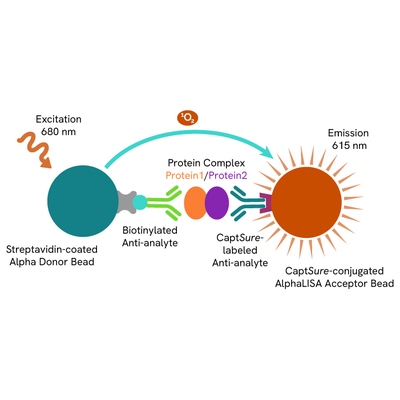
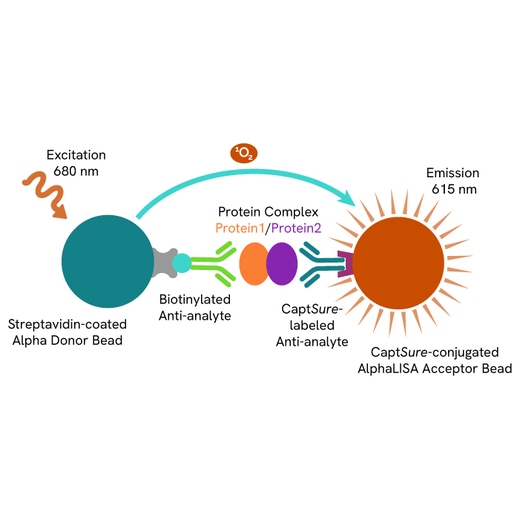
The AlphaLISA™ SureFire® Ultra™ Human and Mouse IRF6 Dimer assay is a sandwich immunoassay for quantitative detection of the IRF6 dimer in cellular lysates using Alpha Technology.
| Feature | Specification |
|---|---|
| Application | Cell Signaling |
| Protocol Time | 2h at RT |
| Sample Volume | 10 µL |
The AlphaLISA™ SureFire® Ultra™ Human and Mouse IRF6 Dimer assay is a sandwich immunoassay for quantitative detection of the IRF6 dimer in cellular lysates using Alpha Technology.
Product variants
Unit Size: 100 Assay Points
Part #:
ALSU-AIRF6-A-HV
List price
USD 737.00
Your price:
Unit Size: 500 Assay Points
Part #:
ALSU-AIRF6-A500
List price
USD 2,490.00
Your price:
Unit Size: 10,000 Assay Points
Part #:
ALSU-AIRF6-A10K
List price
USD 14,982.00
Your price:
Unit Size: 50,000 Assay Points
Part #:
ALSU-AIRF6-A50K
List price
USD 47,624.00
Your price:
For research use only. Not for use in diagnostic procedures. All products to be used in accordance with applicable laws and regulations including without limitation, consumption and disposal requirements under European REACH regulations (EC 1907/2006).
AlphaLISA SureFire Ultra Human and Mouse IRF6 Dimer Detection Kit, 500 Assay Points
Principle of the protein complex detection AlphaLISA SureFire Ultra assay
Loading...
Product information
Overview
Interferon Regulatory Factor 6 (IRF6) is a transcription factor of the IRF family with critical roles in epithelial development, keratinocyte differentiation, and craniofacial morphogenesis. Unlike many IRF family members primarily associated with immune signaling, IRF6 is most prominently expressed in epithelial tissues and is essential for normal palate, lip, and skin development. IRF6 drives expression of genes involved in keratinocyte terminal differentiation and suppresses epithelial proliferation by regulating cyclin D1 and other cell cycle regulators. Loss-of-function mutations in IRF6 are causative for Van der Woude syndrome and popliteal pterygium syndrome, two autosomal dominant disorders characterized by cleft lip and palate. In cancer, IRF6 has been identified as a tumor suppressor in oral, breast, and skin cancers, where reduced IRF6 activity correlates with increased proliferation and invasiveness.
IRF6 dimerization represents a key step in the activation and transcriptional function of this epithelial regulatory transcription factor. Like other IRF family members, IRF6 contains an N-terminal DNA-binding domain and a C-terminal IRF association domain (IAD) that mediates homo- and heterodimerization. Dimerization of IRF6 is required for high-affinity DNA binding at composite regulatory elements and for full transcriptional activation of target genes involved in keratinocyte differentiation and epithelial barrier formation. The IRF6 dimer interface has been shown to be disrupted by several disease-associated mutations found in Van der Woude and popliteal pterygium syndrome patients, underscoring the functional importance of the dimeric state. Detection of the IRF6 dimer, as distinct from total or phosphorylated IRF6 monomer, provides insight into the oligomeric activation state of IRF6 and its capacity for transcriptional engagement, which is particularly relevant in studies of epithelial development, wound healing, and oral cancer biology.
The AlphaLISA SureFire Ultra Human and Mouse IRF6 Dimer Detection Kit is a sandwich immunoassay for the quantitative detection of IRF6 dimer in cellular lysates, using Alpha Technology.
Formats:
- The HV (high volume) kit contains reagents to run 100 wells in 96-well format, using a 60 μL reaction volume.
- The 500-point kit contains enough reagents to run 500 wells in 384-well format, using a 20 μL reaction volume.
- The 10,000-point kit contains enough reagents to run 10,000 wells in 384-well format, using a 20 μL reaction volume.
- The 50,000-point kit contains enough reagents to run 50,000 wells in 384-well format, using a 20 μL reaction volume.
AlphaLISA SureFire Ultra kits are compatible with:
- Cell and tissue lysates
- Antibody modulators
- Biotherapeutic antibodies
AlphaLISA SureFire Ultra kits can be used for:
- Cellular kinase assays
- Receptor activation studies
- High-throughput screening for preclinical studies
Assay validation
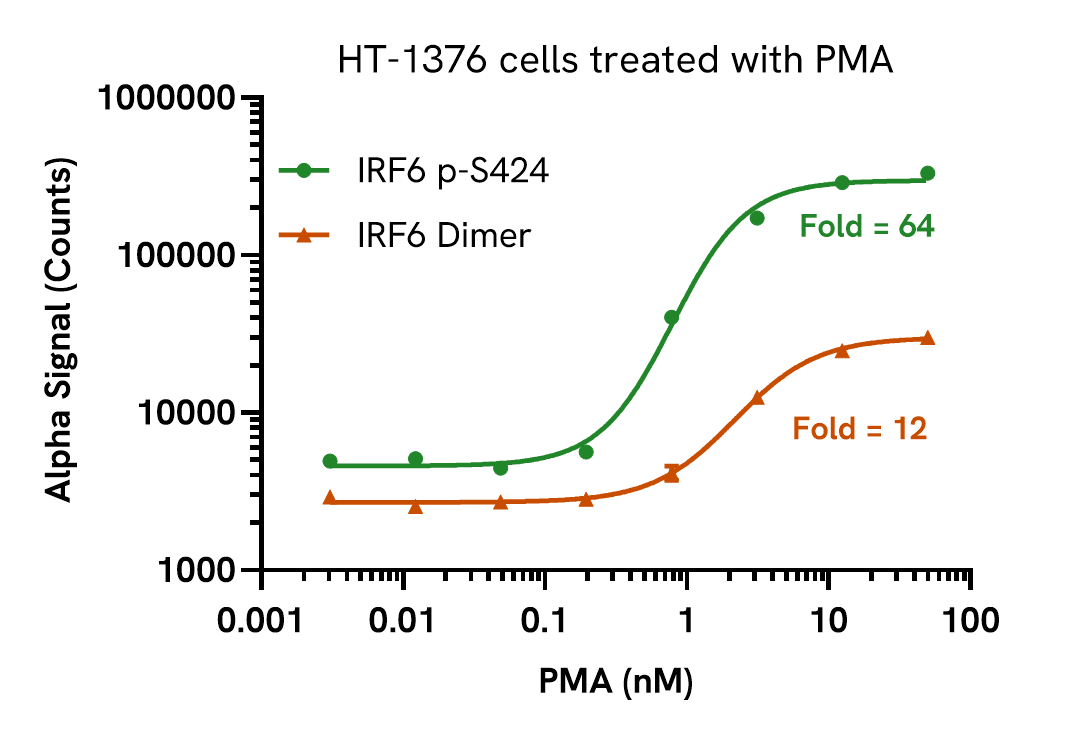
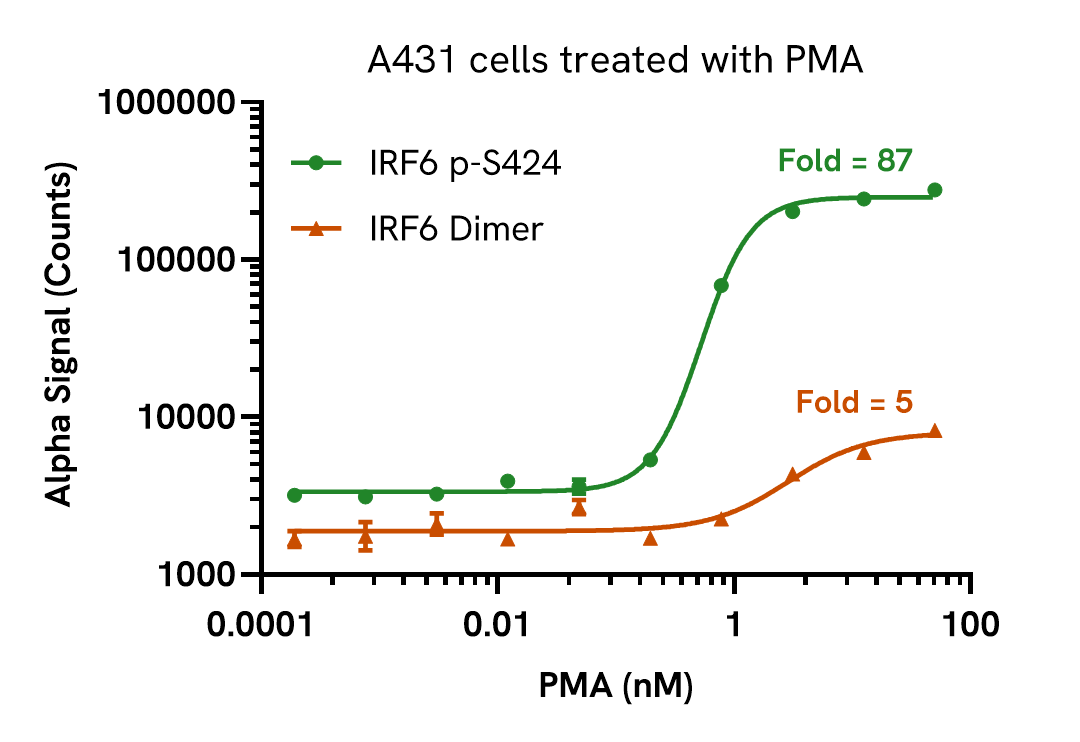
PMA mediated IRF6 activation in various cell lines
HT-1376 and A431 cells were seeded in a 96-well plate (40,000 cells/well) in complete medium and incubated overnight at 37°C, 5% CO2. Cells were treated with increasing concentrations of PMA for 1 hour.
After treatment, the cells were lysed with 50 µL or 100 µL of Lysis Buffer for 10 minutes at RT with shaking (350 rpm). Phospho (Ser424) and Dimer IRF6 levels were evaluated using AlphaLISA SureFire Ultra assays. For the detection step, 10 µL of cell lysate (approximately 4,000 cells for IRF6 Phospho and 8,000 cells for IRF6 Dimer) was transferred into a 384-well white OptiPlate, followed by 5 µL of Acceptor mix and incubated for 1 hour at RT. Finally, 5 µL of Donor mix was then added to each well and incubated for 1 hour at RT in the dark. The plate was read on an Envision using standard AlphaLISA settings.
As expected, treatment with PMA induced IRF6 phosphorylation and subsequent dimerization with no change to Total ERK levels (data not shown).
PMA mediated IRF6 activation in mouse macrophages
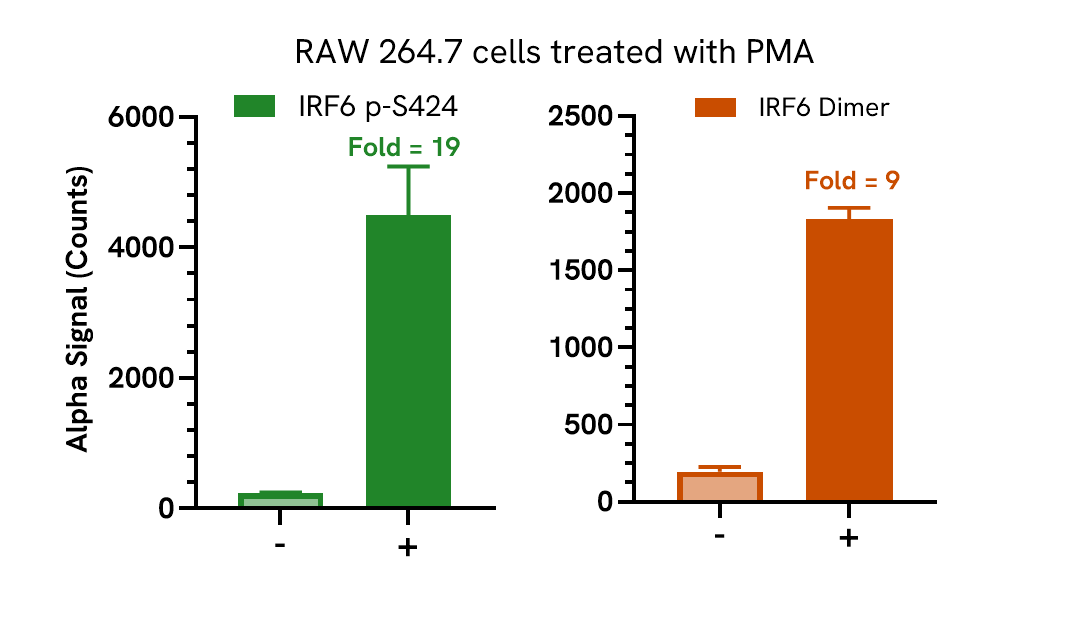
RAW 264.7 cells were seeded in a 96-well plate (40,000 cells/well) in complete medium and incubated overnight at 37°C, 5% CO2. Cells were treated with 50 nM of PMA for 1 hour.
After treatment, the cells were lysed with 50 µL or 100 µL of Lysis Buffer for 10 minutes at RT with shaking (350 rpm). Phospho (Ser424) and Dimer IRF6 levels were evaluated using AlphaLISA SureFire Ultra assays. For the detection step, 10 µL of cell lysate (approximately 4,000 cells for Phospho IRF6, 8,000 cells for Dimer) was transferred into a 384-well white OptiPlate, followed by 5 µL of Acceptor mix and incubated for 1 hour at RT. Finally, 5 µL of Donor mix was then added to each well and incubated for 1 hour at RT in the dark. The plate was read on an Envision using standard AlphaLISA settings.
As expected, treatment with PMA induced IRF6 phosphorylation and subsequent dimerization with no change to Total ERK levels (data not shown).
Assay sensitivity
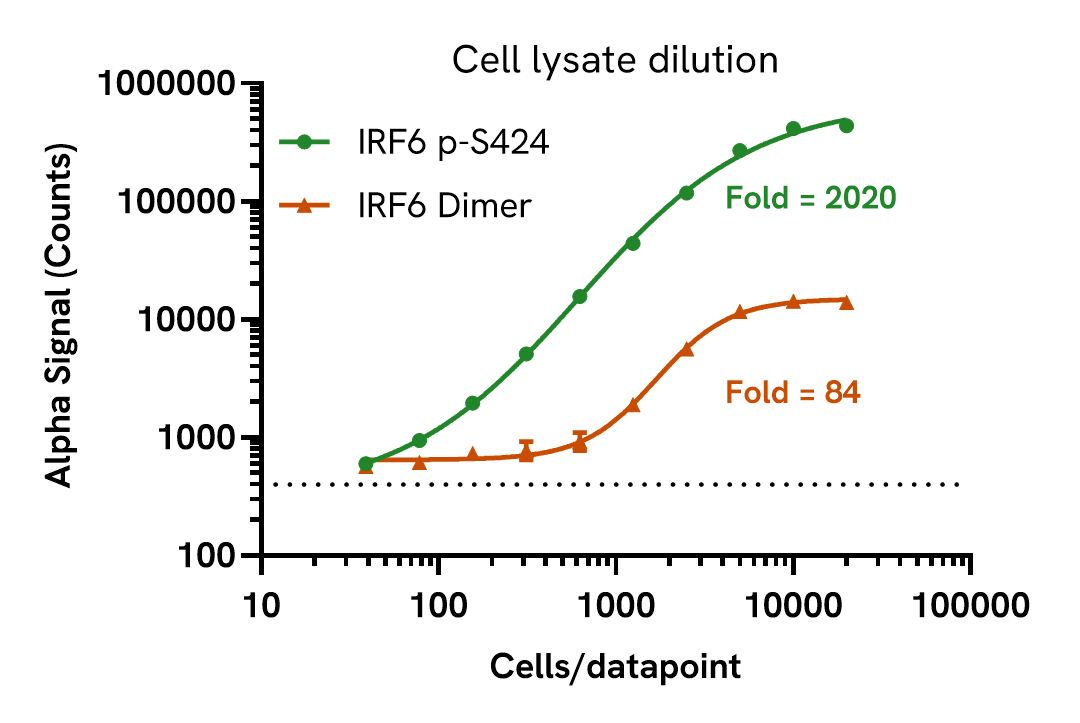
Assay sensitivity - cell lysate dilution
Cell lysate was prepared from HT-1376 cells cultured to confluence in T175 flasks at 37°C, 5% CO2. Cells were treated with 50 nM PMA for 1 hour and lysed in 4 mL of Lysis Buffer for 10 minutes at RT with shaking.
Lysates were serially diluted and Phospho (Ser424) and Dimer IRF6 levels were evaluated using AlphaLISA SureFire Ultra assays. For the detection step, 10 µL of lysate was transferred into a 384-well white OptiPlate, followed by 5 µL of Acceptor mix and incubated for 1 hour at room temperature. Finally, 5 µL of Donor mix was then added to each well and incubated for 1 hour at RT in the dark. The plate was read on an Envision using standard AlphaLISA settings.
Approximate number of cells/datapoint is indicated on the graph. The assay can detect IRF6 Dimer in less than 2,000 cells. The dotted line represents assay background.
Specifications
| Application |
Cell Signaling
|
|---|---|
| Automation Compatible |
Yes
|
| Brand |
AlphaLISA SureFire Ultra
|
| Detection Modality |
Alpha
|
| Product Group |
Kit
|
| Protocol Time |
2h at RT
|
| Sample Volume |
10 µL
|
| Shipping Conditions |
Shipped in Blue Ice
|
| Target |
IRF6
|
| Target Class |
Phosphoproteins
|
| Target Species |
Human
Mouse
|
| Technology |
Alpha
|
| Therapeutic Area |
Inflammation
Oncology
|
| Unit Size |
500 Assay Points
|
Resources
Are you looking for resources, click on the resource type to explore further.

Brochure
Alpha assays and reagents catalog
Alpha technolgy enables the rapid and straightforward mesaure of virtually any target. This includes enzymes, receptor-ligand...

Guide
AlphaLISA SureFire Ultra: the ultimate guide for successful experiments
The definitive guide for setting up a successful AlphaLISA SureFire Ultra assay
Several biological processes are regulated by...
Brochure
Alpha SureFire Ultra no-wash immunoassay catalog
Discover Alpha SureFire® Ultra™ assays, the no-wash cellular kinase assays leveraging Revvity's exclusive bead-based technology...
Brochure
Species compatibility for HTRF, AlphaLISA SureFire Ultra and Alpha SureFire Ultra Multiplex assays
This document includes detailed tables listing HTRF™, AlphaLISA™ SureFire® Ultra™, and Alpha SureFire® Ultra™ Multiplex assays...
Loading...


How can we help you?
We are here to answer your questions.