
Revvity Sites Globally
Select your location.
*e-commerce not available for this region.

Sequins Metagenomics Core Control Set

Sequins Metagenomics Core Control Set

Sequins logo primary image
The Sequins™ Metagenomics Core Control Set is a defined mixture of synthetic DNA reference standards designed to enable absolute quantification, normalization, and quality control in shotgun metagenomic sequencing. Added to extracted DNA before library preparation, the controls represent 52 microbial species across a defined abundance ladder, providing an internal reference for assessing quantitative performance, sensitivity, and workflow-specific limits of detection.
The known concentrations of these standards provide a quantitative reference for estimating absolute microbial DNA abundance and making more meaningful comparisons across samples, sequencing runs, and platforms. The controls can be incorporated into most existing metagenomic workflows for microbiome research, environmental monitoring, and antimicrobial resistance surveillance.
| Feature | Specification |
|---|---|
| Automation Compatible | Yes |
The Sequins™ Metagenomics Core Control Set is a defined mixture of synthetic DNA reference standards designed to enable absolute quantification, normalization, and quality control in shotgun metagenomic sequencing. Added to extracted DNA before library preparation, the controls represent 52 microbial species across a defined abundance ladder, providing an internal reference for assessing quantitative performance, sensitivity, and workflow-specific limits of detection.
The known concentrations of these standards provide a quantitative reference for estimating absolute microbial DNA abundance and making more meaningful comparisons across samples, sequencing runs, and platforms. The controls can be incorporated into most existing metagenomic workflows for microbiome research, environmental monitoring, and antimicrobial resistance surveillance.
Product variants
Unit Size: 24 rxns
Part #:
NOVA-10008
List price
USD 600.00
Your price:
Unit Size: 48 rxns
Part #:
NOVA-10009
List price
USD 900.00
Your price:
For research use only. Not for use in diagnostic procedures.
Sequins Metagenomics Core Control Set
Sequins logo primary image
Loading...
Product information
Overview
The Sequins Metagenomics Core Control Set provides a standardized internal reference for quantitative shotgun metagenomic sequencing. The predefined mixture contains synthetic DNA controls at known relative concentrations, allowing assessment of assay performance across a broad abundance range.
Key features:
- Control composition: 65 synthetic DNA sequences representing 52 microbial species across bacteria, archaea, and eukaryotes, with GC content ranging from 27–71%.
- Quantitative range: 13-level abundance ladder spanning a 32,768-fold concentration range.
- Simple integration: Single-tube blend added to extracted DNA before library preparation, with a recommended spike-in of approximately 1% of DNA input.
- Sequencing compatibility: Demonstrated with Illumina, Oxford Nanopore, and PacBio sequencing technologies.
- Bioinformatics support: Reference sequences, abundance files, and analysis tutorials available for integration into existing bioinformatics workflows.
Additional product information
How Sequins Metagenomics Controls Work
The Sequins Metagenomics Core Control Set uses engineered, mirrored DNA sequences that retain key characteristics of microbial targets while remaining distinguishable from native microbial DNA during analysis. A known amount of these synthetic DNA spike-in controls is introduced after DNA extraction, allowing the reference molecules and microbial DNA to undergo the same library preparation and sequencing conditions. Because the controls are introduced after DNA extraction, they can be used to assess downstream workflow performance, but not DNA extraction efficiency.
Absolute Quantification and Assay Sensitivity
A molecular ladder of known DNA concentrations provides an internal reference for calibrating shotgun metagenomic sequencing data and estimating absolute microbial DNA abundance. Unlike relative abundance measurements, which can shift as the proportions of other organisms change, calibrated measurements provide a clearer basis for comparing microbial DNA levels across samples. The known concentration ladder also allows researchers to evaluate quantitative linearity, dynamic range, and workflow-specific limits of detection (LoD) and quantification (LoQ).
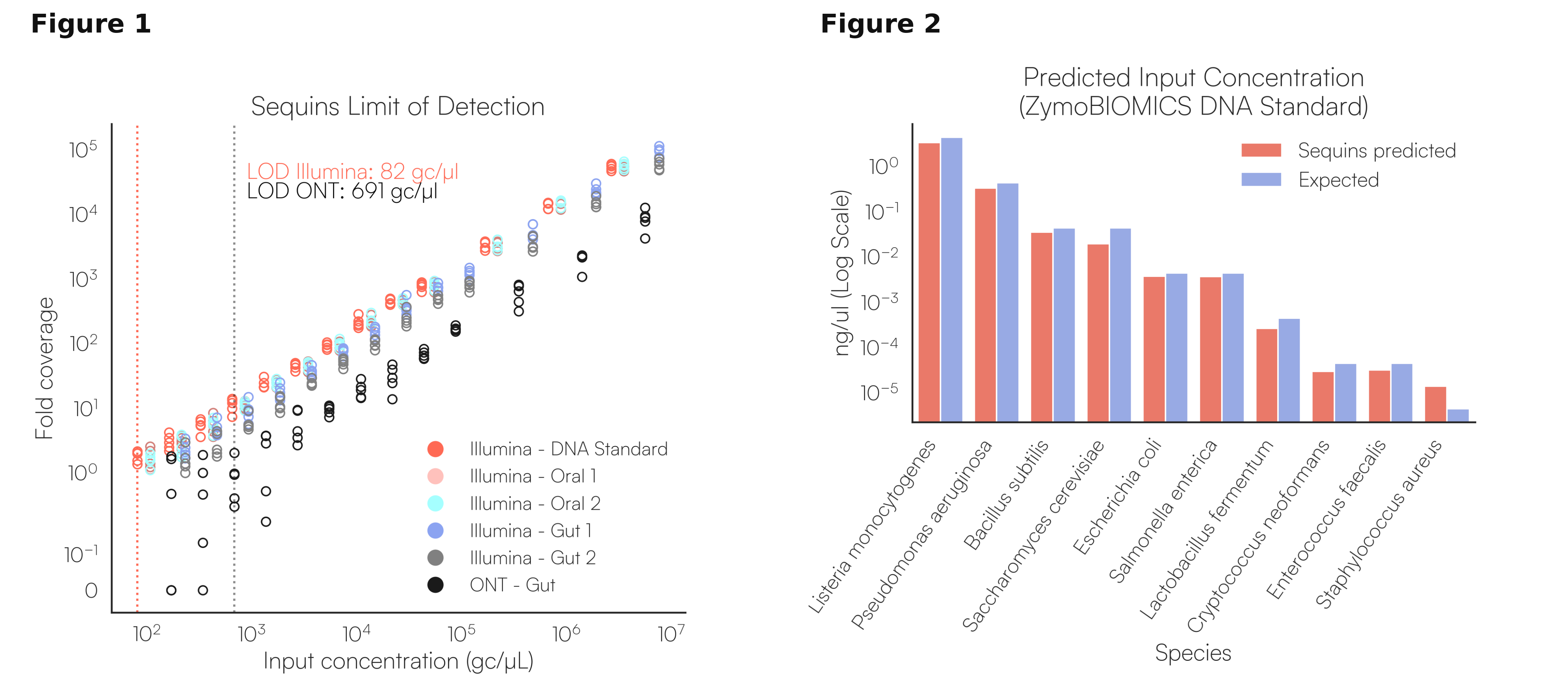
Figure 1. Sequins limit of detection. Detection performance of Sequins synthetic DNA controls across Illumina and Oxford Nanopore sequencing workflows, with reported detection limits of 82 gc/µL and 691 gc/µL, respectively, under the evaluated experimental conditions.
Figure 2. Absolute microbial DNA quantification. Comparison of Sequins-predicted and expected DNA concentrations across ten microbial species in the ZymoBIOMICS DNA Standard, demonstrating quantitative performance across a broad concentration range.
Normalization and Workflow Performance
Sequins-based normalization improves comparisons between shotgun metagenomic samples by using a known reference to account for technical variability introduced during library preparation and sequencing. The controls also provide a means to evaluate workflow consistency by monitoring their performance across samples and sequencing runs. In an evaluation of canine fecal samples, this approach yielded more consistent microbial abundance measurements across replicates than unnormalized read counts or upper-quartile normalization.
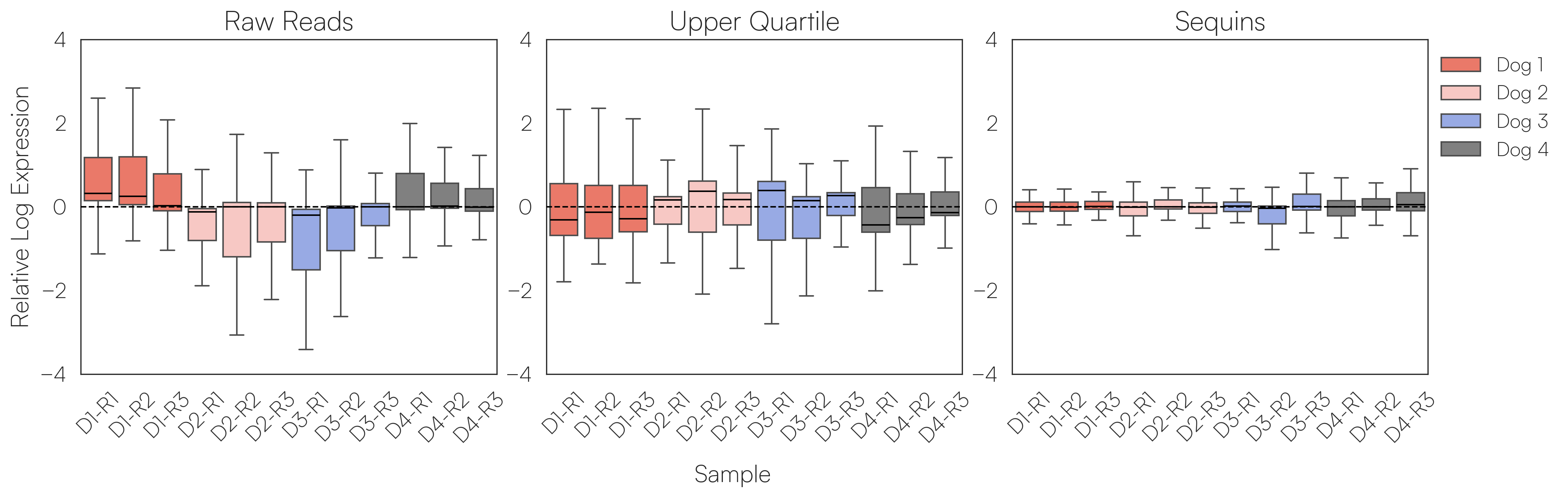
Figure 3. Improved data consistency with Sequins controls. Comparison of raw read counts (left), upper-quartile normalization (middle), and Sequins-based normalization (right) across four canine fecal samples analyzed in triplicate. Sequins-based normalization produced more consistent measurements than the other two approaches.
Specifications
| Automation Compatible |
Yes
|
|---|---|
| Product Group |
Metagenomic Accessories
|
| Shipping Conditions |
Shipped Ambient
|
| Unit Size |
48 rxns
|
Citations
- Hardwick SA, Chen WY, Wong T, et al. Synthetic microbe communities provide internal reference standards for metagenome sequencing and analysis. Nature Communications. 2018;9:3096. https://doi.org/10.1038/s41467-018-05555-0
- Davis BC, Vikesland PJ, Pruden A. Evaluating quantitative metagenomics for environmental monitoring of antibiotic resistance and establishing detection limits. Environmental Science & Technology. 2025;59(12):6192–6202. https://doi.org/10.1021/acs.est.4c08284
FAQs
-
Can Sequins metagenomic controls be used with unknown microbial communities?
-
Do Sequins controls require specialized bioinformatics software?
-
Will Sequins controls interfere with microbial identification during sequencing analysis?
-
Does size selection affect Sequins performance in long-read metagenomic sequencing?
-
Can the published Sequins limits of detection be applied to any metagenomic sample?
Resources
Are you looking for resources, click on the resource type to explore further.
Loading...


How can we help you?
We are here to answer your questions.