
US

Revvity Sites Globally
Select your location.
*e-commerce not available for this region.

AlphaLISA Human PTEN Detection Kit, 5,000 Assay Points
 View All
AlphaLISA Human PTEN Detection Kit, 5,000 Assay Points

AlphaLISA Sandwich Anti-analyte Conjugated Acceptor Bead
The AlphaLISA™ immunoassay kit for human PTEN enables the detection and quantitation of human PTEN in tissue homogenates and cell lysates using a homogeneous AlphaLISA assay (no wash steps). Other species of PTEN were not tested, but detection is expected with mouse and rat PTEN due to >99% sequence homology.
| Feature | Specification |
|---|---|
| Application | Protein Quantification |
| Dynamic Range | 26.2 - 1,000,000 pg/mL |
| Limit of Detection | 26.2 pg/mL |
| Limit of Quantification | 81.9 pg/mL |
| Sample Volume | 5 µL |
The AlphaLISA™ immunoassay kit for human PTEN enables the detection and quantitation of human PTEN in tissue homogenates and cell lysates using a homogeneous AlphaLISA assay (no wash steps). Other species of PTEN were not tested, but detection is expected with mouse and rat PTEN due to >99% sequence homology.
Product variants
Unit Size: 100 assay points
Part #:
AL380HV
List price
USD 787.00
Your online price:
Unit Size: 500 assay points
Part #:
AL380C
List price
USD 2,538.00
Your online price:
Unit Size: 5,000 assay points
Part #:
AL380F
List price
USD 16,921.00
Your online price:
For research use only. Not for use in diagnostic procedures. All products to be used in accordance with applicable laws and regulations including without limitation, consumption, and disposal requirements under European REACH regulations (EC 1907/2006).
AlphaLISA Human PTEN Detection Kit, 5,000 Assay Points
AlphaLISA Sandwich Anti-analyte Conjugated Acceptor Bead
Loading...
Product information
Overview
Formats:
- Our 100 assay point kit allows you to run 100 wells in 96-well format, using a 100 µL reaction volume (10 µL of sample).
- Our 500 assay point kit allows you to run 500 wells in 96-well or 384-well format, using a 50 µL reaction volume (5 µL of sample).
- Our 5,000 assay point kit allows you to run 5,000 wells in 96-well or 384-well format, using a 50 µL reaction volume (5 µL of sample).
Features:
- No-wash steps, no separation steps
- ELISA alternative technology
- Sensitive detection
- Broad sample compatibility
- Small sample volume
Phosphatase and tensin homolog (PTEN) is a 402 AA protein that is expressed ubiquitously in the body. The main function of PTEN is to dephosphorylate phosphatidylinositol 3,4,5-triphosphate whereby resulting in the inhibition of the AKT signaling pathway; a pathway necessary for cell survival. Through this interaction PTEN was determined to play a crucial role in tumor suppression. In cancers like prostate, endometrial, lung and breast, PTEN expression is commonly lost or highly reduced. From the established connections between PTEN and cancer, PTEN is a highly sought after cancer biomarker. The PTEN AlphaLISA detection kit allows for the detection of PTEN in tissues homogenates and cell lysates.
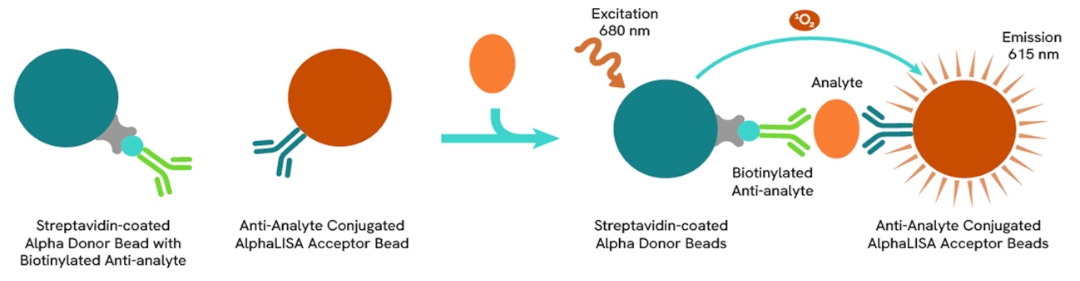
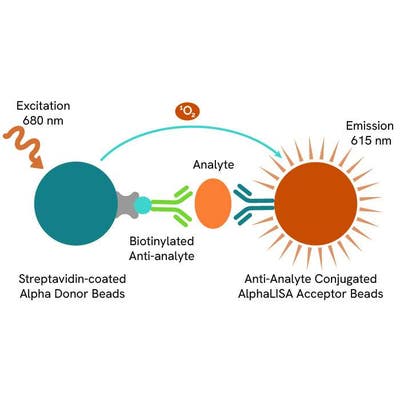
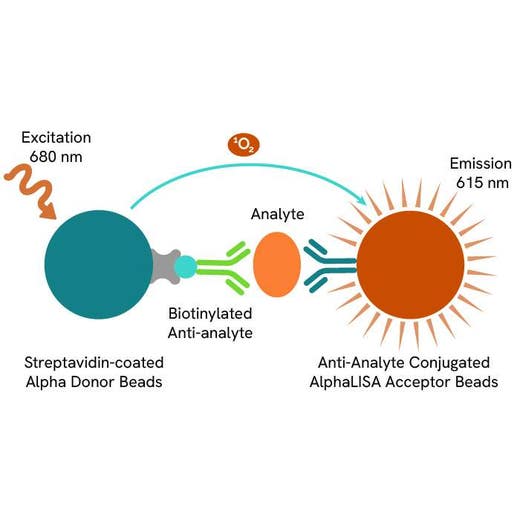
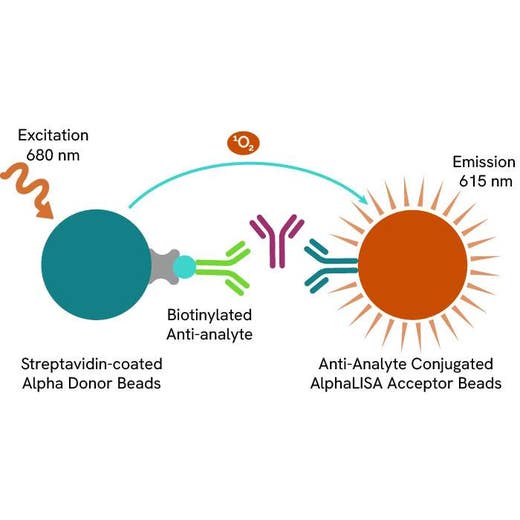
AlphaLISA technology allows the detection of molecules of interest in a no-wash, highly sensitive, quantitative assay. In an AlphaLISA assay, a biotinylated anti-analyte antibody binds to the Streptavidin-coated Donor beads while another anti-analyte antibody is conjugated to AlphaLISA Acceptor beads. In the presence of the analyte, the beads come into close proximity. The excitation of the Donor beads causes the release of singlet oxygen molecules that triggers a cascade of energy transfer in the Acceptor beads, resulting in a sharp peak of light emission at 615 nm.
How it works
Principle of the AlphaLISA assay
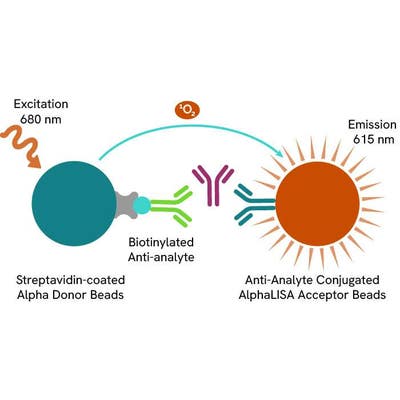
The AlphaLISA assay is based on an AlphaLISA sandwich immunoassay involving a biotinylated anti-analyte antibody bound to Streptavidin-coated AlphaLISA Donor beads and an anti-analyte antibody conjugated to AlphaLISA Acceptor beads. Both antibodies are directed against the analyte of interest. In the presence of the target, both antibodies bind to analyte and the beads come into proximity. The excitation of the Donor beads provokes the release of singlet oxygen molecules that triggers a cascade of energy transfer within the Acceptor beads, resulting in emission with λmax at 615 nm. The intensity of the signal is directly proportional to the concentration of analyte present in the sample.
Protocol of the AlphaLISA assay
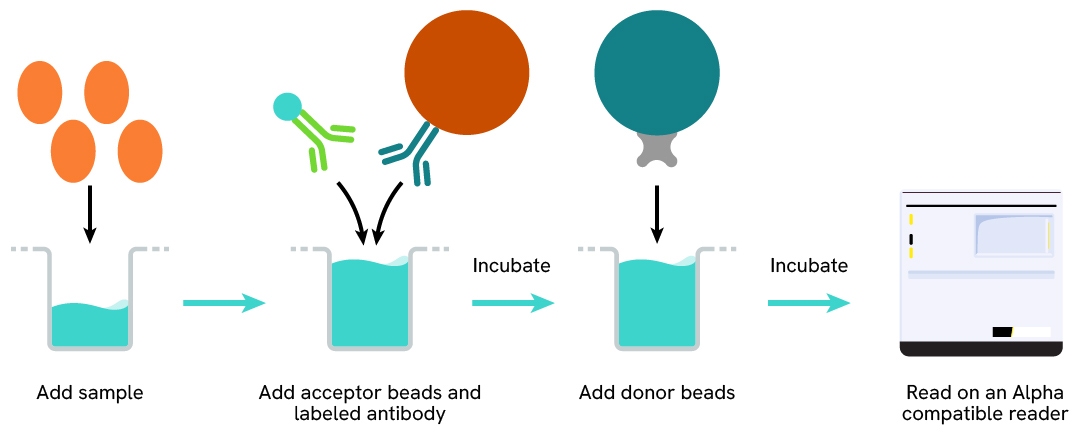
The AlphaLISA assay can be run in a 96- or 384-well detection plate (50 µL final). As described here, samples or standards are dispensed directly into the assay plate for the detection of the analyte of interest by AlphaLISA reagents. No washing steps are needed. The protocol can be further miniaturized or upscaled by simply resizing each addition volume proportionally.
Specifications
| Application |
Protein Quantification
|
|---|---|
| Automation Compatible |
Yes
|
| Brand |
AlphaLISA
|
| Detection Modality |
Alpha
|
| Dynamic Range |
26.2 - 1,000,000 pg/mL
|
| Limit of Detection |
26.2 pg/mL
|
| Limit of Quantification |
81.9 pg/mL
|
| Product Group |
Kit
|
| Sample Volume |
5 µL
|
| Shipping Conditions |
Shipped in Blue Ice
|
| Target |
PTEN
|
| Target Class |
Biomarkers
|
| Target Species |
Human
|
| Technology |
Alpha
|
| Therapeutic Area |
Oncology
|
| Unit Size |
5,000 assay points
|
Video gallery
AlphaLISA Human PTEN Detection Kit, 5,000 Assay Points
Resources
Are you looking for resources, click on the resource type to explore further.
Loading...


How can we help you?
We are here to answer your questions.