
Revvity Sites Globally
Select your location.
*e-commerce not available for this region.

AlphaLISA Human IL-5 Detection Kit, 500 Assay Points
 View All
AlphaLISA Human IL-5 Detection Kit, 500 Assay Points

AlphaLISA Sandwich Anti-analyte Conjugated Acceptor Bead
The AlphaLISA™ Human Interleukin 5 (IL5) Detection Kit is designed for detection and quantitation of human IL5 in serum, buffered solution or cell culture medium in a homogeneous (no-wash steps, no separation steps) assay.
| Feature | Specification |
|---|---|
| Application | Protein Quantification |
| Dynamic Range | 4.5 - 100,000 pg/mL |
| Limit of Detection | 4.5 pg/mL |
| Sample Volume | 5 µL |
The AlphaLISA™ Human Interleukin 5 (IL5) Detection Kit is designed for detection and quantitation of human IL5 in serum, buffered solution or cell culture medium in a homogeneous (no-wash steps, no separation steps) assay.
Product variants
Unit Size: 500 assay points
Part #:
AL267C
List price
USD 2,589.00
Your price:
Unit Size: 5,000 assay points
Part #:
AL267F
List price
USD 17,260.00
Your price:
For research use only. Not for use in diagnostic procedures. All products to be used in accordance with applicable laws and regulations including without limitation, consumption, and disposal requirements under European REACH regulations (EC 1907/2006).
AlphaLISA Human IL-5 Detection Kit, 500 Assay Points
AlphaLISA Sandwich Anti-analyte Conjugated Acceptor Bead
Loading...
Product information
Overview
Formats:
- Our 500 assay point kit allows you to run 500 wells in 96-well or 384-well format, using a 50 µL reaction volume (5 µL of sample).
- Our 5,000 assay point kit allows you to run 5,000 wells in 96-well or 384-well format, using a 50 µL reaction volume (5 µL of sample).
Features:
- No-wash steps, no separation steps
- ELISA alternative technology
- Sensitive detection
- Broad sample compatibility
- Small sample volume
- Results in less than 3 hours
- Half the time of an ELISA assay
Human Interleukin 5 (IL5) is produced as a precursor protein maturing into a 115 amino acid protein. The mature active protein is heavily glycosylated and is covalently linked in a homodimer by a disulfide bond, with a native apparent molecular weight of 45-60 kDa. It is produced by Th2 cells, mast cells, and eosinophils. IL5 stimulates B cell growth and promotes the production of cytotoxic T-cells from thymocytes, but its key function is to mediate activation, maturation, and survival of eosinophils. IL5 activated eosinophils eliminate antibody bound parasites through the release of cytotoxic granule proteins. IL5 seems to play a major role in the development of allergic disease/asthma response, which makes IL5 an interesting target for the development of anti-allergy drugs. IL5 is also a potential marker of acute graft-versus-host disease.
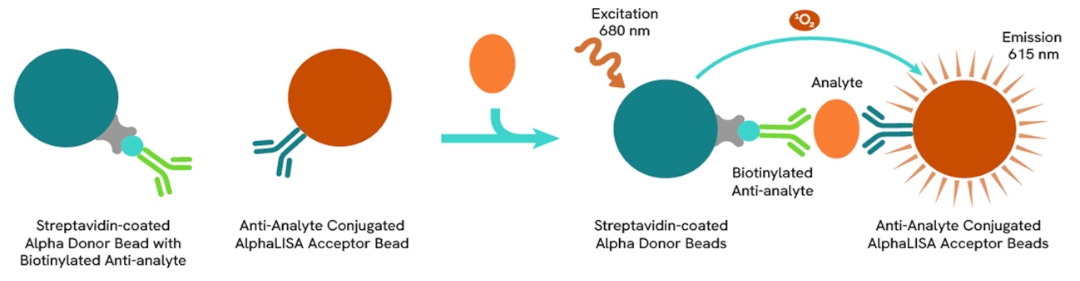
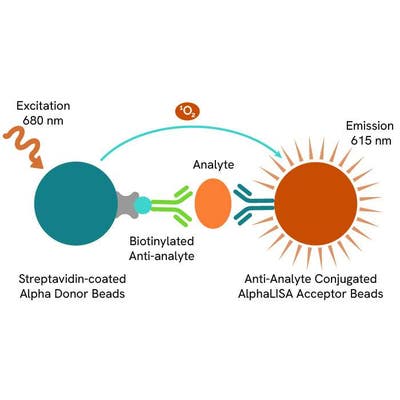
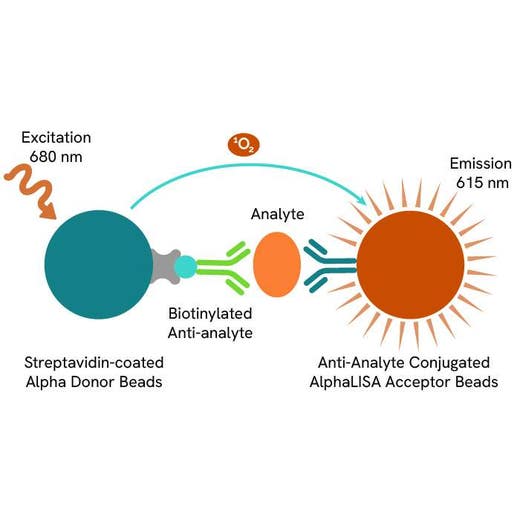
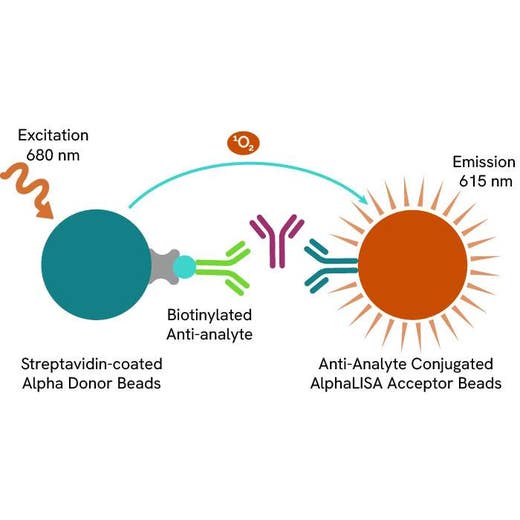
AlphaLISA technology allows the detection of molecules of interest in a no-wash, highly sensitive, quantitative assay. In an AlphaLISA assay, a biotinylated anti-analyte antibody binds to the Streptavidin-coated Donor beads while another anti-analyte antibody is conjugated to AlphaLISA Acceptor beads. In the presence of the analyte, the beads come into close proximity. The excitation of the Donor beads causes the release of singlet oxygen molecules that triggers a cascade of energy transfer in the Acceptor beads, resulting in a sharp peak of light emission at 615 nm.
How it works
Principle of the AlphaLISA assay
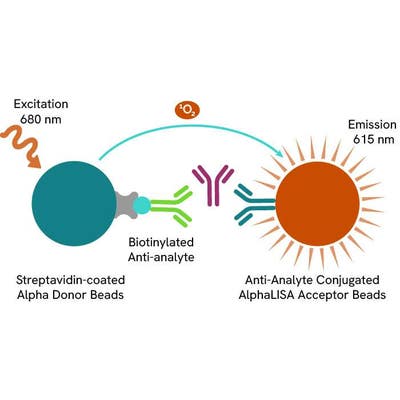
The AlphaLISA assay is based on an AlphaLISA sandwich immunoassay involving a biotinylated anti-analyte antibody bound to Streptavidin-coated AlphaLISA Donor beads and an anti-analyte antibody conjugated to AlphaLISA Acceptor beads. Both antibodies are directed against the analyte of interest. In the presence of the target, both antibodies bind to analyte and the beads come into proximity. The excitation of the Donor beads provokes the release of singlet oxygen molecules that triggers a cascade of energy transfer within the Acceptor beads, resulting in emission with λmax at 615 nm. The intensity of the signal is directly proportional to the concentration of analyte present in the sample.
Protocol of the AlphaLISA assay
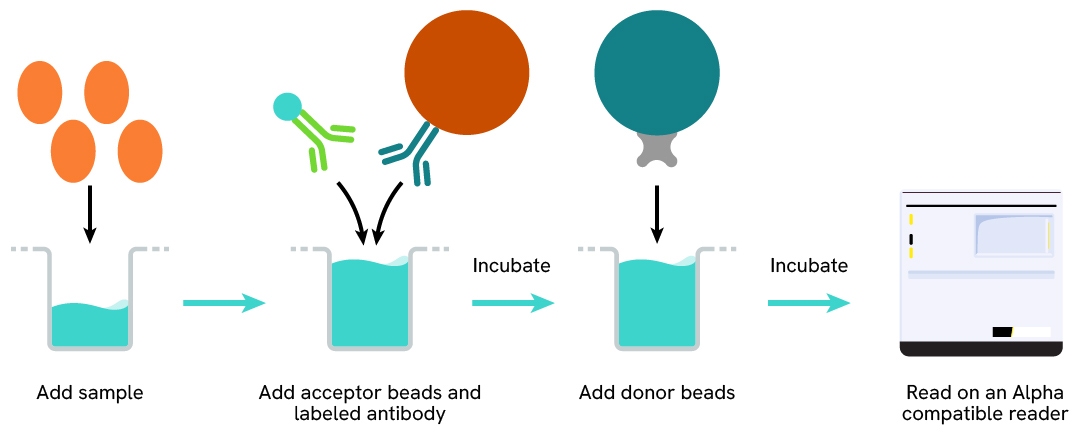
The AlphaLISA assay can be run in a 96- or 384-well detection plate (50 µL final). As described here, samples or standards are dispensed directly into the assay plate for the detection of the analyte of interest by AlphaLISA reagents. No washing steps are needed. The protocol can be further miniaturized or upscaled by simply resizing each addition volume proportionally.
Specifications
| Application |
Protein Quantification
|
|---|---|
| Automation Compatible |
Yes
|
| Brand |
AlphaLISA
|
| Cellular or Signaling Pathway |
Cytokine signaling
|
| Detection Modality |
Alpha
|
| Dynamic Range |
4.5 - 100,000 pg/mL
|
| Limit of Detection |
4.5 pg/mL
|
| Product Group |
Kit
|
| Sample Volume |
5 µL
|
| Shipping Conditions |
Shipped in Blue Ice
|
| Target |
IL-5
|
| Target Class |
Cytokines
|
| Target Species |
Human
|
| Technology |
Alpha
|
| Therapeutic Area |
Inflammation
|
| Unit Size |
500 assay points
|
Video gallery
AlphaLISA Human IL-5 Detection Kit, 500 Assay Points
Citations
Resources
Are you looking for resources, click on the resource type to explore further.

Flyer
No-wash cytokine assay solutions
Cytokines play a vital role in both innate and adaptive immunity and are known for their ability to exert diverse functions on...
Flyer
Solutions to advance your CART-T cell research
Chimeric antigen receptor (CAR) T-cell therapy has transformed the field of immuno-oncology providing a novel approach to treating...
Loading...


How can we help you?
We are here to answer your questions.