US

Revvity Sites Globally
Select your location.
*e-commerce not available for this region.



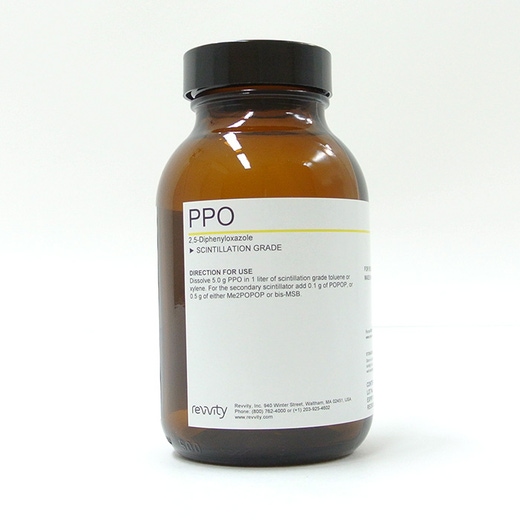
PPO Scintillator, 100 g
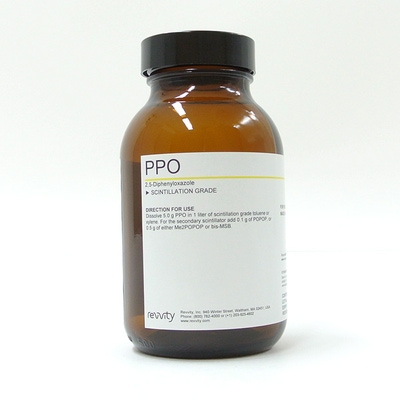
PPO Scintillator, 100 g
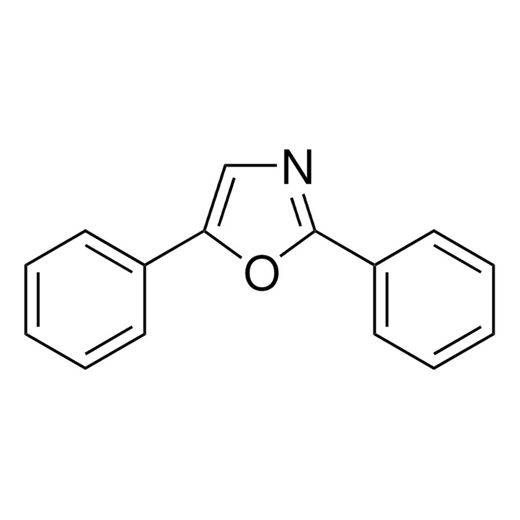
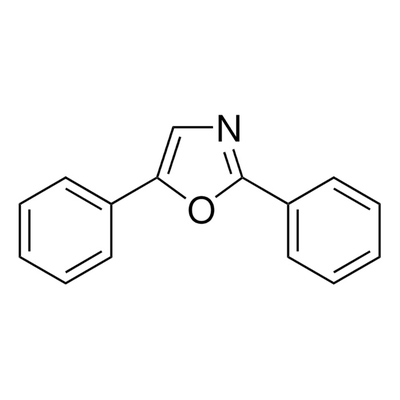
Chemical structure of PPO scintillant
2,5-Diphenyloxazole, commonly known as PPO, (2-phenyl-5-(4-biphenylyl)-1,3,4-oxadiazole) (PBD) is a primary scintillator that directly absorbs energy from radiation and re-emits it as photons. PPO is generally used with a secondary scintillator that can shift the wavelength to match the sensitivity of photomultiplier tubes (PMTs) found in Liquid Scintillation Analyzers (LSAs) such as TriCarb™ or Quantulus GCT™.
PPO is available in a 100g bottle for your research needs.
Bulk quantities of PPO as catalog number 6002021 are available on request.
| Feature | Specification |
|---|---|
| Grade | Normal |
| Maximum Emission Wavelength (Emmax) | ~360 nm |
2,5-Diphenyloxazole, commonly known as PPO, (2-phenyl-5-(4-biphenylyl)-1,3,4-oxadiazole) (PBD) is a primary scintillator that directly absorbs energy from radiation and re-emits it as photons. PPO is generally used with a secondary scintillator that can shift the wavelength to match the sensitivity of photomultiplier tubes (PMTs) found in Liquid Scintillation Analyzers (LSAs) such as TriCarb™ or Quantulus GCT™.
PPO is available in a 100g bottle for your research needs.
Bulk quantities of PPO as catalog number 6002021 are available on request.
Product variant
Unit Size: 1 x 100 g
Part #:
6002023
List price
USD 441.00
Your price:
For research use only. Not for use in diagnostic procedures.
PPO Scintillator, 100 g
Chemical structure of PPO scintillant
Loading...
Product information
Overview
PPO, IUPAC preferred name 2,5-Diphenyl-1,3-oxazole, has an aromatic ring structure fundamental for fluorescent properties.
PPO is well-suited for use as a scintillator in various radiation detection applications. It exhibits a high photoluminescence quantum yield, indicating its efficiency in converting the energy absorbed from ionizing radiation into emitted light. This high efficiency is a desirable characteristic for a scintillator, as it leads to a stronger signal that is easier to detect.
When excited by radiation, PPO fluoresces as a violet color with an excitation wavelength of ~ 303 nm. Its emission wavelength is ~360 nm, which falls within the ultraviolet (UV) range of the electromagnetic spectrum, however, these peaks can vary depending on the solvent used. An important property of PPO is its ability to act as a wavelength shifter. This means that it can absorb light of shorter wavelengths and re-emit light at longer wavelengths.
This characteristic is particularly useful in scintillation detectors because the primary scintillation light produced by the solvent often lies in the UV region, and wavelength shifters like PPO can convert this light to wavelengths that are more efficiently detected by photomultiplier tubes, which typically have higher sensitivity in the visible or near-UV range. However, since PPO's primary emission is still in the UV range, it may be used in conjunction with secondary wavelength shifters for further optimization for liquid scintillation counting. PPO is often paired with secondary scintillator Bis-MSB which acts as a wavelength shifter to re-emit light in the ultraviolet (UV) or visible ranges which is essential for detecting with PMT based detectors.
The molecular formula of PPO is C15H11NO, a melting point of 70 - 72°C and a fluorescence maximum of 362 nm.
Specifications
| Maximum Emission Wavelength (Emmax) |
~360 nm
|
|---|---|
| Molecular Weight |
221.26 g/mol
|
| CAS Number |
92-71-7
|
| Application |
Liquid scintillation counting
|
|---|---|
| Detection Modality |
Radiometric
|
| Format |
Powder
|
| Grade |
Normal
|
| Shipping Conditions |
Shipped Ambient
|
| Unit Size |
1 x 100 g
|
Resources
Are you looking for resources, click on the resource type to explore further.

Brochure
Solutions for liquid scintillation counting
With over 60 years of experience, Revvity provides our customers with total liquid scintillation counting (LSC) solutions for a...
Loading...


How can we help you?
We are here to answer your questions.