



US

Revvity Sites Globally
Select your location.
*e-commerce not available for this region.


 Application Note
Assay-driven buffer selection in bead mill homogenization
Bead-based mechanical homogenization has been leveraged by labs that want to take advantage of physical disruption via bead-milling using simple buffers such as PBS rather than rely solely on harsher chemical buffers. This application note evaluates the Omni Bead Ruptor Elite bead mill homogenizer on chicken tissue samples in PBS vs RIPA lysis buffer, providing a proof-of-concept study for the efficiency of beat-beating for tissue disruption and lysis that is agnostic to buffer conditions.
Access the full application note to see the following:
- Homogenization parameters used with a 2 mL pre-filled homogenization bead mix
- Protein concentration measured by BCA assay from 100 mg of tissue in either lysis buffer or PBS.
- AO/PI analysis of tissue homogenates, indicating complete lysis under both experimental conditions.
Taken together, by incorporating mechanical homogenization via bead-beating for lysis rather than depending on chemical lysis alone, there may be benefits for labs looking for workflow simplification without risking their sample prep. Benefits include the removal of additional workflow complexity including length of incubation, unintended lysis bias or incomplete lysis, as well as the introduction of interference in downstream assays, especially those that may depend on an enzyme-based reaction, mass-spec based assays, and others.
For research use only. Not for use in diagnostic procedures.
To view the full content please answer a few questions
Summary
Efficient and reproducible tissue homogenization is a critical first step in protein analysis workflows, as incomplete lysis can lead to biased results and reduced analytical sensitivity. To address this, many laboratories routinely rely on chemical lysis buffers, such as RIPA lysis buffer, that contain detergents and chaotropic agents designed to disrupt cellular membranes and solubilize proteins. While effective, these reagents present notable limitations, as components such as SDS, Triton™ X-100, and deoxycholate are known to interfere with a broad range of downstream assays, from routine protein absorbance measurements to more complex enzyme-based reactions, immunoassays, and mass spectrometry–based analyses.1,2,3
As a result, researchers are often faced with a trade-off between achieving efficient lysis and maintaining compatibility with downstream applications. In many cases, samples processed in lysis buffers must undergo additional cleanup or buffer exchange steps, increasing workflow complexity, sample loss, and variability. This challenge has driven interest in alternative homogenization strategies that minimize reliance on chemical lysis while still ensuring complete cell disruption.
In addition to assay interference, chemical lysis alone may require extended incubation times and repeated mixing to achieve sufficient tissue disruption, particularly for complex or heterogeneous samples. Even with prolonged exposure to detergents, incomplete homogenization can occur, leaving intact tissue fragments or partially lysed cells. This lack of uniformity can introduce sample-to-sample variability and compromise reproducibility, especially when processing multiple samples in parallel.
Bead-based mechanical homogenization offers a powerful solution by physically disrupting tissues and cells through high-energy bead milling, independent of buffer composition. When sufficient mechanical energy is applied, cellular membranes can be efficiently ruptured in simple, assay-compatible buffers such as PBS.
In this application note, we evaluate the performance of the Omni Bead Ruptor Elite™ for homogenizing chicken tissue samples in PBS compared to a commonly used detergent-based lysis buffer (RIPA). Protein yield was assessed using a bicinchoninic acid (BCA) assay, while lysis efficiency was independently verified using acridine orange/propidium iodide (AO/PI) staining to assess cellular integrity post-homogenization. By decoupling mechanical lysis from chemical solubilization, this study demonstrates how bead milling enables flexible sample preparation workflows, allowing researchers to select buffers based on downstream assay requirements rather than lysis efficiency alone.
Materials and methods
Equipment
- Omni Bead Ruptor Elite bead mill homogenizer (Cat # 19-042E)
- Omni Bead Ruptor Elite bead mill homogenizer 2 mL Tube Carriage (Cat # 19-373)
- Hard Tissue Homogenizing Mix 2.8 mm Ceramic (2 mL Reinforced Tubes) (Cat # 19-628)
- Cellometer™ K2 fluorescent cell counter (Cat # CMT-K2-S150)
- SD100 Counting Chambers (Cat # CHT4-SD100-002)
- ViaStain™ AO/PI Staining Solution (Cat # CS2-0106-5 mL)
Procedure
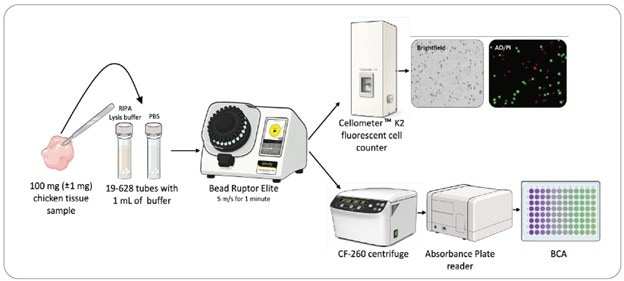
Figure 1. Workflow for homogenizing chicken tissue in PBS or RIPA buffer using the Omni Bead Ruptor Elite, followed by protein quantification by BCA assay and lysis verification by AO/PI staining on a Cellometer K2.
Sample acquisition and preparation
Chicken breast tissue was obtained from a local grocery store and used as a representative complex tissue matrix. Visible fat was removed prior to processing to reduce sample heterogeneity. A single intact piece of tissue was divided into two smaller portions to ensure consistency between assays. One portion was used immediately for homogenization, while the remaining portion was stored at 4 °C for subsequent same-day analysis.
Tissue homogenization and protein extraction
Two parallel assays were performed to compare tissue homogenization in a detergent-based lysis buffer (n = 23) and in PBS (n = 23). For each condition, approximately 100 mg of chicken tissue with a tolerance of ±1% was transferred into a 2 mL Hard Tissue Homogenizing Mix tube pre-filled with 2.8 mm ceramics containing 1 mL of either Pierce® RIPA buffer or PBS. Samples were homogenized using the Omni Bead Ruptor Elite at a speed of 5 m/s for 1 minute.
Following homogenization , the tubes were centrifuged for 5 minutes at 10,000xg. 100 µL of the cleared lysate was transferred into 900 µL of phosphate-buffered saline to generate a 1:10 dilution, bringing protein concentrations within the linear range of the bicinchoninic acid assay. Diluted samples were pipetted in triplicate into a 96-well microplate, with 25 µL added per well in accordance with the Thermo Scientific™ Pierce™ BCA Protein Assay protocol, followed by the addition of 200 µL of the working reagent. Protein standards were prepared using bovine serum albumin (BSA) diluted in the corresponding buffer matrix to get the working concentration range of 20–2,000 µg/mL. Separate standards prepared in 0.1 X RIPA buffer (diluted in PBS) and PBS to match the samples. The microplate was incubated for 30 minutes at room temperature before absorbance was measured at 562 nm using a microplate reader.
Cell lysis verification by AO/PI staining
Cell viability following homogenization was assessed for samples processed in both RIPA buffer and phosphate-buffered saline using acridine orange and propidium iodide staining. Immediately after homogenization, samples were diluted 1:10 in PBS following the same dilution scheme used for protein quantification. A 20 µL aliquot of the diluted sample was mixed with 20 µL of ViaStain AO/PI staining solution according to the manufacturer’s primary cell protocol. A total of 20 µL of the stained suspension was loaded into a two-chamber counting slide and imaged using a Cellometer K2 imaging cytometer to assess viability and confirm lysis.
Statistical analysis
All absorbance data collected on the plate reader was uploaded to GraphPad™ Prism Software (version 10.2.3) and Microsoft Excel. Means and standard deviations were calculated in Microsoft Excel. All graphical figures and statistical analyses were generated using GraphPad™ Prism Software.
Results
Protein quantification was first validated by generating standard curves using BSA standards diluted in either 0.1× RIPA buffer or PBS, confirming that the presence of detergent in RIPA did not interfere with absorbance measurements. Tissue homogenized in RIPA buffer yielded a significantly higher apparent protein concentration compared to samples homogenized in phosphate-buffered saline when quantified using a bicinchoninic acid assay. Samples processed in lysis buffer produced an average protein concentration of 868.5 µg/mL, with values ranging from 780.8 to 1027.8 µg/mL and a relative standard deviation of 7%, indicating good reproducibility across replicates. In contrast, samples homogenized in PBS produced an average protein concentration of 564.7 µg/mL, with values ranging from 479.5 to 637.7 µg/mL and a relative standard deviation of 8%.
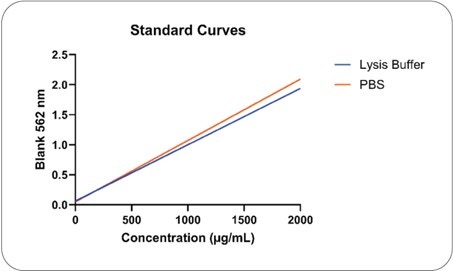
Figure 2. Standard curves of bovine serum albumin (BSA) prepared under two conditions: a 0.1× RIPA buffer stock diluted in PBS, and BSA directly diluted in PBS to defined concentrations.
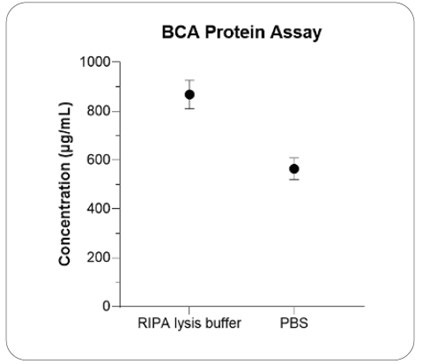
Figure 3. Protein concentration measured by BCA assay for chicken tissue homogenized in RIPA lysis buffer or PBS using the Bead Ruptor Elite. Data represent mean protein concentration with error bars indicating standard deviation.
The difference in measured protein concentration between the two buffer conditions was statistically significant, with a calculated p-value of 9.41 × 10⁻²⁴ . While detergent-based lysis resulted in higher apparent protein recovery, variability between replicates remained comparable between conditions, suggesting that homogenization performance was consistent regardless of buffer composition.
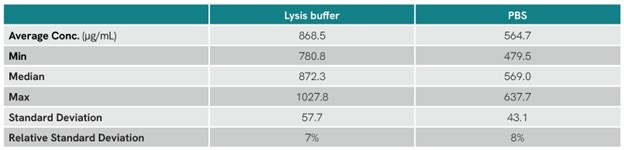
Table 1. Summary statistics of protein concentration measured by BCA assay for chicken tissue homogenized in RIPA lysis buffer or PBS using the Bead Ruptor Elite.
To determine whether differences in protein yield reflected differences in lysis efficiency, cell integrity was independently assessed using acridine orange and propidium iodide staining. AO/PI analysis performed on samples homogenized in both RIPA buffer and PBS showed no detectable intact or viable cells following processing. These results confirm that complete cell lysis was achieved under both conditions and indicate that the observed increase in protein concentration in lysis buffer was not attributable to improved tissue disruption.
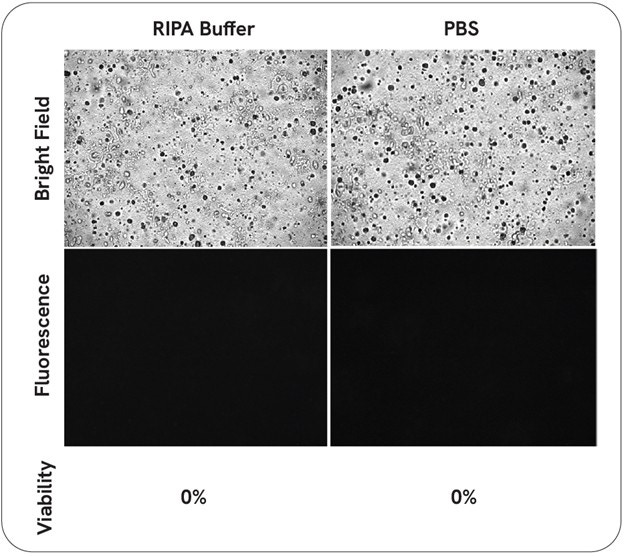
Figure 4. AO/PI analysis of tissue homogenates processed in RIPA buffer or PBS. Brightfield and fluorescence images acquired using a Cellometer K2 show no detectable intact or viable cells following bead-based homogenization, confirming complete cell lysis under both conditions.
Conclusions
This study demonstrates that bead-based mechanical homogenization using the Bead Ruptor Elite achieves complete and reproducible lysis of solid tissue samples independent of buffer chemistry. Although homogenization in RIPA buffer resulted in higher apparent protein concentrations as measured by BCA assay, AO/PI staining confirmed that both PBS and detergent-based conditions achieved full cell lysis. These findings potentially indicate that increased protein yield in lysis buffer is primarily driven by enhanced protein solubilization rather than improved homogenization efficiency.
Previous work has established the ability of bead milling to achieve complete lysis of cultured cell lines, including neuroprogenitor cells. This application note extends those findings to a solid tissue matrix, demonstrating that mechanical disruption alone is sufficient to fully lyse complex samples such as chicken tissue. Together, these results highlight that buffer selection should be guided by downstream assay requirements rather than concerns about lysis efficiency. For workflows requiring detergent-free conditions or maximal assay compatibility, homogenization in PBS provides an effective and reproducible alternative, while detergent-based lysis buffers may be reserved for applications where maximum protein solubilization is required.
Authors: Aamna Aijaz, Olivia Koopman, Caleb Proctor
For research use only. Not for use in diagnostic procedures.
References:
- Beringer, R. W., Ash, D. L., & Page, A. F. (n.d.). Influence of buffer on choice of protein quantification method (Technical Bulletin T112). Thermo Fisher Scientific. Retrieved January 5, 2026, from https://documents.thermofisher.com/TFS-Assets/CAD/Product-Bulletins/T112-Influence-of-Buffer-on-Choice-of-Protein-Quantification-Method.pdf
- Wiśniewski, J. R. (2018). Filter-aided sample preparation for proteome analysis. In Microbial proteomics: methods and protocols (pp. 3-10). New York, NY: Springer New York.
- DeSeau, V., Rosen, N., & Bolen, J. B. (1987). Analysis of pp60c‐src tyrosine kinase activity and phosphotyrosyl phosphatase activity in human colon carcinoma and normal human colon mucosal cells. Journal of Cellular Biochemistry, 35(2), 113-128.
- Revvity Omni homogenizers (2024). Rapid cell count and intactness assessment of pre- and post-Omni Bead Ruptor Elite bead mill homogenized neuroprogenitor cells using the Cellometer K2 fluorescent cell counter (Application note). https://resources.revvity.com/pdfs/app-rapid-cell-count-intactness-assessment-of-pre-and-post-omni-bead-ruptor-elite-beadmill-neuroprogenitor.pdf