


Introduction
Homogeneous fluorescence assays are inherently well-suited to extensive miniaturization. Unlike radioactivity or luminescence, fluorescence intensity depends on concentration, rather than on the absolute quantity of tracer. This property enables HTRF assays to be easily miniaturized while preserving accuracy and reproducibility. Combined with reduced compound and reagent requirements, these features make HTRF assays cost-effective and position HTRF as a truly HTS- and robotics-friendly technology platform.
Two general rules for successful HTRF assay miniaturization
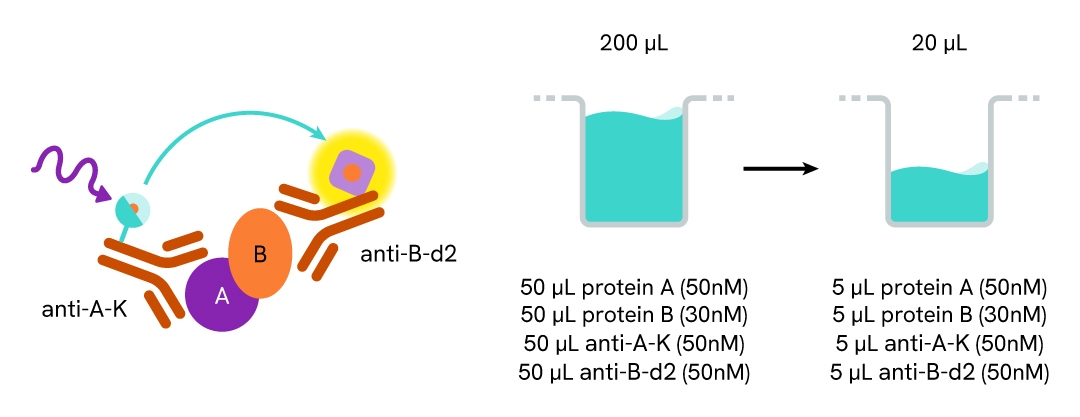
The fluorescent signal is directly dependent on concentration. Therefore, reagents should not be diluted; instead, simply reduce the assay volumes while maintaining reagent concentrations. For example, miniaturization can be achieved by decreasing the volume from 200 µL to 20 µL. For ultra-miniaturized assays (below 5 µL), reagent concentration adjustments may be necessary to ensure optimal assay performance.
Miniaturized Assays and Plate Reader Configuration
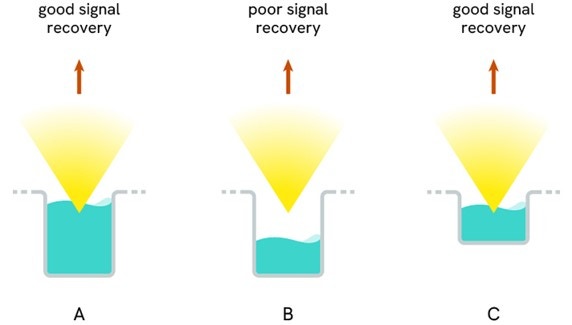
Miniaturized assays require proper plate reader setup to ensure accurate measurements. As illustrated below, the excitation beam must be precisely focused into the well (case A). In case B, when the same plate format is used with a smaller volume, unfocused excitation results in reduced collection of emitted light. Using a plate specifically designed for small assay volumes (case C) restores measurement efficacy and signal quality.
| Plate type | Assay volume |
|---|---|
| 96w regular | 200 µl |
| 96w half area | 100 µl |
| 384w regular | 80 µl |
| 384w low volume | 20 µl |
| 1536w | 8 µl |
Table 1: recommended volumes depending on plate types
For research use only. Not for use in diagnostic procedures.
The information provided above is solely for informational and research purposes only. Revvity assumes no liability or responsibility for any injuries, losses, or damages resulting from the use or misuse of the provided information, and Revvity assumes no liability for any outcomes resulting from the use or misuse of any recommendations. The information is provided on an "as is" basis without warranties of any kind. Users are responsible for determining the suitability of any recommendations for the user's particular research. Any recommendations provided by Revvity should not be considered a substitute for a user's own professional judgment.
