
Multiplex genome engineering is no longer optional in immune cell therapies like allogeneic CAR-T, CAR-NK, or solid tumor CAR programs looking to move in vivo.
Whether made from primary immune cells or iPSC-derived immune cells, allogeneic programs across cell types routinely require three or more gene knockouts to prevent rejection, reduce GVHD risk, or enhance persistence. Solid tumor strategies often demand even more genetic modifications to overcome suppressive microenvironments.
With the increasing availability of gene editing tools, the bottleneck isn’t the ability to edit multiple genes, it’s what those edits are doing to the cells and to the manufacturing process that matters more.
Key bottlenecks in multiplex immune cell engineering
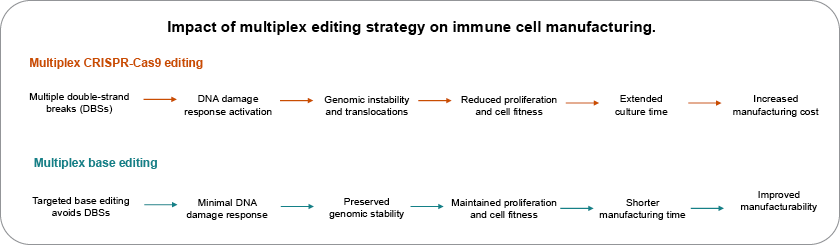
When using double strand break-inducing methods like CRISPR/Cas9 for multi-locus editing, developers commonly encounter:
- Chromosomal translocations between edited loci
- Reduced proliferative capacity
- Increased manufacturing timelines
- More exhausted cells
- Higher cost of goods
- Expanded QC and regulatory burden
Base editing mitigates these risks by preserving genome integrity and cell fitness.
Why do double strand breaks increase risk in multiplex gene editing of immune cells?
Most editing strategies rely on CRISPR-Cas nucleases that introduce DNA double-strand breaks (DSBs). While one cut might be considered manageable, two or more cuts is an entirely different biological event.
In our 2024 Molecular Therapy publication, co-authored with AstraZeneca and Rutgers University, we directly compared four-locus multiplex editing using Cas9 versus a DSB-free base editing approach (The Pin-point™ Platform)1.
When four loci were edited simultaneously using Cas9, chromosomal translocations between target sites were detectable. In fact, modeling suggested that up to 1 in 17–25 diploid cells could carry a translocation event in the final product1.
When the same four loci were edited using a DSB-free multiplex base editing strategy, translocations were undetectable under the same conditions1.
Base editing improves genome stability in multiplex immune cell therapy manufacturing. For a therapeutic developer, that difference is not theoretical. It can affect regulatory risk assessments, release testing burden, deep sequencing requirements, and investor confidence.
This impact isn’t just about T cells or NK cells. In HSC-based therapies, where long-term repopulating cells must maintain genomic integrity, minimizing DSB-induced instability may be particularly important.
How does multiplex CRISPR editing affect T cell expansion and manufacturing timelines?
The impact of multiplex DSB editing doesn’t stop at genome stability, it affects cell fitness.
In the same 2024 study, simultaneous editing at three or four loci using Cas9 impaired T cell proliferation compared to DSB-free base editing1. In a 2025 PNAS study comparing CRISPR/Cas9 nuclease with adenine base editing for quadruple knockout of allogeneic CAR T cells, under prolonged antigenic stimulation in vitro, base-edited CAR T cells maintained higher proliferative capacity and metabolic activity, whereas Cas9-edited cells showed transcriptional signatures of impaired cell cycle progression, DNA repair, and metabolism consistent with reduced functional fitness2.
In preclinical leukemia models, base-edited CAR T cells also demonstrated improved tumor control and extended survival relative to Cas9-edited cells, suggesting that DSB-associated genotoxic stress can translate into meaningful functional disadvantages2.
That matters economically. Manufacturing timelines are largely dictated by expansion kinetics. We’ve seen that switching from sequential Cas9 editing, sometimes considered a valid alternative to simultaneous multiplexing to avoid chromosomal translocations, to base editing can significantly shorten production timelines by days or weeks, which means:
- Less media and cytokine consumption
- Less time occupying cleanroom space
- Less exhausted T cells
- Effectively improving the number of total doses per run.
Even modest expansion penalties compound quickly. If a multiplex DSB strategy reduces effective expansion 2-fold, that can translate into roughly half the number of doses per manufacturing batch, or require additional production runs to meet the same demand. In allogeneic settings, that directly impacts cost of goods and commercial scalability.
For developers trying to shorten vein-to-vein time or scale allogeneic platforms, preserving expansion is not a secondary benefit, it’s a core economic variable.
| Feature | CRISPR/Cas9 | Base Editing |
|---|---|---|
| Double-strand breaks | Yes | Avoided |
| Detectable translocations | Yes | Undetectable1,2 |
| Proliferation potential | Reduced1,2 | Preserved1,2 |
| Anti-tumor performance | Reduced2 | Preserved2 |
| Workflow compatible with lentiviral CAR | Yes | Yes1 |
Can multiplex knockout and CAR integration happen without existing CAR workflow disruption?
Safer editing should not mean more complicated editing.
In the same 2024 publication, we demonstrated:
- Simultaneous multiplex gene knockout
- Concurrent site-specific CAR knock-in
- Use of a single targeting nuclease
- All within a single intervention1
Just as importantly, multiplex base editing can be layered onto existing lentiviral CAR workflows.
CAR transduction by lentivirus was combined with multiplex base editing to generate functional edited CAR-T cells without compromising CAR expression or cytotoxic function1.
In this configuration:
- No HDR-driven integration is required
- No additional DSBs are introduced
- Existing viral manufacturing infrastructure remains intact
This is not a platform reset, it’s a manufacturing risk reduction strategy that can integrate into current processes.
Are multiplex editing bottlenecks limited to T cells?
While demonstrated in primary human T cells, the same biological constraints apply to CAR-NK cells, iPSC-derived immune cell platforms, and edited HSC programs where genome stability and expansion kinetics directly influence manufacturability.
If you are developing next-generation edited immune cell therapies and facing:
- Reduced expansion after multi-locus editing
- Reduced anti-tumor performance
- Increasing translocation signals in deep sequencing
- Mounting QC and regulatory pressure
- Complex sequential editing workflows
It may be time to re-evaluate whether the bottleneck can be solved with base editing. Multiplex engineering does not have to mean compounding DNA damage.
In cell therapy, preserving cell fitness is often the difference between elegant engineering and scalable medicine.
As multiplex engineering strategies evolve, a critical question remains… How many double-strand breaks can your cells tolerate before manufacturability becomes the limiting factor?
Read our literature review on “A breakthrough aptamer-mediated base editing platform for simultaneous knock-in and multiple gene knockout” to learn more.
Frequently asked questions about gene editing in cell therapy.
-
Does CRISPR/Cas9 increase genome instability?
-
Why does CRISPR/Cas9 editing affect T cell expansion and fitness?
-
Why is base editing a safer platform for editing immune cells?
-
Is base editing compatible with existing CAR-T workflows?
-
How is base editing applied in immune cell engineering?
References:
- Porreca, I., et al. “An aptamer-mediated base editing platform for simultaneous knockin and multiple gene knockout for allogeneic CAR-T cells generation”. Molecular Therapy (2024). https://doi.org/10.1016/j.ymthe.2024.06.033
- Engel, N., et al. “Quadruple adenine base-edited allogeneic CAR T cells outperform CRISPR-Cas9-nuclease-engineered T cells.” Proceedings of the National Academy of Sciences (2025). https://doi.org/10.1073/pnas.2427216122
- Aussel, C., Cathomen, T. & Fuster-García, C. The hidden risks of CRISPR/Cas: structural variations and genome integrity. Nat Commun 16, 7208 (2025). https://doi.org/10.1038/s41467-025-62606-z
The Pin-point™ base editing platform technology is available for clinical or diagnostic study and commercialization under a commercial license from Revvity.