
Magnetic beads have emerged as indispensable tools in the development of rapid and highly sensitive diagnostic assays1. Their versatility has been demonstrated in various applications, inc. the extraction of viral RNA during the COVID-19 pandemic, enabling swift and reliable infection detection2, 3, 4, 5. However, the potential of magnetic beads extends far beyond this use case. Among many functionalization available, streptavidin-coated magnetic beads stand out as a cornerstone in molecular testing and immunoassay research immunodiagnostics due to their unique ability to bind biotin with excellent affinity.
This article explores two key examples of their transformative role in research: ribosomal RNA (rRNA) depletion and chemiluminescent immunoassays (CLIAs).
The science behind streptavidin: a molecular source of power
Streptavidin, a tetrameric protein derived from Streptomyces avidinii, exhibits one of the strongest non-covalent interactions known in biology6. Each tetramer binds up to four biotin molecules with remarkable stability, even under harsh conditions such as high salt concentrations, detergents, organic solvents, and elevated temperatures. This robustness makes streptavidin-coated magnetic beads the ideal choice for applications requiring multiple washing and incubation steps. Their reliability and efficiency have positioned them as a go-to solution for researchers, enabling advancements in both molecular and immunoassay workflows.
Example 1: Ribosomal RNA (rRNA) depletion – unlocking the full potential of rna sequencing
In RNA sequencing (RNA-Seq), the presence of rRNA—constituting up to 90 % of total RNA in bacterial cells—poses a significant challenge by overshadowing the detection of messenger RNA (mRNA). To address this, streptavidin-coated magnetic beads offer a highly effective solution through rRNA depletion, leveraging their strong biotin-binding ability.
How it works:
- Biotinylated probes specifically hybridize to rRNA molecules in the sample.
- Streptavidin-coated magnetic beads bind the rRNA-probe complexes.
- A magnetic field is applied to separate the beads, effectively removing rRNA and leaving behind an mRNA-enriched sample.
This approach is widely adopted due to its efficiency, adaptability, and ability to minimize sequencing bias. Compared to enzymatic digestion or selective cDNA synthesis methods, the use of streptavidin beads avoids off-target effects, preserves RNA integrity, and enhances the detection of weakly expressed transcripts7.
Discover Revvity´s solutions with streptavidin-coated magnetic beads - NEXTFLEX RiboNaut rRNA Depletion Kit.
Some of the key applications of rRNA depletion:
- Host response profiling in sepsis analysis: blood samples are typically dominated by globin mRNA and rRNA, requiring effective depletion for accurate analysis.
- Liquid biopsy transcriptomics for cancer research: cell-free RNA is often fragmented and present in low abundance, necessitating rRNA removal to enhance transcriptomic profiling.
- Respiratory pathogen research: rRNA depletion improves the sensitivity of RNA-based assays, enabling the detection of co-infections or novel strains.
- Antimicrobial resistance (AMR) analysis: accelerated workflows, combining RNA extraction and bacterial/human rRNA depletion, reduce turnaround times from days to hours.
The depletion of rRNA not only increases sequencing depth for mRNA but also reduces costs by lowering the need for deep sequencing, making it indispensable for high-throughput RNA-Seq workflows.
Example 2: Chemiluminescent immunoassays (CLIAs) – illuminating diagnostics with precision
CLIAs are highly sensitive techniques that use antibody–antigen interactions coupled to light-emitting chemical reactions to detect biomolecules such as proteins, hormones, and antibodies8. The integration of streptavidin-coated magnetic beads has substantially advanced immunoassay performance by improving analytical sensitivity, specificity, and automation compatibility9,10.
Mechanism of streptavidin–magnetic bead–based CLIAs
Streptavidin-coated magnetic beads function as a solid-phase capture platform that enables efficient immunocomplex formation, magnetic separation, and signal generation in chemiluminescent immunoassays.
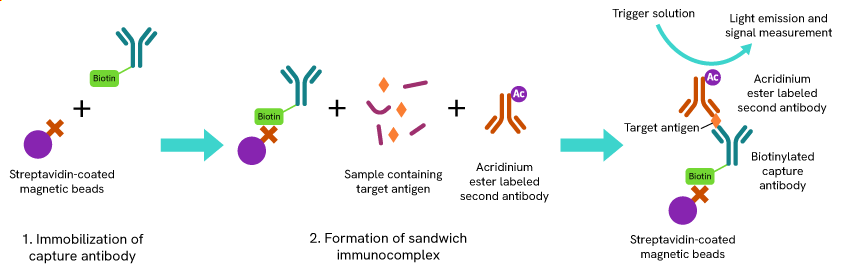
In a typical sandwich CLIA format:
- Immobilization of the capture antibody: streptavidin-coated magnetic beads bind high-affinity biotinylated capture antibodies (or analyte-specific probes) via the strong biotin–streptavidin interaction, creating a stable solid-phase surface.
- Formation of the sandwich immunocomplex: upon addition of the sample, the target analyte binds to the immobilized capture antibody. A second detection antibody, labeled with a chemiluminescent tag (e.g., acridinium ester or an enzyme such as horseradish peroxidase), subsequently binds to a different epitope on the analyte, forming a sandwich complex.
- Magnetic separation and washing: application of a magnetic field enables rapid and efficient separation of bead-bound complexes from unbound components. Washing steps remove excess detection reagents and nonspecific material, thereby improving signal-to-noise ratio.
- Chemiluminescent signal generation: upon addition of a trigger solution, the chemiluminescent label undergoes a light-emitting reaction. The emitted photons are measured by a luminometer, and the signal intensity is proportional to the analyte concentration.
Figure 1: Example overview of a sandwich chemiluminescent immunoassay, where streptavidin-coated magnetic beads play a major role by providing a solid support for the formation of the immunocomplex and making the process easier to automate.
Applications of CLIAs in research:
- Hormone assays: reliable quantification of hormones like insulin or thyroid markers.
- Tumor marker assays: early detection and monitoring of cancer biomarkers.
- Infectious disease research assays: robust detection of viral or bacterial antigens.
- Therapeutic drug monitoring: specific measurement of drug levels in human samples.
The use of magnetic beads in CLIAs streamlines assay workflows, reduces hands-on time, and enables consistent results, making them a preferred choice in research laboratories worldwide.
Wrapping up
Streptavidin-coated magnetic beads are not just tools—they are enablers of scientific progress, unlocking new possibilities in research. Magnetic separation facilitates rapid isolation of target-bound complexes from complex biological matrices, reducing background noise and improving signal-to-noise ratios. These properties make streptavidin-coated magnetic beads highly versatile across applications such as nucleic acid extraction, next-generation sequencing library preparation, immunoassays, pathogen detection, and liquid biopsy research workflows.
Their compatibility with automation and high-throughput platforms has further solidified their role in modern molecular testing and their overall capabilities promise to continue playing a significant role in future research and development efforts.
References:
- Chircov, C., Grumezescu, A. M., & Holban, A. M. (2019). Magnetic particles for advanced molecular diagnosis. Materials, 12(13), 2158.
- Huergo, L. F., Selim, K. A., Conzentino, M. S., Gerhardt, E. C., Santos, A. R., Wagner, B., ... & Forchhammer, K. (2021). Magnetic bead-based immunoassay allows rapid, inexpensive, and quantitative detection of human SARS-CoV-2 antibodies. ACS sensors, 6(3), 703-708.
- Zhong, J., Roesch, E. L., Viereck, T., Schilling, M., & Ludwig, F. (2020). Rapid and sensitive detection of SARS-CoV-2 with functionalized magnetic nanoparticles. arXiv preprint arXiv:2010.03886.
- Heng, F., Magaret, C. A., Rouphael, N. G., Branche, A. R., Fong, Y., Carpp, L. N., ... & Study, C. V. I. L. T. C. (2026). The neutralizing antibody titer correlate of COVID-19 risk in the COVID-19 variant immunologic landscape (COVAIL) trial was not modified by SARS-CoV-2 amino acid sequence distances. Vaccine, 76, 128348. analysis in 2023–2024. PLoS One, 19(11), e0313927.
- Luong, J. H., & Vashist, S. K. (2019). Chemistry of biotin–streptavidin and the growing concern of an emerging biotin interference in clinical immunoassays. ACS omega, 5(1), 10-18.
- Wahl, A., Huptas, C., & Neuhaus, K. (2022). Comparison of rRNA depletion methods for efficient bacterial mRNA sequencing. Scientific Reports, 12(1), 5765.
- Zhang, L., Zhao, P., Liu, Y., Shi, N., Zhou, Y., Peng, S., ... & Luo, L. (2025). Detection of TNF-α using the established ab-MPs-CLIA. Talanta, 285, 127301.
- Shen, W., Xuan, Z., Liu, H., Huang, K., Guan, X., & Guo, B. (2024). A magnetic beads-based sandwich chemiluminescence enzyme immunoassay for the rapid and automatic detection of Lactoferrin in milk. Foods, 13(6), 953.
- Fernandes, G., Katarni, M., Ali, S., Abhyankar, V., & Nagar, S. R. (2025). A Review of Enzyme Linked Immunoabsorbent Assay (ELISA) and Chemiluminescence Immunoassay (CLIA) Technologies. Journal of Pathology Research Reviews & Reports. SRC/JPR-201. DOI: doi. org/10.47363/JPR/2025 (7), 182, 2-5.
For research use only. Not for use in diagnostic procedures.