
Base editing is rapidly emerging as a powerful approach for therapeutic genome editing, with the potential to precisely correct or introduce disease-relevant genetic variants without creating double-strand DNA breaks. Realizing that potential in vivo requires editing platforms that can pair high activity with effective, transient delivery. Here, we asked whether the modular Pin-point™ base editing platform could achieve high-efficiency in vivo editing following lipid nanoparticle (LNP) delivery at modest total RNA doses.
Key takeaways:
- 64-70% whole-liver A>G editing achieved at 1 mg/kg total RNA
- High-efficiency in vivo editing following a single systemic LNP administration
- Performance falls within the high-efficiency range of published in vivo ABE-LNP studies without the use of highly modified RNAs
- The modular, three-component Pin-point base editing system is compatible with efficient systemic RNA delivery
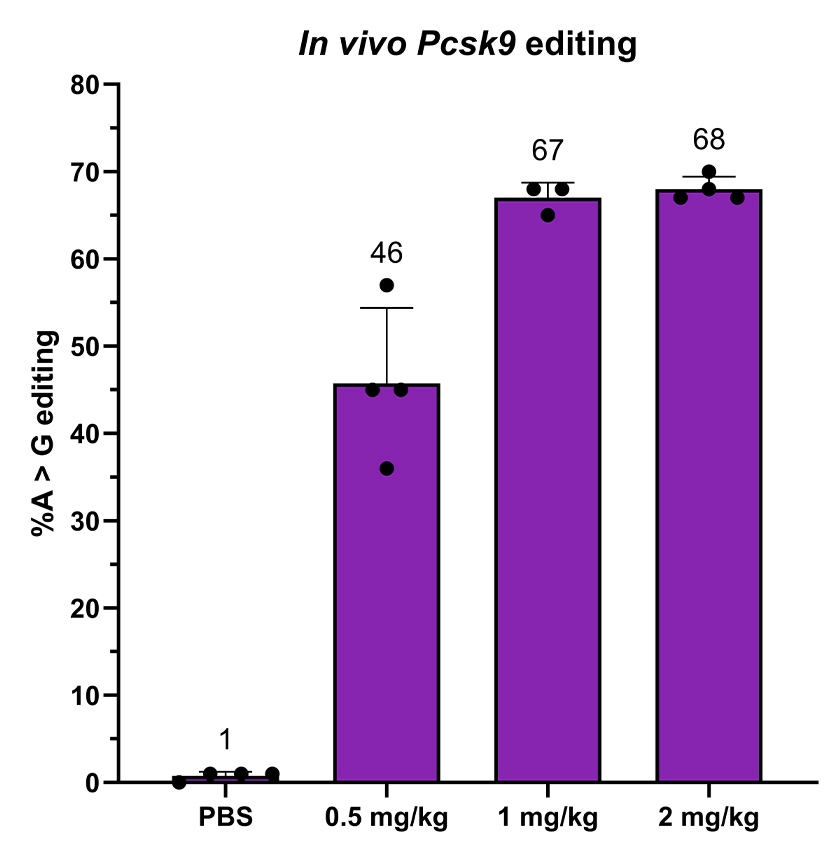
New data from our team at Revvity demonstrate efficient in vivo adenine base editor (ABE) activity with the Pin-point base editing platform following systemic LNP delivery. A single intravenous administration of LNP-formulated Pin-point platform components achieved 64–70% whole-liver A>G editing at a total RNA dose of 1 mg/kg, with similarly high editing observed at 2 mg/kg. Editing remained dose-responsive at lower exposure, with approximately 45% editing at 0.5 mg/kg.
High-efficiency in vivo editing following a single systemic LNP administration. LNPs encapsulating all three Pin-point ABE-flex editor components (nCas9 mRNA, ABE-flex deaminase, and sgRNA targeting Pcsk9) at a 4:1:4 mass ratio were systemically injected into mice at 0.5, 1, or 2 mg/kg total RNA. After 7 days whole liver editing was analyzed by Sanger sequencing.
High-efficiency in vivo editing with room for further optimization
Published in vivo ABE LNP studies provide useful context for the level of editing observed with the Pin-point platform. In landmark studies targeting Pcsk9 Musunuru and colleagues demonstrated approximately 45% editing at 0.05 mg/kg and approached 70% editing at higher doses using an ABE8.8-m editor delivered as highly modified guide RNAs and N1-methylpseudouridine mRNA in a proprietary Acuitas LNP1. In a similar 2021 study, Rothgangl and colleagues reported approximately 4%, 13% and 51% editing following single total RNA doses of 1, 1.5, and 3 mg/kg, respectively, using an ABEmax
Tad7.10 editor delivered as highly modified guide RNAs and N1-methylpseudouridine mRNA in a proprietary Acuitas LNP; a second 3 mg/kg redose increased editing to approximately 67%2. Together, these studies helped establish the potential for LNP-delivered base editing to achieve high levels of editing in the liver.
Against this landscape, the results with the Pin-point platform are encouraging. Approximately 45% editing was achieved at 0.5 mg/kg and 64-70% editing was achieved at 1 mg/kg using a Pin-point ABE-flex editor delivered as 2'-O-methyl/phosphorothioate end protected guide RNAs, and 5-methoxyuridine modified mRNA in a proprietary Millipore Sigma LNP.
These data place the Pin-point system within the high-efficiency range of these published in vivo ABE LNP systems, notably without extensive gRNA engineering or mRNA modifications.
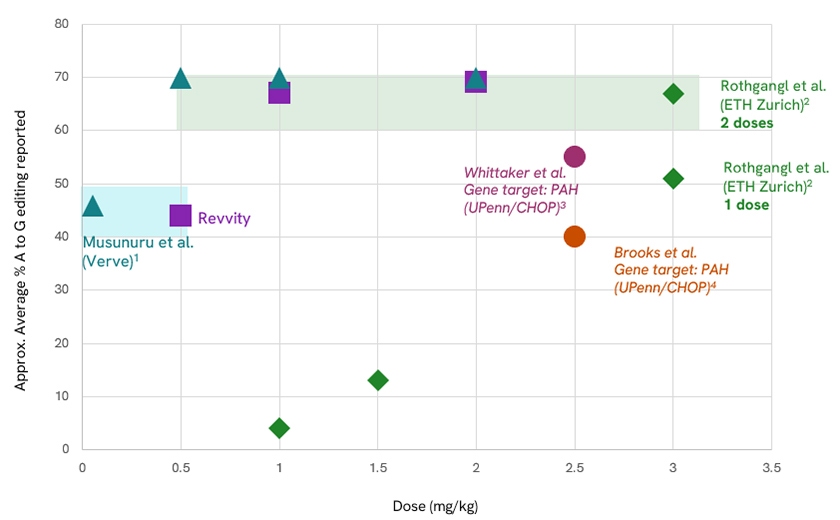
The modular Pin-point base editing system performs comparably to previously published ABE LNP studies. Cross-study context only. Editing efficiency is influenced by target, guide, editor and LNP formulation; studies are not head-to-head comparisons. Colored boxes indicate target editing efficiency and dose ranges for comparison to published studies.
Published work also suggests there may be opportunities to further optimize RNA components for in vivo performance. Whittaker and colleagues showed that engineering hybrid guide RNAs could increase on-target ABE editing to approximately 50-60% at the same dose, alongside improvements in editing specificity for the PAH gene target in liver compared to earlier stuides3,4.
Differences in targets, editors, LNP formulations and experimental designs mean these studies are not direct head-to-head comparisons. However, together they provide an important benchmark for the level of in vivo editing activity achievable with current ABE LNP approaches and demonstrate that the Pin-point platform performs strongly within that landscape.
These results extend previous work demonstrating LNP delivery of Pin-point platform components to human T cells and HSCs ex vivo and provide a foundation for exploring LNP-enabled base editing with the Pin-point platform across additional targets and therapeutic applications. View our ASGCT poster.
Interested in evaluating the Pin-point platform for your gene editing program?
Explore the Pin-point base editing platform or contact our team.
The Pin-point base editing platform technology is available for clinical or diagnostic study and commercialization under a commercial license from Revvity.
References:
- Musunuru K, Chadwick AC, Mizoguchi T, et al. “In vivo CRISPR base editing of PCSK9 durably lowers cholesterol in primates.” Nature (2021). DOI: 10.1038/s41586-021-03534-y
- Rothgangl T, Dennis MK, Lin PJC, et al. “In vivo adenine base editing of PCSK9 in macaques reduces LDL cholesterol levels.” Nature Biotechnology (2021). DOI: 10.1038/s41587-021-00933-4
- Whittaker MN, Testa LC, Quigley A, et al. “Improved specificity and efficiency of in vivo adenine base editing therapies with hybrid guide RNAs.” Nature Biomedical Engineering (2025). DOI: 10.1038/s41551-025-01545-y
- Brooks DL, Carrasco MJ, Qu P, et al. “Rapid and definitive treatment of phenylketonuria in variant-humanized mice with corrective editing.” Nature Communications (2023). DOI: 10.1038/s41467-023-39246-2