
CRISPR applications have expanded beyond conventional CRISPR-based knockout with the ability to activate (CRISPRa) or interfere (CRISPRi) with the transcription of genes by coupling deactivated Cas9 (dCas9) to transcriptional activators or repressors. Researchers can modulate gene expression in addition to eliminating gene products through knockout, allowing the study of gene function and cellular dynamics with greater flexibility.
However, most existing systems fail to provide researchers with the ability to precisely regulate the timing and magnitude of CRISPR-mediated transcriptional modulation and knockout, meaning researchers are limited in their ability to knockout or modulate essential genes, or, precisely deconvolute complex gene interactions. This limitation can confound experiments that depend on strict timing or require transient activation or silencing events.
Why temporal control is critical for CRISPR applications
The ability to control when and the degree to which a gene is activated or silenced, and not just whether it is “on” or “off”, is critical for understanding dynamic biological processes. Cellular pathways are often transient and highly time-dependent, meaning researchers need to distinguish between the immediate, direct effects of gene modulation and secondary changes that occur later. Without temporal control, this distinction can become blurred, leading to misinterpretation of results or outright inability to study a gene.
Precise timing and control of induction magnitude also prevents prolonged perturbation of essential genes, which could trigger unwanted stress responses or adverse effects, particularly in sensitive experimental systems such as stem cells or primary cultures.
While methods like the Tet-On 3G tetracycline-inducible system are commonly used to regulate transgene expression, these systems can exhibit leakiness when paired with powerful activators such as dCas9-VPR. In these cases, even low levels of background expression can lead to unintended gene activation, compromising experimental precision. In the case of CRISPR knockout, which is irreversible, any leakiness causes unintended knockout.
How Strict-R™ solves the problem
The Dharmacon™ Strict-R™ Inducible CRISPRa Lentiviral System overcomes these challenges by employing a dual-regulation mechanism that integrates both transcriptional and post-translational control of gene expression. By utilizing two highly cell-permeable small molecules, doxycycline and Shield1, the system allows researchers to achieve precise and tunable control over gene activation.
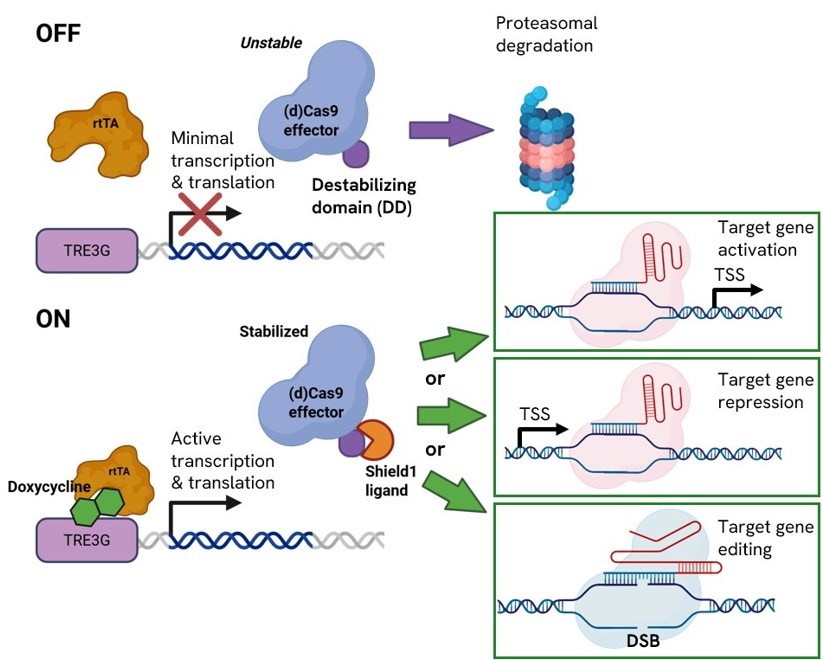
The system operates in two defined states: off and on (Figure 1).
System off: In the absence of doxycycline and Shield1, the system remains inactive. Any residual transcription from the TRE3G promoter produces degron-tagged dCas9-VPR, which undergoes rapid proteasomal degradation. This mechanism minimizes any unintended background activation and ensures the system stays silent.
System on: When doxycycline is added, it activates the Tet-On 3G transactivator, driving robust dCas9-VPR transcription (transcriptional control). Simultaneously, the addition of Shield1 stabilizes the expressed dCas9-VPR protein (post-translational control), allowing its accumulation and enabling precise gene activation. The concentration of Shield1 added to the system directly impacts the magnitude of gene activation.
Together, these two regulatory layers minimize unwanted background leakiness, providing researchers with tight, reversible, and on-demand control of gene expression.
Figure 1: Transcriptional and post-translational control with the Strict-R Inducible Lentiviral CRISPR Systems.
Additional Strict-R systems
The Strict-R Inducible portfolio extends beyond CRISPRa, with the newly introduced Strict-R inducible CRISPRi and Cas9 (CRISPR knockout) systems bringing the same level of precision to gene silencing and knockout applications.
For gene editing workflows, the Strict-R inducible Cas9 system can be paired with Dharmacon Edit-R™ predesigned single guide RNAs (sgRNAs), which are optimized for targeted DNA cleavage. Similarly, the Strict-R inducible CRISPRi system is compatible with Dharmacon CRISPRmod CRISPRi sgRNAs for gene silencing, ensuring researchers have access to a complete toolkit for their experimental needs.
Watch our on-demand webinar to see how Dharmacon™ Strict-R™ systems are transforming CRISPR research. Our experts explain the technology in detail, showcase real-world applications, and offer practical guidance for integrating these tools into your experiments.