
From imaging phenotypes to molecular mechanisms
High-content screening (HCS) and functional genomic screening increasingly combine imaging-based phenotyping with transcriptomic profiling. Cell Painting and related imaging assays generate rich morphological signatures rapidly and at low per-well cost, making them powerful tools for identifying phenotypic hits across large perturbation libraries1.
However, morphology alone cannot always distinguish compounds that produce similar cellular phenotypes through different mechanisms. Nor can it reliably connect an imaging phenotype to the specific pathways or regulatory programs involved. Transcriptomic profiling provides the molecular context needed to interpret these phenotypes and assign mechanism of action2.
The next practical question is which transcriptomic assay to deploy once imaging hits have been identified. The two MERCURIUS™ workflows offered by Revvity (DRUG-seq and Total DRUG-seq) provide complementary solutions optimized for different levels of transcriptomic resolution. Selecting the appropriate assay is therefore important. Using a method with insufficient resolution can miss key biological signals, while unnecessarily deep profiling adds cost without improving interpretability. This guide outlines when each approach is most appropriate.
Two complementary transcriptomic readouts
MERCURIUS™ DRUG-seq
MERCURIUS™ DRUG-seq is a 3′ end poly-A mRNA sequencing method built on the principle of sample multiplexing before library preparation. Cells are lysed directly in-plate, barcoded individually, pooled into a single tube, and carried through reverse transcription with a high-yield enzyme, enabling massively multiplexed library preparation directly from cell lysates. The result is a streamlined workflow designed for high-throughput gene-expression profiling across large perturbation sets3.
At ~2 million reads per sample, DRUG-seq typically detects ~15,000–18,000 expressed genes depending on cell type. At higher sequencing depths (e.g., 7–10 million reads per sample), gene-level expression estimates show strong concordance with conventional bulk RNA-seq for differential expression analysis. Because samples from each 96- or 384-well plate are pooled early in the workflow, library preparation and sequencing are performed on a single combined sample rather than on individual wells. This design substantially reduces reagent consumption and sequencing overhead on a per-sample basis as the number of samples increases.
As a result, DRUG-seq is particularly well suited for experiments involving hundreds to thousands of perturbations, including compound screening campaigns, arrayed CRISPR libraries, and large-scale toxicogenomic studies3.
MERCURIUS™ Total DRUG-seq
Total DRUG-seq retains the extraction-free, massively multiplexed workflow of DRUG-seq but extends sequencing coverage beyond polyadenylated transcripts to profile total cellular RNA. Instead of capturing only the polyadenylated 3′ tail, Total DRUG-seq generates libraries across fragmented total RNA, enabling detection of coding and non-coding RNA species within the same assay.
The additional resolution supports analysis of splicing variants, alternative promoter usage, fusion transcripts, long non-coding RNAs (lncRNAs), circular RNAs, and other non-polyadenylated RNA species. These features are invisible to 3′ sequencing but are relevant in a growing set of drug mechanisms, particularly those targeting RNA processing machinery, splicing modulators, or epigenetic regulators whose primary readout manifests in isoform ratios rather than raw gene counts.
Both assays are compatible with 96- and 384-well plate formats. Crucially, both workflows can be performed from frozen cell plates, meaning they can fit sequential imaging-plus-transcriptomics designs when the upstream imaging workflow preserves material for downstream lysis (Table 1).
| Parameter | MERCURIUS™ DRUG-seq | MERCURIUS™ Total DRUG-seq |
|---|---|---|
| Coverage | 3′ end of polyadenylated mRNA transcripts | Full-length, total RNA (coding + non-coding) |
| Isoform resolution | Not applicable | Splicing variants, alt. promoters, fusion genes |
| Non-coding RNA | Limited to poly-adenylated transcripts (e.g., some lncRNAs) | lncRNA, circRNA, pre-mRNA and other non-polyadenylated RNAs captured |
| RNA extraction | Not required | Not required |
| Reads/sample | 1–2 M | 2–5 M |
| Cost per sample | Lower per sample at large scale | Moderate (deeper sequencing) |
Table 1. Side-by-side comparison between MERCURIUS™ DRUG-seq and Total DRUG-seq. Read depth indicated is the recommended to detect 15,000-18,000 genes.
When DRUG-seq is enough
For the majority of HCS follow-up scenarios, 3′ DRUG-seq provides sufficient resolution to confirm hits, rank compound series, and infer mechanisms of action. The situations that favor DRUG-seq include:
- Large perturbation libraries. DRUG-seq is optimized for experiments involving hundreds to tens of thousands of perturbations. Early pooling and multiplexed library preparation enable efficient profiling of very large sample sets at moderate sequencing depth.
- Gene expression–based MoA profiling. When the primary question is which transcriptional programs are activated or suppressed, gene-level expression profiles across thousands of genes are sufficient to generate compound signatures, cluster perturbations by mechanism, and compare profiles with reference resources such as the Connectivity Map4.
- CRISPR and RNAi arrayed screens. Functional genomics screens that perturb one gene per well and measure downstream transcriptional responses are natural DRUG-seq applications. Gene-count matrices derived from 3′ sequencing provide robust statistical power for pathway-level phenotypes at relatively low sequencing depth.
- Confirmation and triage of imaging hits. Morphological outliers identified by Cell Painting can be rapidly characterized by DRUG-seq profiling of the same plate. If the resulting transcriptional signature aligns with a known mechanism or pathway, the hit can be prioritized; if the signature is dominated by general stress or cytotoxicity signals, it can be deprioritized early.
- Large-scale toxicogenomic profiling. Dose-dependent transcriptional responses in stress pathways, metabolic enzymes, and cell-cycle regulators are readily captured by 3′ RNA-seq. DRUG-seq provides a practical approach for generating toxicity signatures across large compound panels.
When you need Total DRUG-seq after imaging
Some biological questions cannot be resolved through 3′ gene counting alone. Total DRUG-seq becomes valuable when the relevant signal lies in transcript structure or in RNA species that are under-represented in poly-A–based assays.
- Imaging hits suggest RNA splicing or isoform switching. Compounds targeting the spliceosome (e.g., SF3B inhibitors or splicing modulators) or RNA-binding proteins can produce imaging phenotypes such as nuclear speckle redistribution or stress granule formation. While 3′ RNA-seq captures downstream gene-expression changes, it does not directly quantify exon usage or alternative splice-site selection. Total DRUG-seq enables transcript-level analysis of these events from the same lysate.
- Non-coding RNA biology is central to the hypothesis. Long non-coding RNAs, enhancer RNAs, and circular RNAs regulate many biological processes, particularly in oncology and chromatin biology. Because 3′ RNA-seq mainly captures polyadenylated transcripts, some of these RNA classes are under-represented. Total RNA profiling broadens coverage to coding and non-coding transcripts, enabling analysis of regulatory RNA populations linked to chromatin and epigenetic phenotypes.
- Fusion transcripts are a key biological readout. In oncology models containing fusion drivers such as EML4-ALK or BCR-ABL, the fusion transcript itself can serve as a pharmacodynamic biomarker. Because fusion junctions typically occur upstream of the 3′ end, they are difficult to detect using 3′ counting approaches. Total DRUG-seq enables detection and quantification of fusion transcripts across screening plates.
- Alternative promoter usage affects the target gene. Genes with multiple transcription start sites (such as VEGFA orTP53) can produce isoforms with distinct biological functions. If a perturbation alters promoter usage rather than overall transcription, 3′ gene counts may show little change. Total DRUG-seq enables transcript-level analysis that reveals these regulatory shifts.
- Deep mechanistic characterization of prioritized hits. After a large screening campaign identifies promising compounds, deeper molecular characterization is often required before advancing candidates. Total DRUG-seq provides transcript-level resolution like conventional RNA-seq while retaining the multiplexed workflow used in DRUG-seq screens, allowing multiple compounds, doses, and time points to be profiled in parallel.
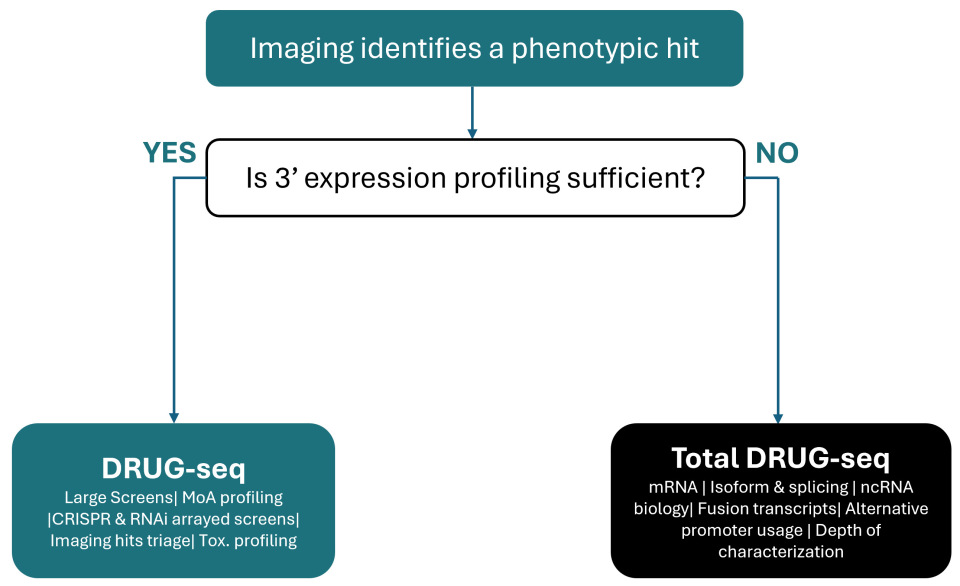
Figure 1. Decision tree for selecting DRUG-seq or Total DRUG-seq following imaging-based phenotypic screening.
MERCURIUS™ DRUG-seq and Total DRUG-seq address different levels of transcriptomic resolution. DRUG-seq enables scalable gene-level expression profiling across thousands of samples, making it well suited for primary screens, hit triage, and mechanism-of-action studies. Total DRUG-seq extends this approach to transcript-level analysis and broader RNA classes when deeper mechanistic insight is required.
For many imaging-plus-transcriptomics studies, the most practical strategy is sequential: DRUG-seq for large-scale screening and Total DRUG-seq for a focused subset of prioritized perturbations. Because both workflows can use frozen lysates from the same imaged plates, this approach can be implemented without repeating the experiment.
When imaging phenotypes cannot be explained by gene-level expression changes alone, Total DRUG-seq provides the additional transcriptomic resolution needed to interpret them, helping ensure screening campaigns generate actionable biological insight rather than simply large datasets.
References:
- Bray, M.A., et al. (2016). Cell Painting, a high-content image-based assay for morphological profiling using multiplexed fluorescent dyes. Nat Protoc. 11(9):1757-74. doi: 10.1038/nprot.2016.105.
- Chandrasekaran, S.N., et al. (2024). Three million images and morphological profiles of cells treated with matched chemical and genetic perturbations. Nat Methods. 21(6):1114-1121. doi: 10.1038/s41592-024-02241-6.
- Ye, C., et al. (2018). DRUG-seq for miniaturized high-throughput transcriptome profiling in drug discovery. Nat Commun. 9(1):4307. doi: 10.1038/s41467-018-06500-x.
- Subramanian, A., et al. (2017). A Next Generation Connectivity Map: L1000 Platform and the First 1,000,000 Profiles. Cell. 171(6), 1437–1452.e17 (2017). doi:10.1016/j.cell.2017.10.049.