

Clinical genomics is reaching an inflection point: the whole genome sequencing (WGS) market is projected to grow from 3 billion to over 9 billion by 2030, while long-read sequencing is solving 15-40 % of previously undiagnosable cases by detecting structural variants that short-read WGS misses1.
Third-generation sequencing technologies like Oxford Nanopore and PacBio HiFi sequencing have revolutionized our ability to resolve complex genomic regions. The improved accuracy (95 - 99.9 %) and declining costs of these technologies have increased their adoption by healthcare systems in the areas of rare diseases, oncology, and carrier screening. Numerous population-scale studies have also incorporated long-read methods to provide more reliable, actionable genomic data to improve precision medicine and health outcomes across diverse populations.
However, realizing the full potential of these platforms critically depends on high-quality sample preparation. Fragmented DNA limits read lengths, defeating the very purpose of these technologies. High molecular weight (HMW) DNA, defined as intact DNA fragments exceeding 50 kb, is essential for providing accurate reads of > 10 kb performed in long-read sequencing (LRS). This blog post describes how you can achieve optimal long-read sequencing results in a rapid, automated, and cost-efficient manner.
The challenge: extraction and preservation
DNA is surprisingly fragile. Mechanical shearing from pipetting, physical agitation, heating, enzymatic degradation from nucleases, and chemical damage from improper storage can quickly fragment HMW DNA into unusable pieces.
Best practices for sample collection:
- Use sample collection tubes that inhibit nucleases (e.g. K2EDTA, K3EDTA)
- Avoid heparin tubes which can inhibit downstream enzymatic reactions
- During transport, avoid excessive physical agitation or long-term storage at warm temperatures
- Process samples within 24-48 h of collection or freeze until analysis, avoiding freeze-thaw cycles
- Avoid vortexing or excessive pipetting and perform mixing by gentle inversion of tubes
- Gently handle samples with wide-bore pipette tips
- Ensure sufficient sample input to obtain enough yields for downstream assay (1 ml of blood typically yields around 20 – 50 µg of DNA)
Extraction tips:
- Avoid the use of columns – these would shear DNA/RNA to < 10 kb
- Avoid heated lysis or elution steps
- Choose extraction methods that gently handle samples, excessive physical agitation should be avoided
- Perform extraction in large batches, ideally with automation, to enhance consistency and reproducibility
- To enrich for long fragments, perform an optional size selection step to remove < 10 kb fragments
- Shearing isolated HMW DNA to ~20 kb fragments can help increase long-read sequencing efficiency (increases flow cell longevity for ONT and increases efficiency of SMRTbell adapter ligation for PacBio)
Revvity’s chemagic™ extraction technology automates the extraction of HMW DNA at fast run-times with standard chemagic extraction kits on chemagic instruments. The proprietary M-PVA Magnetic Beads with gentle chemagic separation technology has proven superior to other automated platforms in isolating higher yields of HMW DNA with fewer hands-on steps.2 This not only avoids laborious manual sample processing steps but has helped biobanks and genetic testing labs achieve a consistent, high quality of nucleic acids at scale, suited for present and future day challenging assays.
Revvity’s chemagic HMW DNA extraction was also found to work with archived blood samples, with samples collected in 2014 working for PacBio HiFi long-read sequencing performed in 2024.3
Figure 1. chemagic separation technology gently but efficiently resuspends magnetic particles, avoiding DNA fragmentation. Movement of beads instead of liquids avoids pipetting and lowers sample cross-contamination risk.
Further protocol modifications for long-read sequencing such as a size selection step and controlled HMW DNA fragmentation have shown to improve sequencing outcomes.4 Scientists from University Medical Centre Ljubljana performed the below workflow achieving N50 values > 30 kb and total yields surpassing 100 Gb per Oxford Nanopore flow cell with the chemagic 360 instrument.
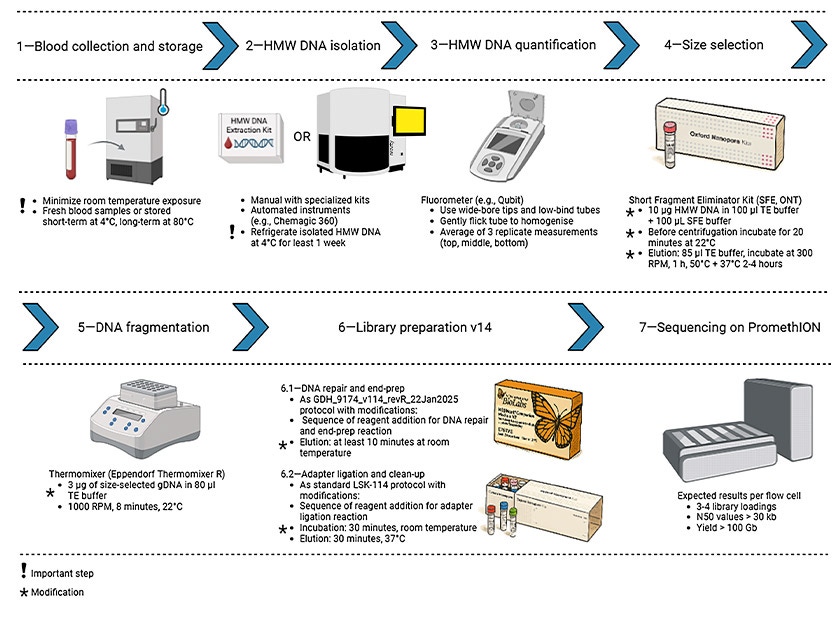
Figure 2: Protocol overview from Mikec S et al. 2025, Modified Oxford Nanopore ligation-based whole-genome sequencing from human blood: simplified fragmentation and enhanced N50 and yield (Protocol.io)
Prior to running long-read sequencing, it is critical to analyze DNA integrity to ensure a high quality of sequencing data. Longer, more intact DNA fragments will aid genetic resolution and improve the reliability of genome assembly. Capillary electrophoresis systems are often used to size DNA, and depending on the sample material, a major peak > 50 kb should typically be seen after HMW DNA extraction (Fig 3.), It is important to choose a system that can resolve HMW DNA.
The Agilent® Femto Pulse™ system resolves fragments > 165 kb while other systems may offer lower sizing limits and less sensitivity.
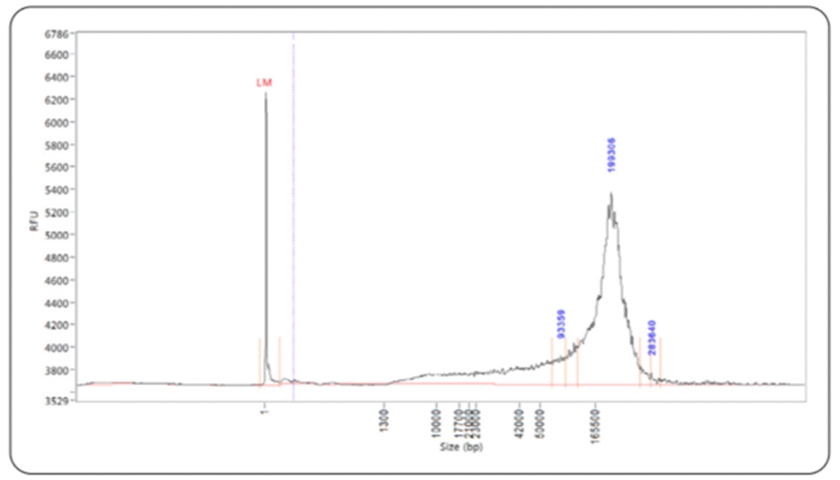
Figure 3. DNA is not degraded during extraction. DNA was extracted from 4 mL samples of whole blood using the chemagic 360 instrument and diluted 1:1000 for analysis of molecular weight using an Agilent® Femto Pulse™ system.
If size selection or shearing are incorporated, DNA lengths should also be analyzed after these processes to ensure a tight distribution around ~20 kb, which is ideal for long-read sequencing platforms. Yields and purity values should also meet the requirements of the chosen long-read sequencing assay. Visual inspection of eluates is advised as reddish eluates may indicate hemoglobin carryover which can inhibit PCR.
As research questions become more sophisticated, from understanding complex structural variations in cancer genomes to assembling complete genomes of non-model organisms, the demand for HMW DNA will only intensify. Investing in proper extraction methods and quality control upfront saves time, resources, and frustration downstream.
For researchers embarking on long-read sequencing projects, genome assembly efforts, or structural variation studies, HMW DNA is not just important, it is necessary. The integrity of your extracted DNA today determines the quality of your discoveries tomorrow.
Click here to learn more about automated HMW DNA extraction.
For research use only. Not for use in diagnostic procedures.
References :
- del Gobbo, G. F., & Boycott, K. M. (2025). The additional diagnostic yield of long-read sequencing in undiagnosed rare diseases. Genome Research, 35(4), 559–571. https://doi.org/10.1101/gr.279970.124
- Application Note: Comparison of Automated Nucleic Acid Purification Systems on High Molecular Weight (HMW) DNA Extraction Efficiency. https://www.revvity.com/sg-en/content/comparison-automated-nucleic-acid-purification-systems-hmw-dna-extraction-efficiency
- Webinar: Automated DNA isolation for Long-read NGS – One isolation for multiple assays https://www.revvity.com/sg-en/content/unleashing-power-genomics-webinar-review
- Mikec, S., Tesovnik, T., Šket, R., Mužina, K., Slapnik, B., & Kovac, J. (2025). Modified Oxford Nanopore ligation-based whole-genome sequencing from human blood: simplified fragmentation and enhanced N50 and yield v1. https://doi.org/10.17504/protocols.io.8epv5o8nng1b/v1
Revvity is a trademark of Revvity, Inc. All other trademarks are the property of their respective owners.