
Solid Phase Reversible Immobilization (SPRI) has become a standard approach for nucleic acid purification in molecular biology and next-generation sequencing (NGS) workflows. The technology combines paramagnetic beads with carefully controlled chemical conditions to capture nucleic acids, separate them from contaminants, and release them for downstream use.
One of the advantages of SPRI technology is its versatility. The same basic chemistry can be used for routine DNA cleanup or, by adjusting reaction conditions, to influence which fragment sizes are recovered.
What are SPRI beads?
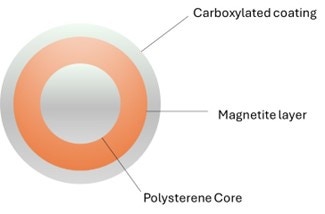
SPRI beads are paramagnetic particles with surfaces that support reversible nucleic acid binding under appropriate buffer conditions. Because the particles are magnetic in the presence of a magnetic field, DNA bound to the beads can be immobilized against the wall of a tube or plate while unwanted components are removed.
After washing, the DNA can be released from the beads using water or a low-salt elution buffer.
This bind, wash, and elute workflow provides a simple way to purify DNA without centrifugation or column-based purification and is readily adaptable to both manual and automated workflows.
Figure 1. Simplified schematic of a carboxyl-functionalized paramagnetic bead used in SPRI-based purification.
How does DNA bind to SPRI beads?
Nucleic acid binding in a SPRI reaction is driven largely by the combination of polyethylene glycol (PEG) and salt.
In SPRI reactions, PEG and salt create conditions that reduce DNA solubility and promote reversible association of nucleic acids with the bead surface. Changes in these conditions also affect how efficiently fragments of different sizes are recovered.
The binding is reversible. When PEG and salt are removed during washing and the beads are placed in an appropriate elution buffer, DNA returns to solution.
The chemistry also helps explain why SPRI purification can be used for more than simply separating DNA from other reaction components. DNA fragments of different lengths do not respond identically to changing PEG and salt conditions.
Why bead-to-sample ratio matters
In a given SPRI bead formulation, changing the volume of bead suspension added to a sample also changes the amount of binding solution introduced into the reaction.
This is commonly expressed as the bead-to-sample ratio. For example, adding 25 µL of beads to 25 µL of sample produces a 1.0X ratio, while adding 25 µL of beads to 50 µL of sample produces a 0.5X ratio.
At lower ratios, binding conditions favor recovery of larger DNA fragments while a greater proportion of smaller fragments remains in solution. As the ratio increases, progressively smaller DNA fragments can also be recovered.
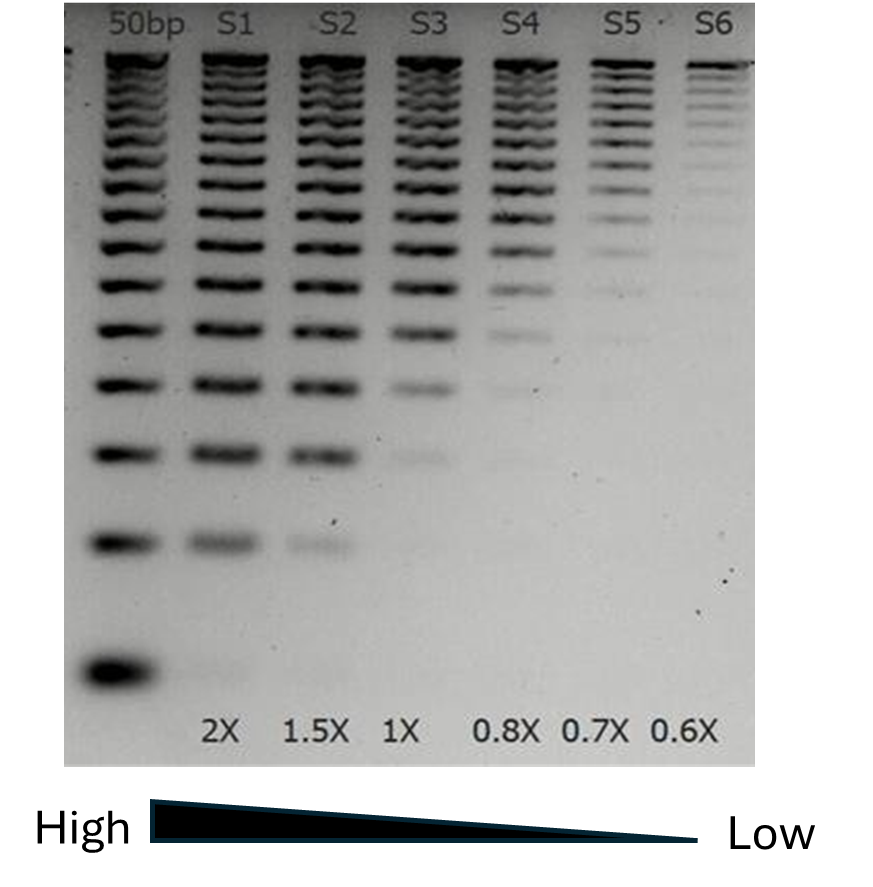
Figure 2. Effect of bead-to-sample ratio on DNA fragment recovery. A fixed amount of a 50-bp DNA ladder was purified using NEXTFLEX™ NGS Cleanup Beads at bead-to-sample ratios ranging from 2.0X to 0.6X. Under these conditions, decreasing the bead ratio progressively reduced recovery of smaller DNA fragments.
The relationship is useful, but a bead ratio should not be viewed as a universal fragment-size cutoff. Recovery can also be affected by factors such as the bead formulation, sample composition, DNA concentration, fragment distribution, and other components carried into the cleanup reaction.
SPRI beads for DNA cleanup
In many NGS workflows, SPRI beads are used primarily for DNA purification. After enzymatic reactions such as end repair, adapter ligation, or PCR, SPRI beads can be used to recover the desired DNA while removing salts, enzymes, primers, nucleotides, and other reaction components that could interfere with subsequent steps.
Bead-to-sample ratio can also influence library recovery during cleanup. A ratio that is too low for a particular library may leave some desired fragments in the supernatant, reducing yield. Increasing the ratio generally broadens fragment recovery, although it may also retain more small DNA species.
For validated library preparation workflows, the specified bead ratio should be followed unless the protocol is being intentionally modified.
Using SPRI beads for size selection
The fragment-dependent nature of SPRI binding can also be used when control over DNA size distribution is needed.
A single-sided selection can use a defined bead ratio to separate larger fragments from smaller DNA species. More complex workflows can use sequential bead ratios to establish both upper and lower boundaries around a desired fragment population.
This approach can be used to remove small fragments, adapter dimers, or unwanted high-molecular-weight DNA from a library.
However, size selection is only one application of SPRI chemistry. In many NGS protocols, the goal of the bead step is simply efficient cleanup and recovery of the library rather than creation of a narrowly defined fragment distribution.
Selecting the right bead ratio
There is no single bead-to-sample ratio that is optimal for every application.
When working within a validated NGS protocol, using the specified ratio helps maintain the expected balance between DNA recovery and removal of unwanted material. When developing or modifying a workflow, testing several ratios can help determine how the bead conditions affect yield and fragment distribution for the specific sample type and library.
Understanding how SPRI conditions influence DNA binding and recovery helps explain why bead ratios matter across cleanup and size-selection workflows.
NEXTFLEX NGS Cleanup Beads
NEXTFLEX™ NGS Cleanup Beads provide SPRI-based magnetic bead purification for NGS library preparation workflows. They support DNA cleanup and bead-ratio-based fragment selection in NGS library preparation workflows.
For research use only. Not for use in diagnostic procedures.
Reference
- DeAngelis MM, Wang DG, Hawkins TL. Solid-phase reversible immobilization for the isolation of PCR products. Nucleic Acids Research. 1995;23(22):4742–4743.