


HTRF Fluorescent partners
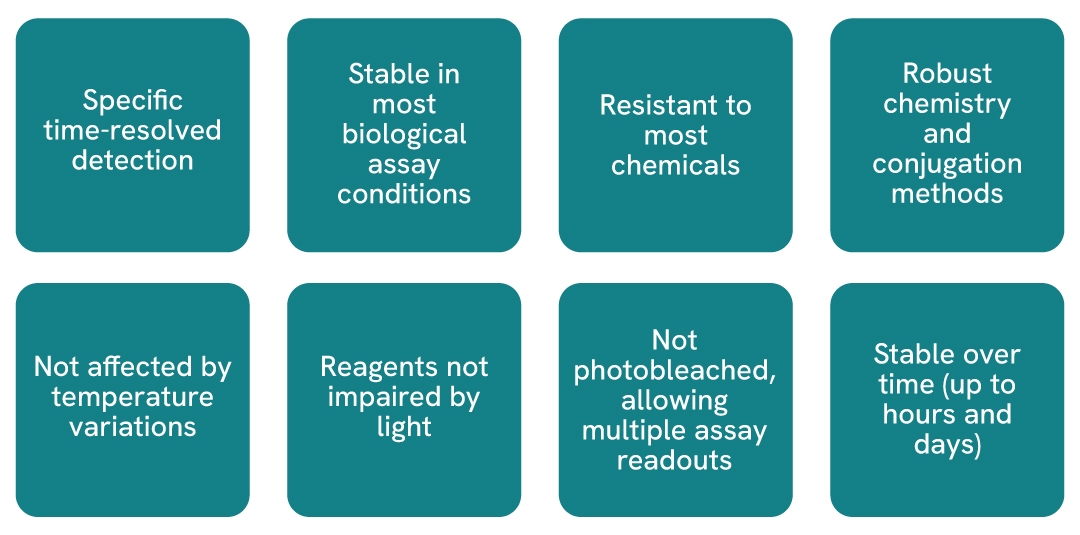
The usual limitations of FRET principle applications lie in two main characteristics: signal specificity and stability. Because of the nature of its fluorescent partners, HTRF performs outstandingly in both areas, making it better at exploiting the FRET principle than any other approach.
HTRF involves several carefully selected fluorophores. Obviously, FRET partners must fulfill multiple compatibility criteria.
- First, their emission spectra must show non-overlapping regions in order to be able to measure each partner's fluorescence individually.
- Second, the FRET quantum yield (i.e. its efficacy) must be as high as possible.
- Third, fluorescence emission must occur within a region of the spectrum remote from that naturally produced by proteins; in other words, a red-shifted emission is theoretically better in order to avoid medium-intrinsic fluorescence.
To match all these criteria, HTRF uses a combination of several fluorophores forming different TR-FRET systems. HTRF's central element, the energy donor, consists of a rare earth complex in which the lanthanide ion (Europium or Terbium) is tightly embedded in a macrocycle. This very unique type of structure gives HTRF donors their long-lived fluorescence properties, as well as robustness that enables these molecules to be used in most assay conditions.
Two donors are currently included in HTRF products:
These macrocyclic structures allow both the collection and transfer of energy to the Eu3+ or the Tb3+ ions, which ultimately release this energy in a specific fluorescent pattern (Tab. 1). Both cryptates show long-lived emission in the range of 1 to 2 msec, a characteristic that is fundamental for a time-resolved detection.
- Europium cryptates (Eu3+-cryptate) are the fruit of Prof. J.M. Lehn's work, for which he was awarded a Nobel Prize for Chemistry in 1987. They are a series of rare earth complexes whose macrocycle is based on an lanthanide embedded in a tris-bipyridine motif.
- Lumi4®-Tb cryptate was developed by Prof. K. Raymond's group at Berkeley and consists of a tight association of a terbium ion with a cage of similar structure and properties.
| Europium Cryptate | Lumi4-Terbium Cryptate | |
|---|---|---|
| MW | 1000 – 1500 Da | 1000 – 1500 Da |
| Absorption | 305 nm or 317 nm (5COOH) | 340 nm |
| Emission | 570-720 nm, Including peaks at 490, 550, 590 and 620 nm 0.65 - 1 msec lifetime | 470-690 nm, Including peaks at 585, 605, 620 and 700 nm > 2 msec lifetime |
| Acceptor compatibility | Near infrared ("Red") acceptor compatible | "Red" and "green" acceptor compatible |
| KF need | Fluoride ions (KF) needed for enhanced stability | No KF needed |
Europium and Terbium cryptate structures and characteristics
HTRF acceptors
The other fluorescent partners of HTRF are the acceptor dyes. They have been carefully optimized to pair with Eu3+ and Tb3+ cryptate donor dyes and ensure maximum FRET signal. In particular, acceptors have been developed to match the emission properties of donors.
Eu3+ cryptates are mainly compatible with near-infrared acceptors ("red acceptors"), whereas Lumi4-Tb cryptates can be paired with both red and green dyes like fluorescein or GFP.
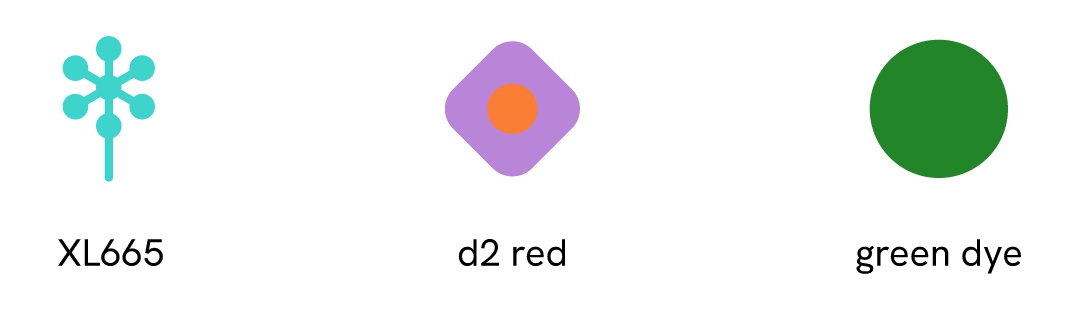
The first red acceptor developed for HTRF was XL665, a phycobiliprotein pigment purified from red algae (cyanobacteria phycobilisomes). The second generation of red acceptors is characterized by synthetic structures 100 times smaller, displaying a series of very similar photophysical properties.
| XL665 | d2 red | Green dye | |
|---|---|---|---|
| Description | XL665 is a large heterohexameric structure of 105 kDa, cross-linked after isolation for better stability and preservation of its photophysical properties in HTRF assays. | d2 and Green dye excitation spectra overlap Lumi4®-Tb cryptate emission spectrum, and d2 excitation spectrum overlaps Eu3+ Cryptate emission spectrum, thereby allowing the donors to excite these acceptors. Their maximum emission at 665 nm (d2) or 520 nm (Green) spans a region where HTRF cryptates do not emit or do so only weakly. In the end, energy transfer from the donor occurs with a high quantum yield. | |
| Nature | Protein | Chemical | Chemical |
| Molecular weight | 105 000 Da | 994 Da | 591 Da |
| Absorption | 650 nm | 653 nm | 488 nm |
| Emission | 660 nm Short-lived (4 nsec) |
665 nm Short-lived (4 nsec) |
520 nm Short-lived (4 nsec) |
HTRF acceptors characteristics
Assessed compatibility of Donors and Acceptors
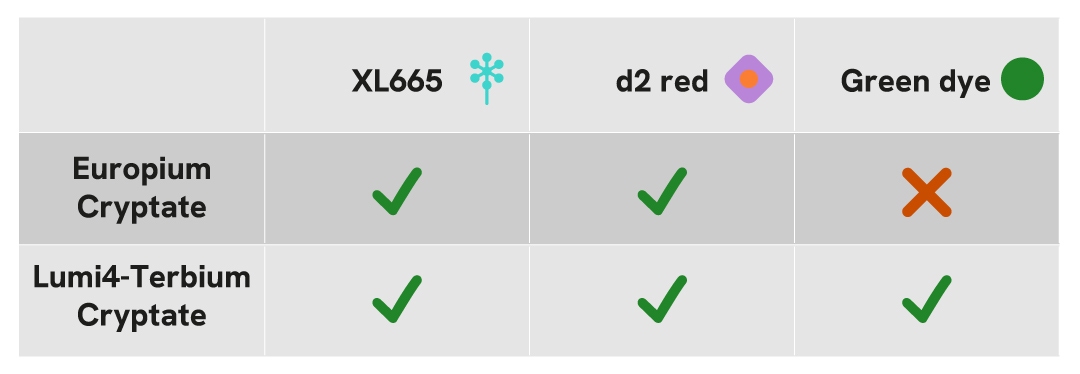
Recapitulative table of Donors/Acceptors compatibility
Consequence on the specificity and stability of the detection signal
Signal specificity
HTRF reagents are optimized to match each other's photophysical properties.
Red acceptors emissions occur in a region where the donor does not emit significantly. Long-lived fluorescence detected at this specific wavelength is therefore characteristic of the emission of the acceptor engaged in the FRET process.
The same is true for the green acceptor emitting around 520 nm when combined with a Lumi4-Tb donor.
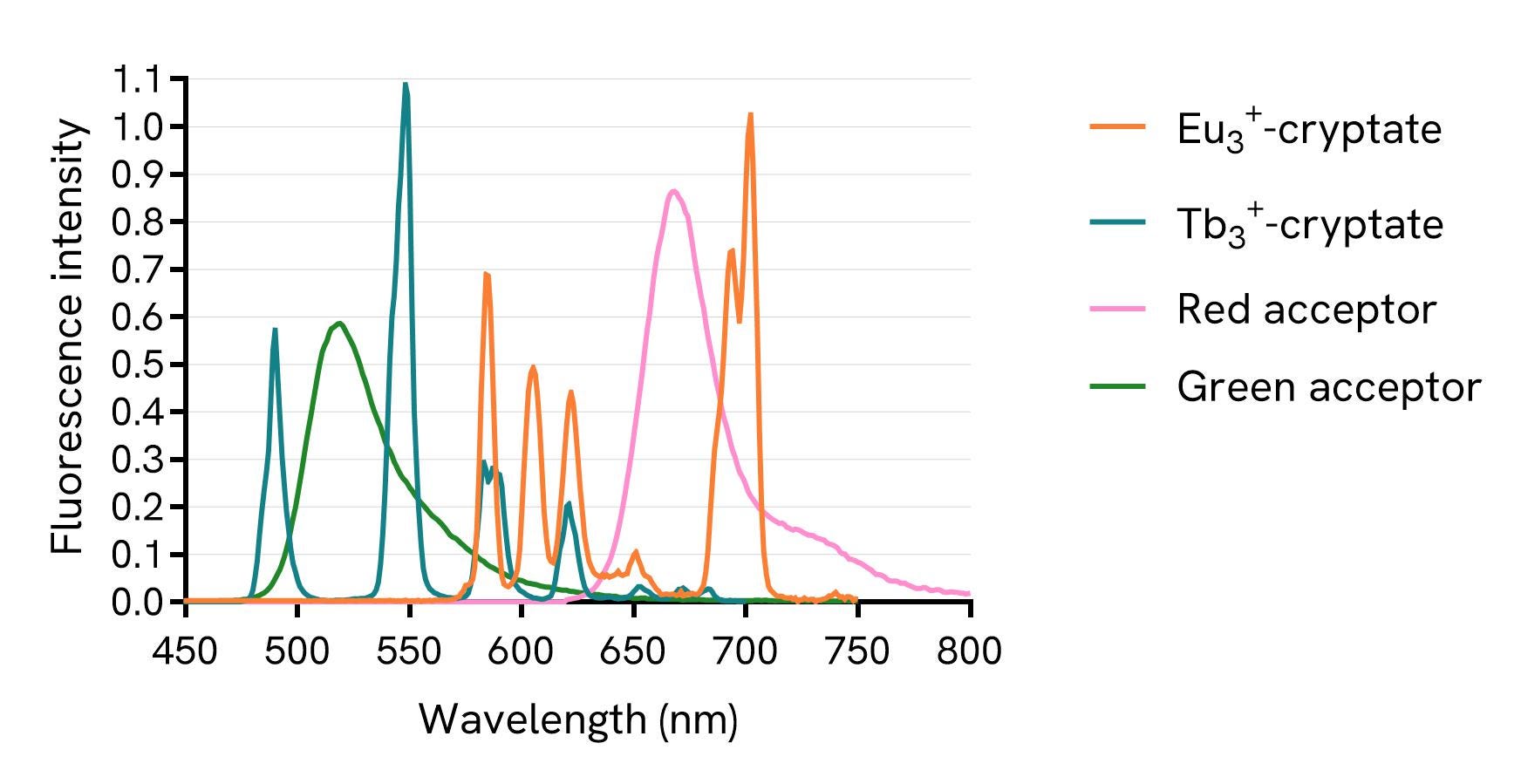
HTRF donor and acceptor emission spectra.
Resistance to assay conditions and additives
Europium and Terbium cryptates are very resistant structures
Cryptate structures, in which either the europium or the terbium ion is tightly embedded in its macrocycle, resist harsh assay conditions or additives:
- presence of large quantities of challenging cations (Mg2+ , Mn2+ …)
- chelators (EDTA),
- solvents,
- pH or temperature variations.
HTRF can also be used with high serum concentrations (up to 50%).
For Europium cryptate based assays, addition of fluoride ions at the time of readout or during the incubation enhances assay resistance to the great majority of compound interferences (e.g. quenchers). Fluoride ion supplementation is not necessary for Lumi4®-Tb based assays.
The following figure shows the rapid dissociation of chelates in presence of EDTA, while cryptates remain unaffected at first, then exhibit a slow dissociation and loss of fluorescence due to their macrocycle embedded ion.
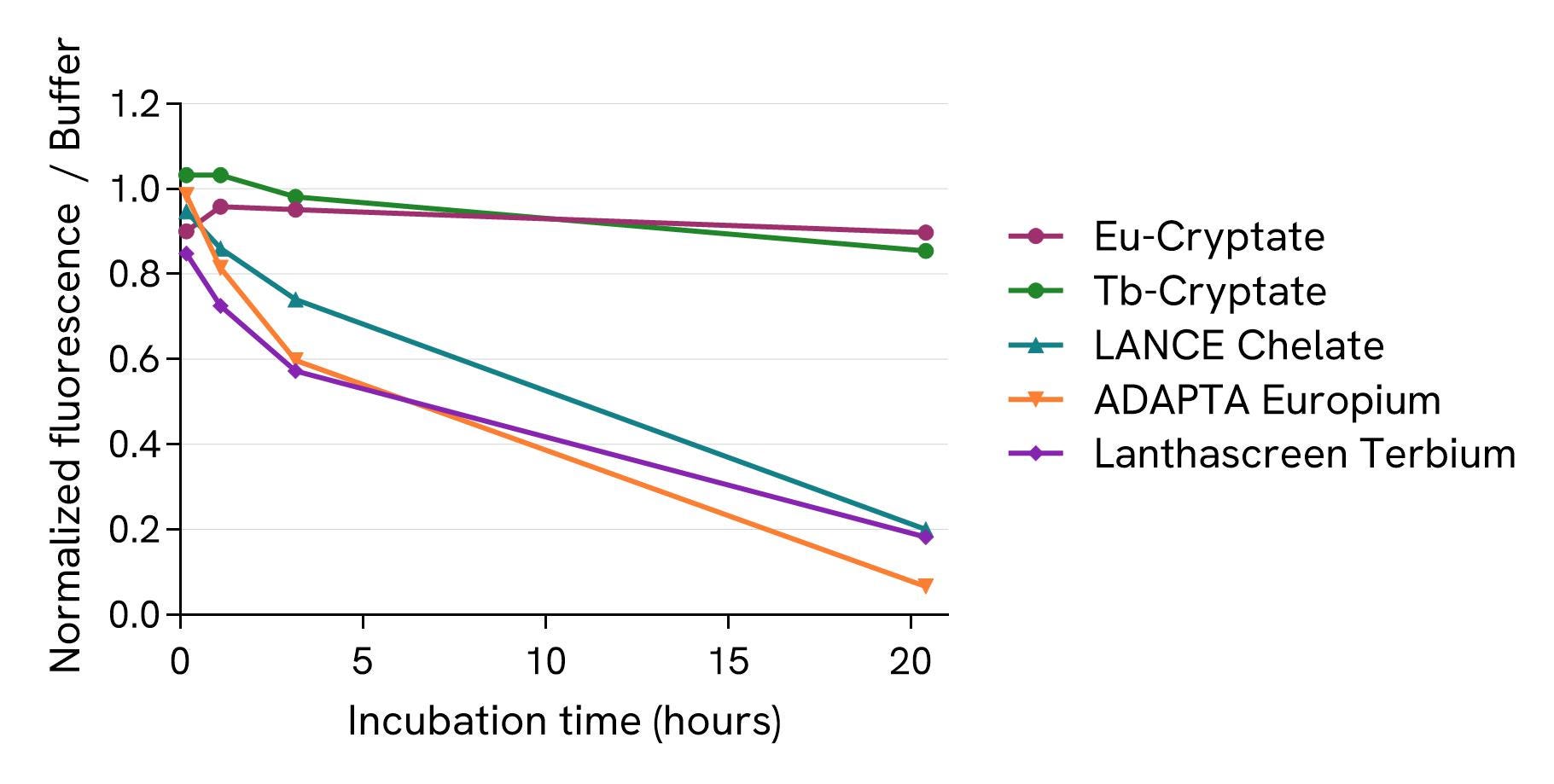
Europium and Terbium cryptates stability compared to chelates stability (Lance Europium, Revvity), Lanthascreen Terbium (ThermoFisher), ADAPTA Europium (BellBrook Labs) were conditioned in buffer + EDTA (20 mM), i.e. typically the kind of assay conditions that are used to stop an enzymatic reaction.
Tolerance to cell culture media
Europium cryptate was incubated in various media used for cell cultures and compared to non-supplemented buffer.
The results show that the effect is marginal (within less than 20% variation), proving that cryptates are particularly well-suited to cell-based assays.
HTRF reagents are especially resistant to culture media with FCS, BSA, DMSO or detergents.
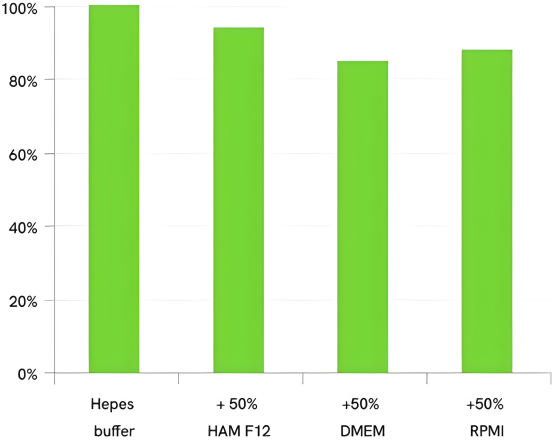
Eu3+ cryptate in various supplemented media
Time stability of the fluorescence signal
HTRF assay signal stays stable for days
A number of homogeneous technologies (e.g. luminescence) are limited by reduced signal intensity following assay measurement or prolonged incubations.
One of the key benefits of HTRF technology is its long-lasting signal stability. HTRF fluorescence is not diminished by assay measurement, by additives such as DMSO, or by extended incubation prior to reading.
The exceptional stability of HTRF fluorescence offers several advantages, including flexible read times during HTS measurements, the ability to perform kinetic studies, and wide sample types compatibility.
As an example, the cAMP IC50s remained stable for up to 7 days.
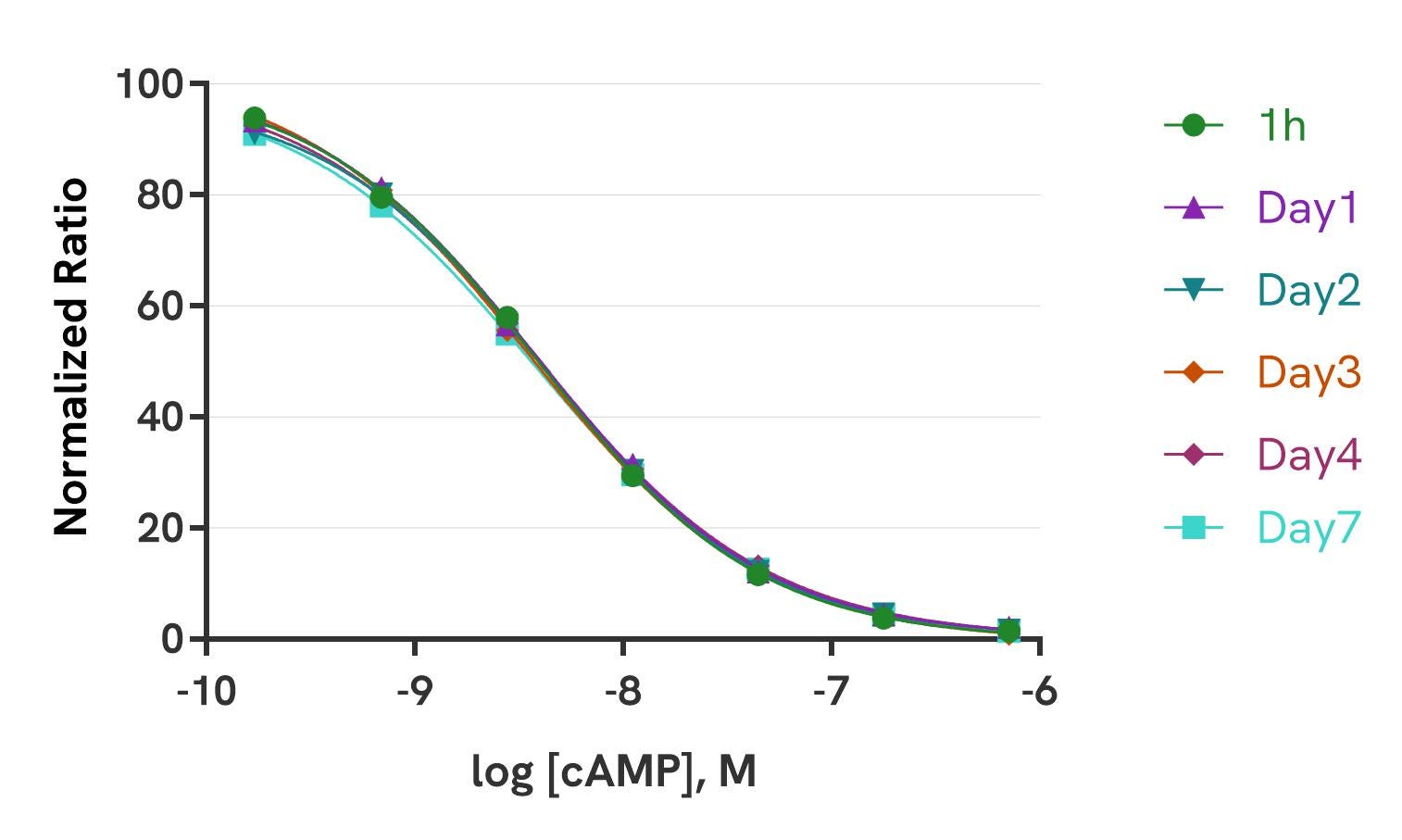
Seven-day signal stability of cAMP assay
Time flexibility and assay security
In the event of instrument failure, microplates can still be read after an extended period of time.
Assays can be measured as often as needed, enabling kinetic analysis of interactions across many assay configurations and supporting flexible assay formats.
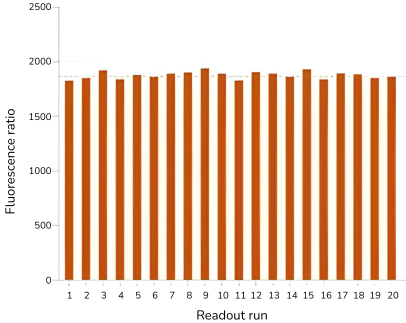
20 successive readouts of kinase biochemical assay
Photobleaching resistance
Photobleaching – a phenomenon affecting many fluorophores – refers to the loss of fluorescence emission after prolonged or repeated excitation. In this state, the fluorophore remains permanently excited without returning to its ground state, and thus no longer emits fluorescence.
HTRF reagents, however, are not impaired by repeated light exposure. They are highly resistant to photobleaching and maintain their ability to deactivate and re-emit fluorescence even after intense excitation.
For research use only. Not for use in diagnostic procedures.
The information provided above is solely for informational and research purposes only. Revvity assumes no liability or responsibility for any injuries, losses, or damages resulting from the use or misuse of the provided information, and Revvity assumes no liability for any outcomes resulting from the use or misuse of any recommendations. The information is provided on an "as is" basis without warranties of any kind. Users are responsible for determining the suitability of any recommendations for the user's particular research. Any recommendations provided by Revvity should not be considered a substitute for a user's own professional judgment.
